

14
1 Polar Flocks
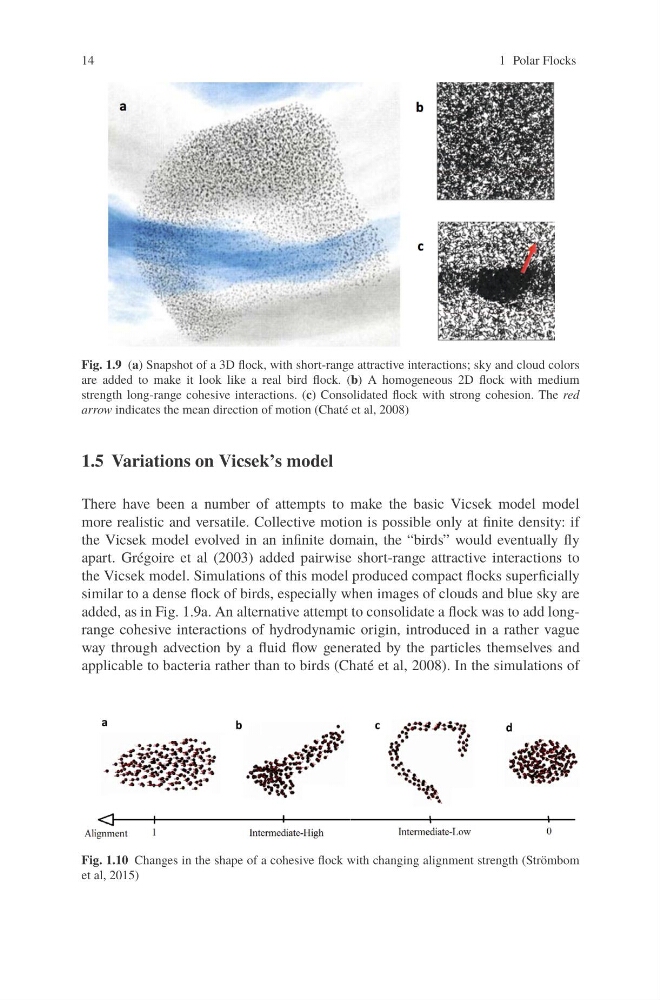
Fig. 1.9 (a) Snapshot of a 3D flock, with short-range attractive interactions; sky and cloud colors
are added to make it look like a real bird flock. (b) A homogeneous 2D flock with medium
strength long-range cohesive interactions. (c) Consolidated flock with strong cohesion. The red
arrow indicates the mean direction of motion (Chaté et al, 2008)
1.5 Variations on Vicsek’s model
There have been a number of attempts to make the basic Vicsek model model
more realistic and versatile. Collective motion is possible only at finite density: if
the Vicsek model evolved in an infinite domain, the “birds” would eventually fly
apart. Grégoire et al (2003) added pairwise short-range attractive interactions to
the Vicsek model. Simulations of this model produced compact flocks superficially
similar to a dense flock of birds, especially when images of clouds and blue sky are
added, as in Fig. 1.9a. An alternative attempt to consolidate a flock was to add longrange cohesive interactions of hydrodynamic origin, introduced in a rather vague
way through advection by a fluid flow generated by the particles themselves and
applicable to bacteria rather than to birds (Chaté et al, 2008). In the simulations of
Fig. 1.10 Changes in the shape of a cohesive flock with changing alignment strength (Strömbom
et al, 2015)
1 Polar Flocks
Fig. 1.9 (a) Snapshot of a 3D flock, with short-range attractive interactions; sky and cloud colors
are added to make it look like a real bird flock. (b) A homogeneous 2D flock with medium
strength long-range cohesive interactions. (c) Consolidated flock with strong cohesion. The red
arrow indicates the mean direction of motion (Chaté et al, 2008)
1.5 Variations on Vicsek’s model
There have been a number of attempts to make the basic Vicsek model model
more realistic and versatile. Collective motion is possible only at finite density: if
the Vicsek model evolved in an infinite domain, the “birds” would eventually fly
apart. Grégoire et al (2003) added pairwise short-range attractive interactions to
the Vicsek model. Simulations of this model produced compact flocks superficially
similar to a dense flock of birds, especially when images of clouds and blue sky are
added, as in Fig. 1.9a. An alternative attempt to consolidate a flock was to add longrange cohesive interactions of hydrodynamic origin, introduced in a rather vague
way through advection by a fluid flow generated by the particles themselves and
applicable to bacteria rather than to birds (Chaté et al, 2008). In the simulations of
Fig. 1.10 Changes in the shape of a cohesive flock with changing alignment strength (Strömbom
et al, 2015)