

184
8 Morphogenesis
closer to chemistry than to continuum mechanics, and would not contribute to
continuous chemo-mechanical models of the kind described by Murray, as well as
in Chap. 6 of this book.
Concurrently with Murray and Oster, Donald Ingber was advancing the ideas,
already mentioned in Sect. 6.6, of mechanotransduction affecting the biochemistry of
cells and tissues, recently reviewed by himself (Ingber, 2018), and Larry Taber started
a long series of morphomechanical studies (Taber, 2009). On the other side of the Iron
Curtain and for a while outside the international discourse, Lev Beloussov and his
coworkers paid particular attention to mechanical effects in embryonic development,
also reviewed by himself (Beloussov, 2018). Beloussov’s attitude mirrors that of
Murray:
The embryological textbooks are either completely descriptive, or enumerate one by one the
instructions, “ordering” a given piece of embryonic tissue to develop in this or that direction.
[...] Most modern embryological texts give an impression that an embryo is a mere toy of
its genes, so that the ultimate and sole task of investigating development is in enumerating,
one after another, the expressed genes.
However, not all biologists share this attitude, and there are clear signs of a
revival of interest in physical factors of a general nature in this field dominated by
the particularities of proteomics and genetics. The changing attitude, confirmed by
numerous citations, is expressed in a review coauthored by a large group of biologists
(Paluch et al, 2015):
Despite our often detailed understanding of the biochemical reactions that control cellular
fates, or maybe because of it, we may overlook the fact that mechanical forces are a powerful
means to modulate or override many of these biochemical reactions.
Established cases of stress-induced gene expression have been known at least since
studies by Farge (2003), who proved this by submitting the early Drosophila embryo
b
a
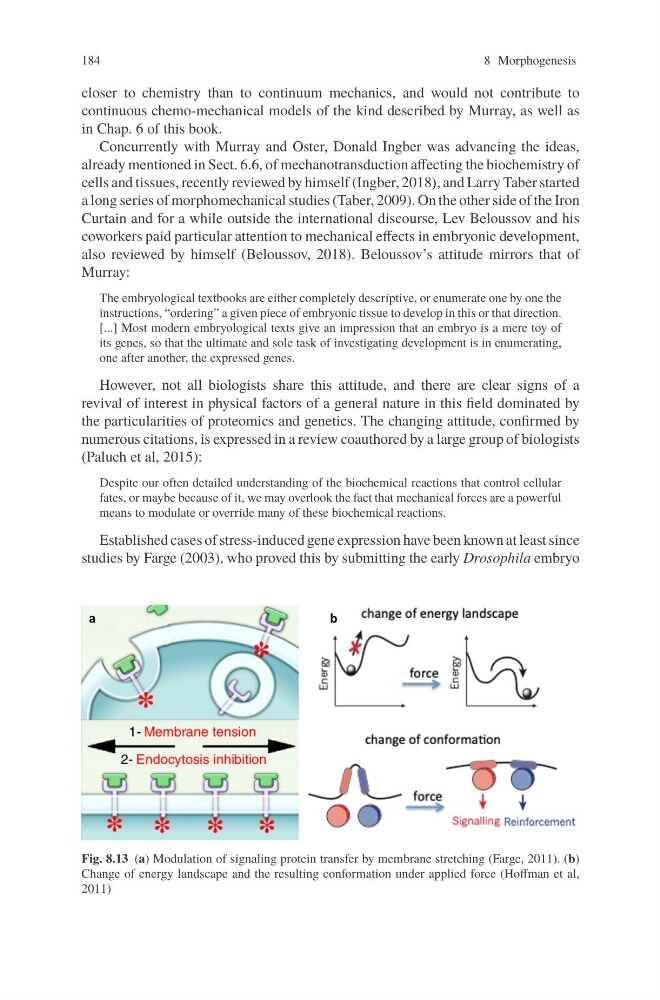
Fig. 8.13 (a) Modulation of signaling protein transfer by membrane stretching (Farge, 2011). (b)
Change of energy landscape and the resulting conformation under applied force (Hoffman et al,
2011)
8 Morphogenesis
closer to chemistry than to continuum mechanics, and would not contribute to
continuous chemo-mechanical models of the kind described by Murray, as well as
in Chap. 6 of this book.
Concurrently with Murray and Oster, Donald Ingber was advancing the ideas,
already mentioned in Sect. 6.6, of mechanotransduction affecting the biochemistry of
cells and tissues, recently reviewed by himself (Ingber, 2018), and Larry Taber started
a long series of morphomechanical studies (Taber, 2009). On the other side of the Iron
Curtain and for a while outside the international discourse, Lev Beloussov and his
coworkers paid particular attention to mechanical effects in embryonic development,
also reviewed by himself (Beloussov, 2018). Beloussov’s attitude mirrors that of
Murray:
The embryological textbooks are either completely descriptive, or enumerate one by one the
instructions, “ordering” a given piece of embryonic tissue to develop in this or that direction.
[...] Most modern embryological texts give an impression that an embryo is a mere toy of
its genes, so that the ultimate and sole task of investigating development is in enumerating,
one after another, the expressed genes.
However, not all biologists share this attitude, and there are clear signs of a
revival of interest in physical factors of a general nature in this field dominated by
the particularities of proteomics and genetics. The changing attitude, confirmed by
numerous citations, is expressed in a review coauthored by a large group of biologists
(Paluch et al, 2015):
Despite our often detailed understanding of the biochemical reactions that control cellular
fates, or maybe because of it, we may overlook the fact that mechanical forces are a powerful
means to modulate or override many of these biochemical reactions.
Established cases of stress-induced gene expression have been known at least since
studies by Farge (2003), who proved this by submitting the early Drosophila embryo
b
a
Fig. 8.13 (a) Modulation of signaling protein transfer by membrane stretching (Farge, 2011). (b)
Change of energy landscape and the resulting conformation under applied force (Hoffman et al,
2011)