

182
8 Morphogenesis
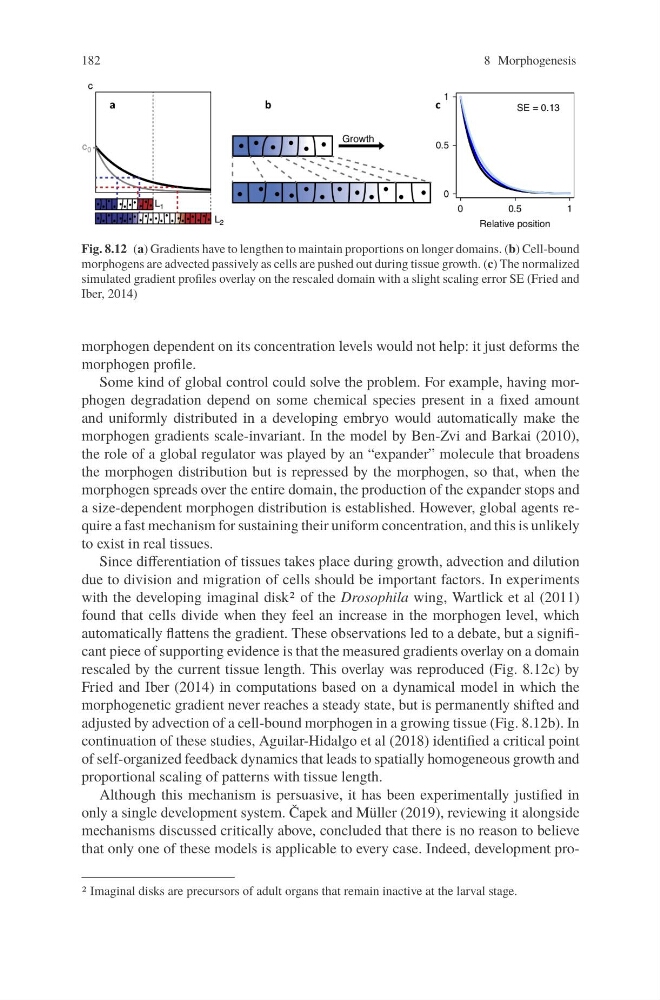
Fig. 8.12 (a) Gradients have to lengthen to maintain proportions on longer domains. (b) Cell-bound
morphogens are advected passively as cells are pushed out during tissue growth. (c) The normalized
simulated gradient profiles overlay on the rescaled domain with a slight scaling error SE (Fried and
Iber, 2014)
morphogen dependent on its concentration levels would not help: it just deforms the
morphogen profile.
Some kind of global control could solve the problem. For example, having morphogen degradation depend on some chemical species present in a fixed amount
and uniformly distributed in a developing embryo would automatically make the
morphogen gradients scale-invariant. In the model by Ben-Zvi and Barkai (2010),
the role of a global regulator was played by an “expander” molecule that broadens
the morphogen distribution but is repressed by the morphogen, so that, when the
morphogen spreads over the entire domain, the production of the expander stops and
a size-dependent morphogen distribution is established. However, global agents require a fast mechanism for sustaining their uniform concentration, and this is unlikely
to exist in real tissues.
Since differentiation of tissues takes place during growth, advection and dilution
due to division and migration of cells should be important factors. In experiments
with the developing imaginal disk2 of the Drosophila wing, Wartlick et al (2011)
found that cells divide when they feel an increase in the morphogen level, which
automatically flattens the gradient. These observations led to a debate, but a significant piece of supporting evidence is that the measured gradients overlay on a domain
rescaled by the current tissue length. This overlay was reproduced (Fig. 8.12c) by
Fried and Iber (2014) in computations based on a dynamical model in which the
morphogenetic gradient never reaches a steady state, but is permanently shifted and
adjusted by advection of a cell-bound morphogen in a growing tissue (Fig. 8.12b). In
continuation of these studies, Aguilar-Hidalgo et al (2018) identified a critical point
of self-organized feedback dynamics that leads to spatially homogeneous growth and
proportional scaling of patterns with tissue length.
Although this mechanism is persuasive, it has been experimentally justified in
only a single development system. Čapek and Müller (2019), reviewing it alongside
mechanisms discussed critically above, concluded that there is no reason to believe
that only one of these models is applicable to every case. Indeed, development pro2 Imaginal disks are precursors of adult organs that remain inactive at the larval stage.
8 Morphogenesis
Fig. 8.12 (a) Gradients have to lengthen to maintain proportions on longer domains. (b) Cell-bound
morphogens are advected passively as cells are pushed out during tissue growth. (c) The normalized
simulated gradient profiles overlay on the rescaled domain with a slight scaling error SE (Fried and
Iber, 2014)
morphogen dependent on its concentration levels would not help: it just deforms the
morphogen profile.
Some kind of global control could solve the problem. For example, having morphogen degradation depend on some chemical species present in a fixed amount
and uniformly distributed in a developing embryo would automatically make the
morphogen gradients scale-invariant. In the model by Ben-Zvi and Barkai (2010),
the role of a global regulator was played by an “expander” molecule that broadens
the morphogen distribution but is repressed by the morphogen, so that, when the
morphogen spreads over the entire domain, the production of the expander stops and
a size-dependent morphogen distribution is established. However, global agents require a fast mechanism for sustaining their uniform concentration, and this is unlikely
to exist in real tissues.
Since differentiation of tissues takes place during growth, advection and dilution
due to division and migration of cells should be important factors. In experiments
with the developing imaginal disk2 of the Drosophila wing, Wartlick et al (2011)
found that cells divide when they feel an increase in the morphogen level, which
automatically flattens the gradient. These observations led to a debate, but a significant piece of supporting evidence is that the measured gradients overlay on a domain
rescaled by the current tissue length. This overlay was reproduced (Fig. 8.12c) by
Fried and Iber (2014) in computations based on a dynamical model in which the
morphogenetic gradient never reaches a steady state, but is permanently shifted and
adjusted by advection of a cell-bound morphogen in a growing tissue (Fig. 8.12b). In
continuation of these studies, Aguilar-Hidalgo et al (2018) identified a critical point
of self-organized feedback dynamics that leads to spatially homogeneous growth and
proportional scaling of patterns with tissue length.
Although this mechanism is persuasive, it has been experimentally justified in
only a single development system. Čapek and Müller (2019), reviewing it alongside
mechanisms discussed critically above, concluded that there is no reason to believe
that only one of these models is applicable to every case. Indeed, development pro2 Imaginal disks are precursors of adult organs that remain inactive at the larval stage.