

178
8 Morphogenesis
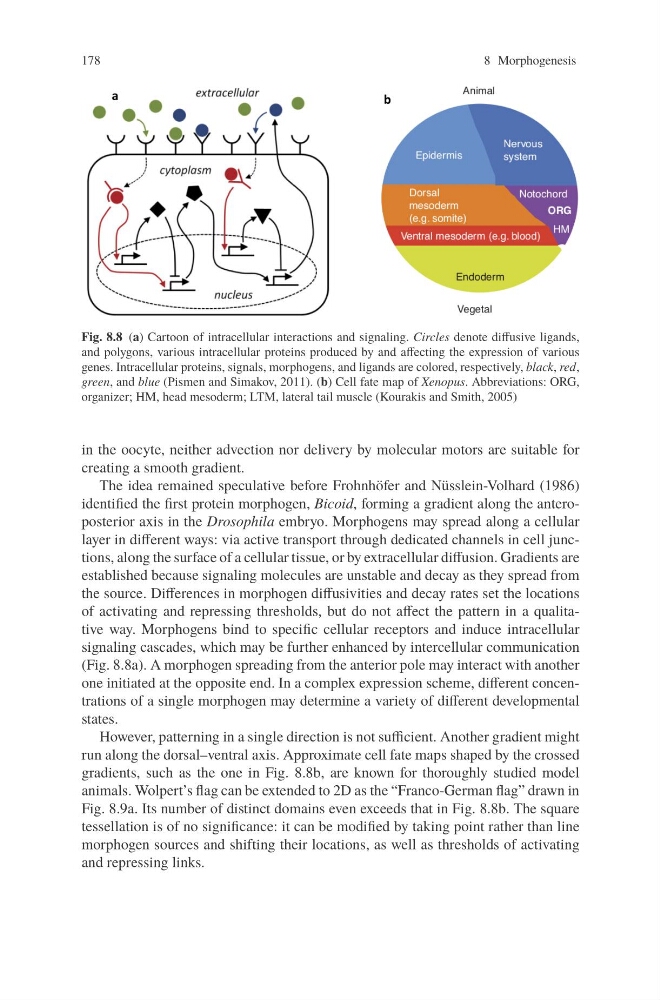
Fig. 8.8 (a) Cartoon of intracellular interactions and signaling. Circles denote diffusive ligands,
and polygons, various intracellular proteins produced by and affecting the expression of various
genes. Intracellular proteins, signals, morphogens, and ligands are colored, respectively, black, red,
green, and blue (Pismen and Simakov, 2011). (b) Cell fate map of Xenopus. Abbreviations: ORG,
organizer; HM, head mesoderm; LTM, lateral tail muscle (Kourakis and Smith, 2005)
in the oocyte, neither advection nor delivery by molecular motors are suitable for
creating a smooth gradient.
The idea remained speculative before Frohnhöfer and Nüsslein-Volhard (1986)
identified the first protein morphogen, Bicoid, forming a gradient along the anteroposterior axis in the Drosophila embryo. Morphogens may spread along a cellular
layer in different ways: via active transport through dedicated channels in cell junctions, along the surface of a cellular tissue, or by extracellular diffusion. Gradients are
established because signaling molecules are unstable and decay as they spread from
the source. Differences in morphogen diffusivities and decay rates set the locations
of activating and repressing thresholds, but do not affect the pattern in a qualitative way. Morphogens bind to specific cellular receptors and induce intracellular
signaling cascades, which may be further enhanced by intercellular communication
(Fig. 8.8a). A morphogen spreading from the anterior pole may interact with another
one initiated at the opposite end. In a complex expression scheme, different concentrations of a single morphogen may determine a variety of different developmental
states.
However, patterning in a single direction is not sufficient. Another gradient might
run along the dorsal–ventral axis. Approximate cell fate maps shaped by the crossed
gradients, such as the one in Fig. 8.8b, are known for thoroughly studied model
animals. Wolpert’s flag can be extended to 2D as the “Franco-German flag” drawn in
Fig. 8.9a. Its number of distinct domains even exceeds that in Fig. 8.8b. The square
tessellation is of no significance: it can be modified by taking point rather than line
morphogen sources and shifting their locations, as well as thresholds of activating
and repressing links.
8 Morphogenesis
Fig. 8.8 (a) Cartoon of intracellular interactions and signaling. Circles denote diffusive ligands,
and polygons, various intracellular proteins produced by and affecting the expression of various
genes. Intracellular proteins, signals, morphogens, and ligands are colored, respectively, black, red,
green, and blue (Pismen and Simakov, 2011). (b) Cell fate map of Xenopus. Abbreviations: ORG,
organizer; HM, head mesoderm; LTM, lateral tail muscle (Kourakis and Smith, 2005)
in the oocyte, neither advection nor delivery by molecular motors are suitable for
creating a smooth gradient.
The idea remained speculative before Frohnhöfer and Nüsslein-Volhard (1986)
identified the first protein morphogen, Bicoid, forming a gradient along the anteroposterior axis in the Drosophila embryo. Morphogens may spread along a cellular
layer in different ways: via active transport through dedicated channels in cell junctions, along the surface of a cellular tissue, or by extracellular diffusion. Gradients are
established because signaling molecules are unstable and decay as they spread from
the source. Differences in morphogen diffusivities and decay rates set the locations
of activating and repressing thresholds, but do not affect the pattern in a qualitative way. Morphogens bind to specific cellular receptors and induce intracellular
signaling cascades, which may be further enhanced by intercellular communication
(Fig. 8.8a). A morphogen spreading from the anterior pole may interact with another
one initiated at the opposite end. In a complex expression scheme, different concentrations of a single morphogen may determine a variety of different developmental
states.
However, patterning in a single direction is not sufficient. Another gradient might
run along the dorsal–ventral axis. Approximate cell fate maps shaped by the crossed
gradients, such as the one in Fig. 8.8b, are known for thoroughly studied model
animals. Wolpert’s flag can be extended to 2D as the “Franco-German flag” drawn in
Fig. 8.9a. Its number of distinct domains even exceeds that in Fig. 8.8b. The square
tessellation is of no significance: it can be modified by taking point rather than line
morphogen sources and shifting their locations, as well as thresholds of activating
and repressing links.