

8.1 Approaches to Morphogenesis
173
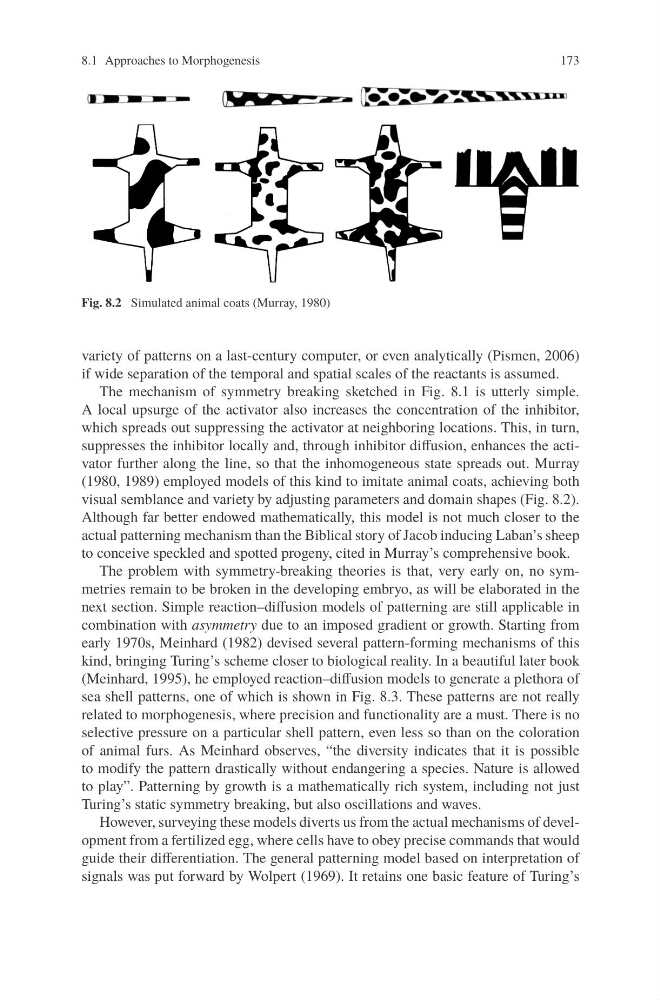
Fig. 8.2 Simulated animal coats (Murray, 1980)
variety of patterns on a last-century computer, or even analytically (Pismen, 2006)
if wide separation of the temporal and spatial scales of the reactants is assumed.
The mechanism of symmetry breaking sketched in Fig. 8.1 is utterly simple.
A local upsurge of the activator also increases the concentration of the inhibitor,
which spreads out suppressing the activator at neighboring locations. This, in turn,
suppresses the inhibitor locally and, through inhibitor diffusion, enhances the activator further along the line, so that the inhomogeneous state spreads out. Murray
(1980, 1989) employed models of this kind to imitate animal coats, achieving both
visual semblance and variety by adjusting parameters and domain shapes (Fig. 8.2).
Although far better endowed mathematically, this model is not much closer to the
actual patterning mechanism than the Biblical story of Jacob inducing Laban’s sheep
to conceive speckled and spotted progeny, cited in Murray’s comprehensive book.
The problem with symmetry-breaking theories is that, very early on, no symmetries remain to be broken in the developing embryo, as will be elaborated in the
next section. Simple reaction–diffusion models of patterning are still applicable in
combination with asymmetry due to an imposed gradient or growth. Starting from
early 1970s, Meinhard (1982) devised several pattern-forming mechanisms of this
kind, bringing Turing’s scheme closer to biological reality. In a beautiful later book
(Meinhard, 1995), he employed reaction–diffusion models to generate a plethora of
sea shell patterns, one of which is shown in Fig. 8.3. These patterns are not really
related to morphogenesis, where precision and functionality are a must. There is no
selective pressure on a particular shell pattern, even less so than on the coloration
of animal furs. As Meinhard observes, “the diversity indicates that it is possible
to modify the pattern drastically without endangering a species. Nature is allowed
to play”. Patterning by growth is a mathematically rich system, including not just
Turing’s static symmetry breaking, but also oscillations and waves.
However, surveying these models diverts us from the actual mechanisms of development from a fertilized egg, where cells have to obey precise commands that would
guide their differentiation. The general patterning model based on interpretation of
signals was put forward by Wolpert (1969). It retains one basic feature of Turing’s
173
Fig. 8.2 Simulated animal coats (Murray, 1980)
variety of patterns on a last-century computer, or even analytically (Pismen, 2006)
if wide separation of the temporal and spatial scales of the reactants is assumed.
The mechanism of symmetry breaking sketched in Fig. 8.1 is utterly simple.
A local upsurge of the activator also increases the concentration of the inhibitor,
which spreads out suppressing the activator at neighboring locations. This, in turn,
suppresses the inhibitor locally and, through inhibitor diffusion, enhances the activator further along the line, so that the inhomogeneous state spreads out. Murray
(1980, 1989) employed models of this kind to imitate animal coats, achieving both
visual semblance and variety by adjusting parameters and domain shapes (Fig. 8.2).
Although far better endowed mathematically, this model is not much closer to the
actual patterning mechanism than the Biblical story of Jacob inducing Laban’s sheep
to conceive speckled and spotted progeny, cited in Murray’s comprehensive book.
The problem with symmetry-breaking theories is that, very early on, no symmetries remain to be broken in the developing embryo, as will be elaborated in the
next section. Simple reaction–diffusion models of patterning are still applicable in
combination with asymmetry due to an imposed gradient or growth. Starting from
early 1970s, Meinhard (1982) devised several pattern-forming mechanisms of this
kind, bringing Turing’s scheme closer to biological reality. In a beautiful later book
(Meinhard, 1995), he employed reaction–diffusion models to generate a plethora of
sea shell patterns, one of which is shown in Fig. 8.3. These patterns are not really
related to morphogenesis, where precision and functionality are a must. There is no
selective pressure on a particular shell pattern, even less so than on the coloration
of animal furs. As Meinhard observes, “the diversity indicates that it is possible
to modify the pattern drastically without endangering a species. Nature is allowed
to play”. Patterning by growth is a mathematically rich system, including not just
Turing’s static symmetry breaking, but also oscillations and waves.
However, surveying these models diverts us from the actual mechanisms of development from a fertilized egg, where cells have to obey precise commands that would
guide their differentiation. The general patterning model based on interpretation of
signals was put forward by Wolpert (1969). It retains one basic feature of Turing’s