

172
8 Morphogenesis
note of the prefix eu, the same as in eugenic, hinting at the aristocratic status of the
enslaver.
All cells in a particular organism are clones, containing the same genome copied
in consecutive divisions, and in a society of clones any individual can do any work.
The same applies to social insects, but worker ants or bees remain undifferentiated.
This is impossible in a complex society where diverse specialized functions need to
be implemented. Therefore cells have to be directed as to which part of their genome
to activate in order to carry out a particular assigned task. Once a cell turns into a
narrow specialist, there is no way back. Only a few pluripotent stem cells remain
as a reserve, idle for a time but capable of serving as a replacement whenever the
need arises. There is no Central Committee assigning the tasks, but certain groups
of cells, called organizers play this role by sending signals to somatic cells. Such an
organizer establishing the major axis was first discovered by Spemann and Mangold
(1924) in experiments on the Hydra embryo1.
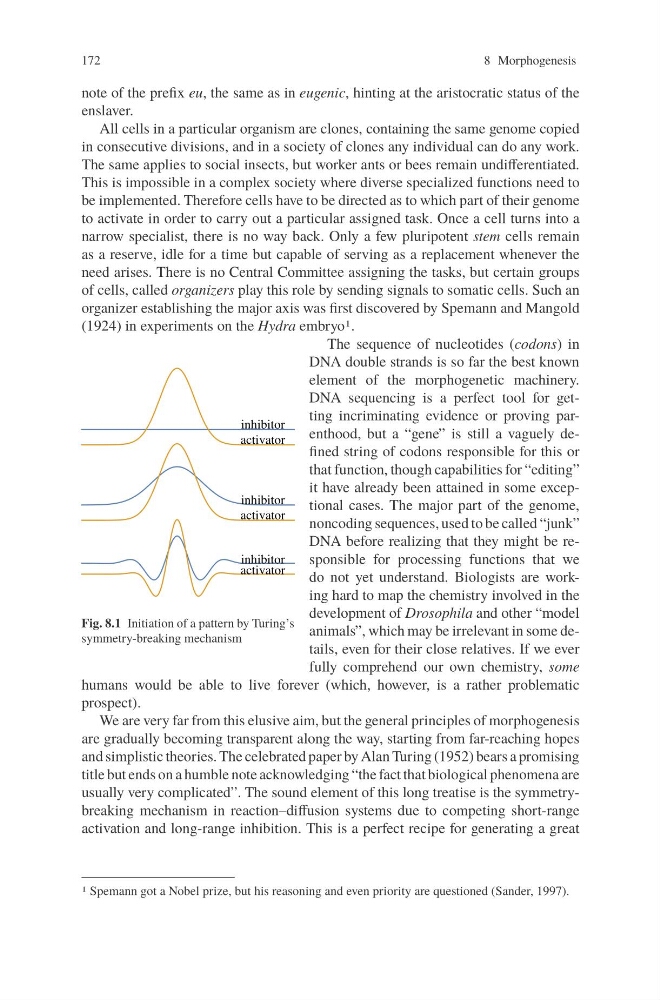
Fig. 8.1 Initiation of a pattern by Turing’s
symmetry-breaking mechanism
The sequence of nucleotides (codons) in
DNA double strands is so far the best known
element of the morphogenetic machinery.
DNA sequencing is a perfect tool for getting incriminating evidence or proving parenthood, but a “gene” is still a vaguely defined string of codons responsible for this or
that function, though capabilities for “editing”
it have already been attained in some exceptional cases. The major part of the genome,
noncoding sequences, used to be called “junk”
DNA before realizing that they might be responsible for processing functions that we
do not yet understand. Biologists are working hard to map the chemistry involved in the
development of Drosophila and other “model
animals”, which may be irrelevant in some details, even for their close relatives. If we ever
fully comprehend our own chemistry, some
humans would be able to live forever (which, however, is a rather problematic
prospect).
We are very far from this elusive aim, but the general principles of morphogenesis
are gradually becoming transparent along the way, starting from far-reaching hopes
and simplistic theories. The celebrated paper by Alan Turing (1952) bears a promising
title but ends on a humble note acknowledging “the fact that biological phenomena are
usually very complicated”. The sound element of this long treatise is the symmetrybreaking mechanism in reaction–diffusion systems due to competing short-range
activation and long-range inhibition. This is a perfect recipe for generating a great
1 Spemann got a Nobel prize, but his reasoning and even priority are questioned (Sander, 1997).
8 Morphogenesis
note of the prefix eu, the same as in eugenic, hinting at the aristocratic status of the
enslaver.
All cells in a particular organism are clones, containing the same genome copied
in consecutive divisions, and in a society of clones any individual can do any work.
The same applies to social insects, but worker ants or bees remain undifferentiated.
This is impossible in a complex society where diverse specialized functions need to
be implemented. Therefore cells have to be directed as to which part of their genome
to activate in order to carry out a particular assigned task. Once a cell turns into a
narrow specialist, there is no way back. Only a few pluripotent stem cells remain
as a reserve, idle for a time but capable of serving as a replacement whenever the
need arises. There is no Central Committee assigning the tasks, but certain groups
of cells, called organizers play this role by sending signals to somatic cells. Such an
organizer establishing the major axis was first discovered by Spemann and Mangold
(1924) in experiments on the Hydra embryo1.
Fig. 8.1 Initiation of a pattern by Turing’s
symmetry-breaking mechanism
The sequence of nucleotides (codons) in
DNA double strands is so far the best known
element of the morphogenetic machinery.
DNA sequencing is a perfect tool for getting incriminating evidence or proving parenthood, but a “gene” is still a vaguely defined string of codons responsible for this or
that function, though capabilities for “editing”
it have already been attained in some exceptional cases. The major part of the genome,
noncoding sequences, used to be called “junk”
DNA before realizing that they might be responsible for processing functions that we
do not yet understand. Biologists are working hard to map the chemistry involved in the
development of Drosophila and other “model
animals”, which may be irrelevant in some details, even for their close relatives. If we ever
fully comprehend our own chemistry, some
humans would be able to live forever (which, however, is a rather problematic
prospect).
We are very far from this elusive aim, but the general principles of morphogenesis
are gradually becoming transparent along the way, starting from far-reaching hopes
and simplistic theories. The celebrated paper by Alan Turing (1952) bears a promising
title but ends on a humble note acknowledging “the fact that biological phenomena are
usually very complicated”. The sound element of this long treatise is the symmetrybreaking mechanism in reaction–diffusion systems due to competing short-range
activation and long-range inhibition. This is a perfect recipe for generating a great
1 Spemann got a Nobel prize, but his reasoning and even priority are questioned (Sander, 1997).