

5.3 Branched Structure
95
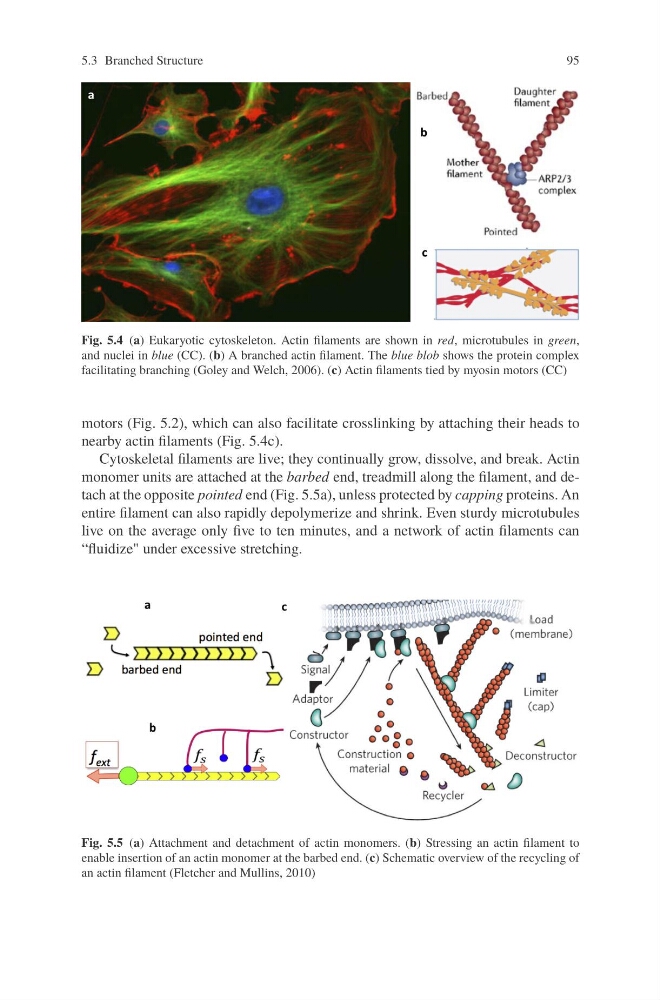
Fig. 5.4 (a) Eukaryotic cytoskeleton. Actin filaments are shown in red, microtubules in green,
and nuclei in blue (CC). (b) A branched actin filament. The blue blob shows the protein complex
facilitating branching (Goley and Welch, 2006). (c) Actin filaments tied by myosin motors (CC)
motors (Fig. 5.2), which can also facilitate crosslinking by attaching their heads to
nearby actin filaments (Fig. 5.4c).
Cytoskeletal filaments are live; they continually grow, dissolve, and break. Actin
monomer units are attached at the barbed end, treadmill along the filament, and detach at the opposite pointed end (Fig. 5.5a), unless protected by capping proteins. An
entire filament can also rapidly depolymerize and shrink. Even sturdy microtubules
live on the average only five to ten minutes, and a network of actin filaments can
“fluidize" under excessive stretching.
Fig. 5.5 (a) Attachment and detachment of actin monomers. (b) Stressing an actin filament to
enable insertion of an actin monomer at the barbed end. (c) Schematic overview of the recycling of
an actin filament (Fletcher and Mullins, 2010)
95
Fig. 5.4 (a) Eukaryotic cytoskeleton. Actin filaments are shown in red, microtubules in green,
and nuclei in blue (CC). (b) A branched actin filament. The blue blob shows the protein complex
facilitating branching (Goley and Welch, 2006). (c) Actin filaments tied by myosin motors (CC)
motors (Fig. 5.2), which can also facilitate crosslinking by attaching their heads to
nearby actin filaments (Fig. 5.4c).
Cytoskeletal filaments are live; they continually grow, dissolve, and break. Actin
monomer units are attached at the barbed end, treadmill along the filament, and detach at the opposite pointed end (Fig. 5.5a), unless protected by capping proteins. An
entire filament can also rapidly depolymerize and shrink. Even sturdy microtubules
live on the average only five to ten minutes, and a network of actin filaments can
“fluidize" under excessive stretching.
Fig. 5.5 (a) Attachment and detachment of actin monomers. (b) Stressing an actin filament to
enable insertion of an actin monomer at the barbed end. (c) Schematic overview of the recycling of
an actin filament (Fletcher and Mullins, 2010)