

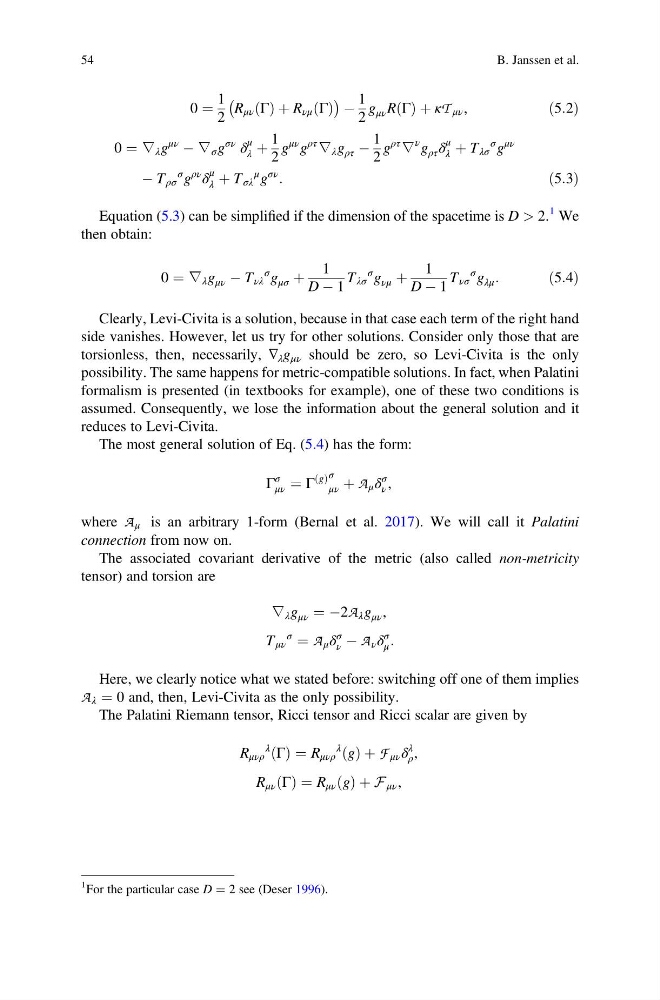
0 ¼
1
2
R μν Γ
ð Þ þ R νμ Γ
ð Þ
À
Á À
1
2
g μν R Γ
ð Þ þ κT μν ,
ð5:2Þ
0 ¼ ∇ λ g
μν
À ∇ σ g
σν
δ
μ
λ þ
1
2
g
μν g
ρτ
∇ λ g ρτ À
1
2
g
ρτ
∇
ν g ρτ δ
μ
λ þ T λσ
σ g
μν
À T ρσ
σ g
ρν
δ
μ
λ þ T σλ
μ g
σν
:
ð5:3Þ
Equation (5.3) can be simplified if the dimension of the spacetime is D > 2.
1 We
then obtain:
0 ¼ ∇ λ g μν À T νλ
σ g μσ þ
1
D À 1
T λσ
σ g νμ þ
1
D À 1
T νσ
σ g λμ :
ð5:4Þ
Clearly, Levi-Civita is a solution, because in that case each term of the right hand
side vanishes. However, let us try for other solutions. Consider only those that are
torsionless, then, necessarily, ∇ λ g μν should be zero, so Levi-Civita is the only
possibility. The same happens for metric-compatible solutions. In fact, when Palatini
formalism is presented (in textbooks for example), one of these two conditions is
assumed. Consequently, we lose the information about the general solution and it
reduces to Levi-Civita.
The most general solution of Eq. (5.4) has the form:
Γ
σ
μν ¼ Γ
g
ð Þ σ
μν þ A μ δ
σ
ν ,
where A μ is an arbitrary 1-form (Bernal et al. 2017). We will call it Palatini
connection from now on.
The associated covariant derivative of the metric (also called non-metricity
tensor) and torsion are
∇ λ g μν ¼ À2A λ g μν ,
T μν
σ
¼ A μ δ
σ
ν À A ν δ
σ
μ :
Here, we clearly notice what we stated before: switching off one of them implies
A λ ¼ 0 and, then, Levi-Civita as the only possibility.
The Palatini Riemann tensor, Ricci tensor and Ricci scalar are given by
R μνρ
λ
ðΓÞ ¼ R μνρ
λ
ðgÞ þ F μν δ
λ
ρ ,
R μν Γ
ð Þ ¼ R μν g
ð Þ þ F μν ,
1 For the particular case D ¼ 2 see (Deser 1996).
54
B. Janssen et al.
1
2
R μν Γ
ð Þ þ R νμ Γ
ð Þ
À
Á À
1
2
g μν R Γ
ð Þ þ κT μν ,
ð5:2Þ
0 ¼ ∇ λ g
μν
À ∇ σ g
σν
δ
μ
λ þ
1
2
g
μν g
ρτ
∇ λ g ρτ À
1
2
g
ρτ
∇
ν g ρτ δ
μ
λ þ T λσ
σ g
μν
À T ρσ
σ g
ρν
δ
μ
λ þ T σλ
μ g
σν
:
ð5:3Þ
Equation (5.3) can be simplified if the dimension of the spacetime is D > 2.
1 We
then obtain:
0 ¼ ∇ λ g μν À T νλ
σ g μσ þ
1
D À 1
T λσ
σ g νμ þ
1
D À 1
T νσ
σ g λμ :
ð5:4Þ
Clearly, Levi-Civita is a solution, because in that case each term of the right hand
side vanishes. However, let us try for other solutions. Consider only those that are
torsionless, then, necessarily, ∇ λ g μν should be zero, so Levi-Civita is the only
possibility. The same happens for metric-compatible solutions. In fact, when Palatini
formalism is presented (in textbooks for example), one of these two conditions is
assumed. Consequently, we lose the information about the general solution and it
reduces to Levi-Civita.
The most general solution of Eq. (5.4) has the form:
Γ
σ
μν ¼ Γ
g
ð Þ σ
μν þ A μ δ
σ
ν ,
where A μ is an arbitrary 1-form (Bernal et al. 2017). We will call it Palatini
connection from now on.
The associated covariant derivative of the metric (also called non-metricity
tensor) and torsion are
∇ λ g μν ¼ À2A λ g μν ,
T μν
σ
¼ A μ δ
σ
ν À A ν δ
σ
μ :
Here, we clearly notice what we stated before: switching off one of them implies
A λ ¼ 0 and, then, Levi-Civita as the only possibility.
The Palatini Riemann tensor, Ricci tensor and Ricci scalar are given by
R μνρ
λ
ðΓÞ ¼ R μνρ
λ
ðgÞ þ F μν δ
λ
ρ ,
R μν Γ
ð Þ ¼ R μν g
ð Þ þ F μν ,
1 For the particular case D ¼ 2 see (Deser 1996).
54
B. Janssen et al.