

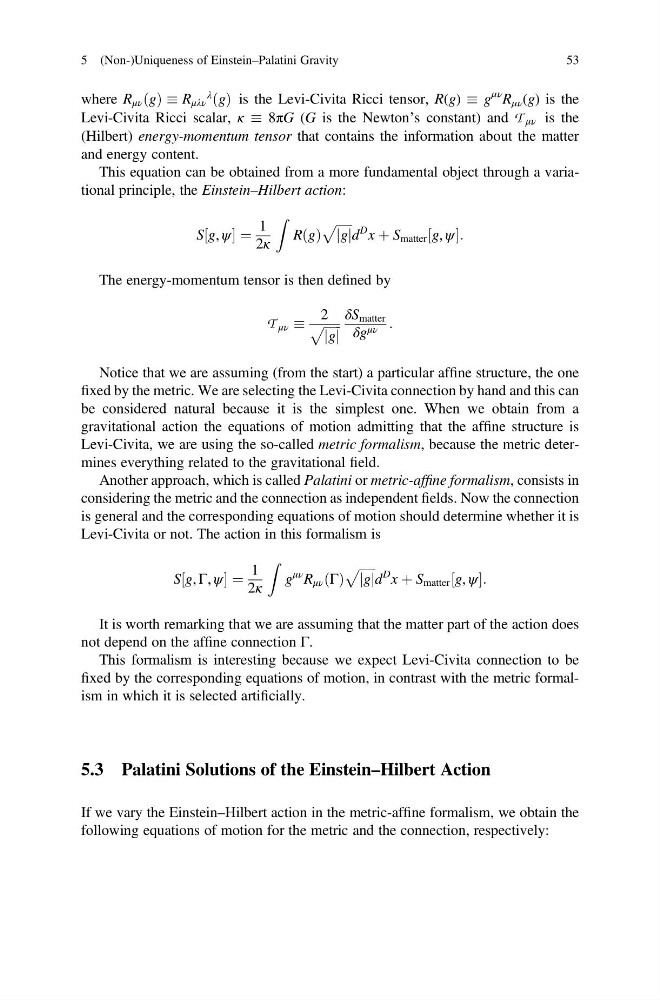
where R μν ðgÞ R μλν
λ
ðgÞ is the Levi-Civita Ricci tensor, R(g) g
μν R μν (g) is the
Levi-Civita Ricci scalar, κ 8πG (G is the Newton’s constant) and T μν is the
(Hilbert) energy-momentum tensor that contains the information about the matter
and energy content.
This equation can be obtained from a more fundamental object through a variational principle, the Einstein–Hilbert action:
S g, ψ
½
¼
1
2κ
Z
R g
ð Þ
ffiffiffiffiffi ffi
g
j j
p
d
D x þ S matter g, ψ
½
:
The energy-momentum tensor is then defined by
T μν
2
ffiffiffiffiffi ffi
g
j j
p
δS matter
δg μν :
Notice that we are assuming (from the start) a particular affine structure, the one
fixed by the metric. We are selecting the Levi-Civita connection by hand and this can
be considered natural because it is the simplest one. When we obtain from a
gravitational action the equations of motion admitting that the affine structure is
Levi-Civita, we are using the so-called metric formalism, because the metric determines everything related to the gravitational field.
Another approach, which is called Palatini or metric-affine formalism, consists in
considering the metric and the connection as independent fields. Now the connection
is general and the corresponding equations of motion should determine whether it is
Levi-Civita or not. The action in this formalism is
S g, Γ, ψ
½
¼
1
2κ
Z
g
μν R μν Γ
ð Þ
ffiffiffiffiffi ffi
g
j j
p
d
D x þ S matter g, ψ
½
:
It is worth remarking that we are assuming that the matter part of the action does
not depend on the affine connection Γ.
This formalism is interesting because we expect Levi-Civita connection to be
fixed by the corresponding equations of motion, in contrast with the metric formalism in which it is selected artificially.
5.3 Palatini Solutions of the Einstein–Hilbert Action
If we vary the Einstein–Hilbert action in the metric-affine formalism, we obtain the
following equations of motion for the metric and the connection, respectively:
5 (Non-)Uniqueness of Einstein–Palatini Gravity
53
λ
ðgÞ is the Levi-Civita Ricci tensor, R(g) g
μν R μν (g) is the
Levi-Civita Ricci scalar, κ 8πG (G is the Newton’s constant) and T μν is the
(Hilbert) energy-momentum tensor that contains the information about the matter
and energy content.
This equation can be obtained from a more fundamental object through a variational principle, the Einstein–Hilbert action:
S g, ψ
½
¼
1
2κ
Z
R g
ð Þ
ffiffiffiffiffi ffi
g
j j
p
d
D x þ S matter g, ψ
½
:
The energy-momentum tensor is then defined by
T μν
2
ffiffiffiffiffi ffi
g
j j
p
δS matter
δg μν :
Notice that we are assuming (from the start) a particular affine structure, the one
fixed by the metric. We are selecting the Levi-Civita connection by hand and this can
be considered natural because it is the simplest one. When we obtain from a
gravitational action the equations of motion admitting that the affine structure is
Levi-Civita, we are using the so-called metric formalism, because the metric determines everything related to the gravitational field.
Another approach, which is called Palatini or metric-affine formalism, consists in
considering the metric and the connection as independent fields. Now the connection
is general and the corresponding equations of motion should determine whether it is
Levi-Civita or not. The action in this formalism is
S g, Γ, ψ
½
¼
1
2κ
Z
g
μν R μν Γ
ð Þ
ffiffiffiffiffi ffi
g
j j
p
d
D x þ S matter g, ψ
½
:
It is worth remarking that we are assuming that the matter part of the action does
not depend on the affine connection Γ.
This formalism is interesting because we expect Levi-Civita connection to be
fixed by the corresponding equations of motion, in contrast with the metric formalism in which it is selected artificially.
5.3 Palatini Solutions of the Einstein–Hilbert Action
If we vary the Einstein–Hilbert action in the metric-affine formalism, we obtain the
following equations of motion for the metric and the connection, respectively:
5 (Non-)Uniqueness of Einstein–Palatini Gravity
53