

There are two distinguished cases.
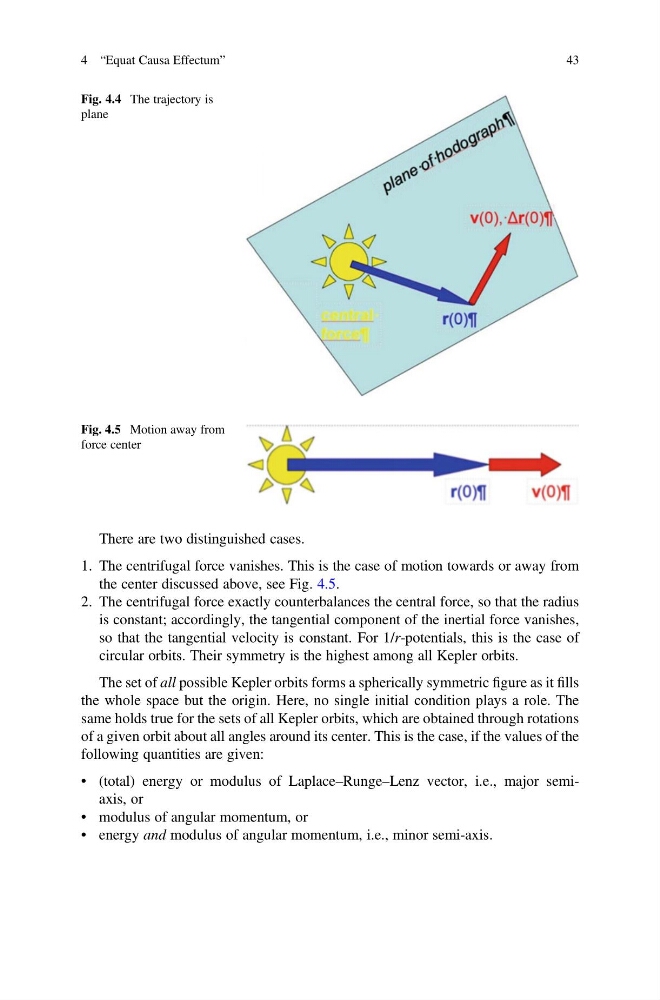
1. The centrifugal force vanishes. This is the case of motion towards or away from
the center discussed above, see Fig. 4.5.
2. The centrifugal force exactly counterbalances the central force, so that the radius
is constant; accordingly, the tangential component of the inertial force vanishes,
so that the tangential velocity is constant. For 1/r-potentials, this is the case of
circular orbits. Their symmetry is the highest among all Kepler orbits.
The set of all possible Kepler orbits forms a spherically symmetric figure as it fills
the whole space but the origin. Here, no single initial condition plays a role. The
same holds true for the sets of all Kepler orbits, which are obtained through rotations
of a given orbit about all angles around its center. This is the case, if the values of the
following quantities are given:
• (total) energy or modulus of Laplace–Runge–Lenz vector, i.e., major semiaxis, or
• modulus of angular momentum, or
• energy and modulus of angular momentum, i.e., minor semi-axis.
Fig. 4.4 The trajectory is
plane
Fig. 4.5 Motion away from
force center
4 “Equat Causa Effectum”
43
1. The centrifugal force vanishes. This is the case of motion towards or away from
the center discussed above, see Fig. 4.5.
2. The centrifugal force exactly counterbalances the central force, so that the radius
is constant; accordingly, the tangential component of the inertial force vanishes,
so that the tangential velocity is constant. For 1/r-potentials, this is the case of
circular orbits. Their symmetry is the highest among all Kepler orbits.
The set of all possible Kepler orbits forms a spherically symmetric figure as it fills
the whole space but the origin. Here, no single initial condition plays a role. The
same holds true for the sets of all Kepler orbits, which are obtained through rotations
of a given orbit about all angles around its center. This is the case, if the values of the
following quantities are given:
• (total) energy or modulus of Laplace–Runge–Lenz vector, i.e., major semiaxis, or
• modulus of angular momentum, or
• energy and modulus of angular momentum, i.e., minor semi-axis.
Fig. 4.4 The trajectory is
plane
Fig. 4.5 Motion away from
force center
4 “Equat Causa Effectum”
43