

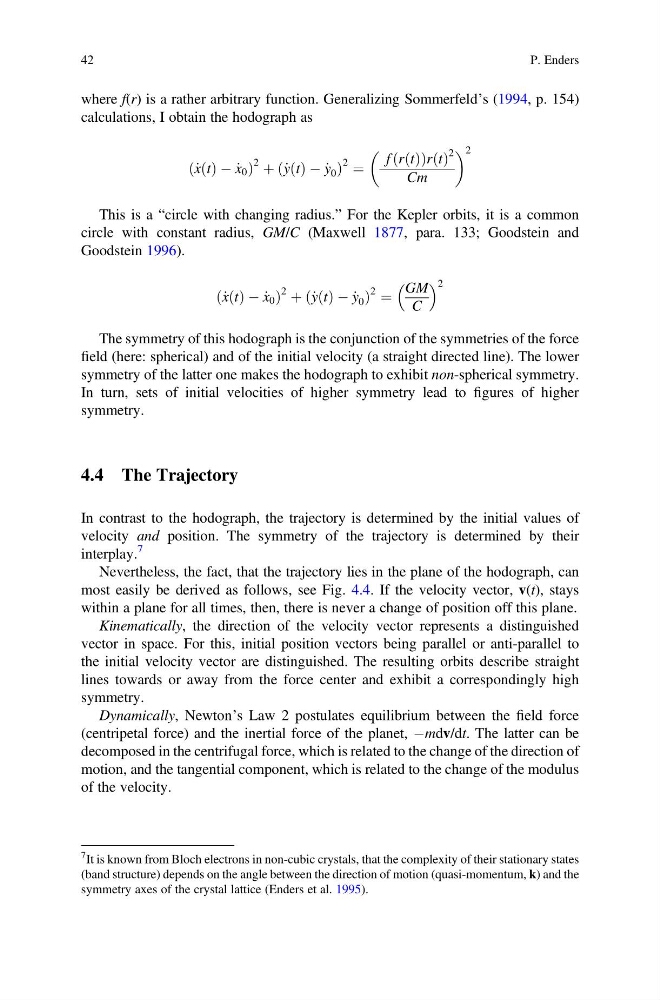
where f(r) is a rather arbitrary function. Generalizing Sommerfeld’s (1994, p. 154)
calculations, I obtain the hodograph as
_
x t
ð Þ À _
x 0
ð
Þ
2 þ _
y t
ð Þ À _
y 0
ð
Þ
2 ¼
f r t
ð Þ
ð Þr t
ð Þ
2
Cm
2
This is a “circle with changing radius.” For the Kepler orbits, it is a common
circle with constant radius, GM/C (Maxwell 1877, para. 133; Goodstein and
Goodstein 1996).
_
x t
ð Þ À _
x 0
ð
Þ
2 þ _
y t
ð Þ À _
y 0
ð
Þ
2 ¼
GM
C
2
The symmetry of this hodograph is the conjunction of the symmetries of the force
field (here: spherical) and of the initial velocity (a straight directed line). The lower
symmetry of the latter one makes the hodograph to exhibit non-spherical symmetry.
In turn, sets of initial velocities of higher symmetry lead to figures of higher
symmetry.
4.4 The Trajectory
In contrast to the hodograph, the trajectory is determined by the initial values of
velocity and position. The symmetry of the trajectory is determined by their
interplay.
7
Nevertheless, the fact, that the trajectory lies in the plane of the hodograph, can
most easily be derived as follows, see Fig. 4.4. If the velocity vector, v(t), stays
within a plane for all times, then, there is never a change of position off this plane.
Kinematically, the direction of the velocity vector represents a distinguished
vector in space. For this, initial position vectors being parallel or anti-parallel to
the initial velocity vector are distinguished. The resulting orbits describe straight
lines towards or away from the force center and exhibit a correspondingly high
symmetry.
Dynamically, Newton’s Law 2 postulates equilibrium between the field force
(centripetal force) and the inertial force of the planet, Àmdv/dt. The latter can be
decomposed in the centrifugal force, which is related to the change of the direction of
motion, and the tangential component, which is related to the change of the modulus
of the velocity.
7 It is known from Bloch electrons in non-cubic crystals, that the complexity of their stationary states
(band structure) depends on the angle between the direction of motion (quasi-momentum, k) and the
symmetry axes of the crystal lattice (Enders et al. 1995).
42
P. Enders
calculations, I obtain the hodograph as
_
x t
ð Þ À _
x 0
ð
Þ
2 þ _
y t
ð Þ À _
y 0
ð
Þ
2 ¼
f r t
ð Þ
ð Þr t
ð Þ
2
Cm
2
This is a “circle with changing radius.” For the Kepler orbits, it is a common
circle with constant radius, GM/C (Maxwell 1877, para. 133; Goodstein and
Goodstein 1996).
_
x t
ð Þ À _
x 0
ð
Þ
2 þ _
y t
ð Þ À _
y 0
ð
Þ
2 ¼
GM
C
2
The symmetry of this hodograph is the conjunction of the symmetries of the force
field (here: spherical) and of the initial velocity (a straight directed line). The lower
symmetry of the latter one makes the hodograph to exhibit non-spherical symmetry.
In turn, sets of initial velocities of higher symmetry lead to figures of higher
symmetry.
4.4 The Trajectory
In contrast to the hodograph, the trajectory is determined by the initial values of
velocity and position. The symmetry of the trajectory is determined by their
interplay.
7
Nevertheless, the fact, that the trajectory lies in the plane of the hodograph, can
most easily be derived as follows, see Fig. 4.4. If the velocity vector, v(t), stays
within a plane for all times, then, there is never a change of position off this plane.
Kinematically, the direction of the velocity vector represents a distinguished
vector in space. For this, initial position vectors being parallel or anti-parallel to
the initial velocity vector are distinguished. The resulting orbits describe straight
lines towards or away from the force center and exhibit a correspondingly high
symmetry.
Dynamically, Newton’s Law 2 postulates equilibrium between the field force
(centripetal force) and the inertial force of the planet, Àmdv/dt. The latter can be
decomposed in the centrifugal force, which is related to the change of the direction of
motion, and the tangential component, which is related to the change of the modulus
of the velocity.
7 It is known from Bloch electrons in non-cubic crystals, that the complexity of their stationary states
(band structure) depends on the angle between the direction of motion (quasi-momentum, k) and the
symmetry axes of the crystal lattice (Enders et al. 1995).
42
P. Enders