

22.5 Conclusions
The main required features for an effective educational lab system for spectroscopic
measurements, i.e., the importance of the calibration process, the insight into the
physical processes, the possibility to change the accuracy, and the data acquisition
modality emerged after having analyzed potentialities and limits of some available
digital spectrometers and mobile APPs. A cheap but affordable digital device,
SPETTROGRAFO, has been thus designed and realized in order to implement in a
simple setup all the emerged needs. The original device allows analysis of optical
spectra of different light sources and it consists of a USB webcam with the possibility to place in front of it different diffraction gratings, and colored filters to study
selective absorption of colors. Virtual images of spectra are recorded on the CCD
sensor of the webcam and observed with the aid of a specifically designed software.
Calibration occurs via software itself by selecting the used diffraction grating or with
the aid of a calibration source, and the tests showed that precision of the measures
have uncertainties less than 5%. Recorded spectra are digitalized in a graph
representing luminous intensity as a function of the wavelength, or energy. The
device can be also mounted on a rotating base allowing to measure the diffraction
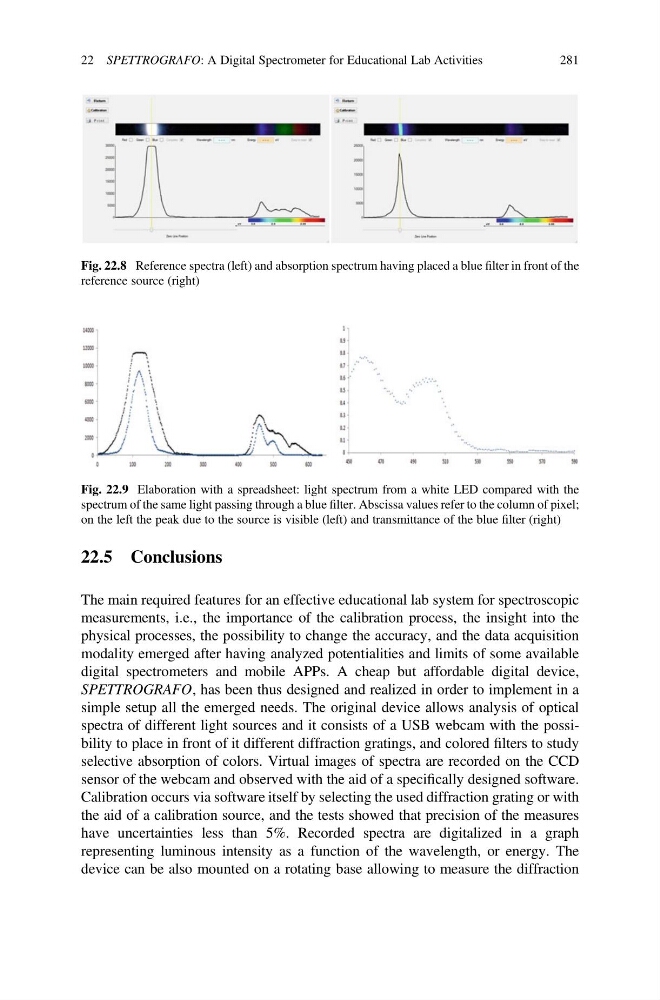
Fig. 22.9 Elaboration with a spreadsheet: light spectrum from a white LED compared with the
spectrum of the same light passing through a blue filter. Abscissa values refer to the column of pixel;
on the left the peak due to the source is visible (left) and transmittance of the blue filter (right)
Fig. 22.8 Reference spectra (left) and absorption spectrum having placed a blue filter in front of the
reference source (right)
22 SPETTROGRAFO: A Digital Spectrometer for Educational Lab Activities
281
The main required features for an effective educational lab system for spectroscopic
measurements, i.e., the importance of the calibration process, the insight into the
physical processes, the possibility to change the accuracy, and the data acquisition
modality emerged after having analyzed potentialities and limits of some available
digital spectrometers and mobile APPs. A cheap but affordable digital device,
SPETTROGRAFO, has been thus designed and realized in order to implement in a
simple setup all the emerged needs. The original device allows analysis of optical
spectra of different light sources and it consists of a USB webcam with the possibility to place in front of it different diffraction gratings, and colored filters to study
selective absorption of colors. Virtual images of spectra are recorded on the CCD
sensor of the webcam and observed with the aid of a specifically designed software.
Calibration occurs via software itself by selecting the used diffraction grating or with
the aid of a calibration source, and the tests showed that precision of the measures
have uncertainties less than 5%. Recorded spectra are digitalized in a graph
representing luminous intensity as a function of the wavelength, or energy. The
device can be also mounted on a rotating base allowing to measure the diffraction
Fig. 22.9 Elaboration with a spreadsheet: light spectrum from a white LED compared with the
spectrum of the same light passing through a blue filter. Abscissa values refer to the column of pixel;
on the left the peak due to the source is visible (left) and transmittance of the blue filter (right)
Fig. 22.8 Reference spectra (left) and absorption spectrum having placed a blue filter in front of the
reference source (right)
22 SPETTROGRAFO: A Digital Spectrometer for Educational Lab Activities
281