

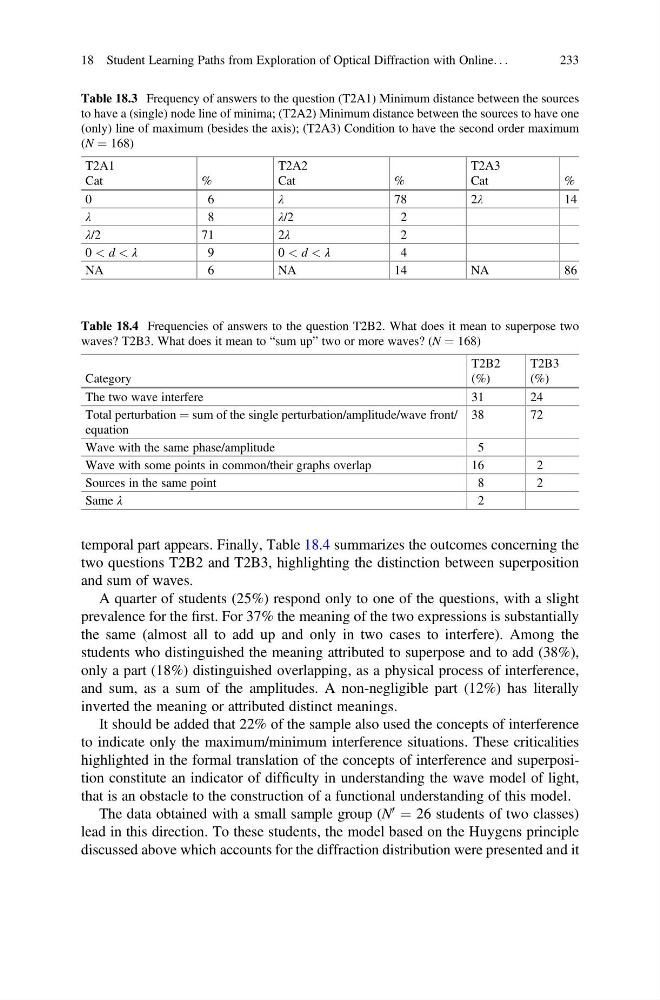
temporal part appears. Finally, Table 18.4 summarizes the outcomes concerning the
two questions T2B2 and T2B3, highlighting the distinction between superposition
and sum of waves.
A quarter of students (25%) respond only to one of the questions, with a slight
prevalence for the first. For 37% the meaning of the two expressions is substantially
the same (almost all to add up and only in two cases to interfere). Among the
students who distinguished the meaning attributed to superpose and to add (38%),
only a part (18%) distinguished overlapping, as a physical process of interference,
and sum, as a sum of the amplitudes. A non-negligible part (12%) has literally
inverted the meaning or attributed distinct meanings.
It should be added that 22% of the sample also used the concepts of interference
to indicate only the maximum/minimum interference situations. These criticalities
highlighted in the formal translation of the concepts of interference and superposition constitute an indicator of difficulty in understanding the wave model of light,
that is an obstacle to the construction of a functional understanding of this model.
The data obtained with a small sample group (N
0
¼ 26 students of two classes)
lead in this direction. To these students, the model based on the Huygens principle
discussed above which accounts for the diffraction distribution were presented and it
Table 18.3 Frequency of answers to the question (T2A1) Minimum distance between the sources
to have a (single) node line of minima; (T2A2) Minimum distance between the sources to have one
(only) line of maximum (besides the axis); (T2A3) Condition to have the second order maximum
(N ¼ 168)
T2A1
Cat
%
T2A2
Cat
%
T2A3
Cat
%
0
6
λ
78
2λ
14
λ
8
λ/2
2
λ/2
71
2λ
2
0 < d < λ
9
0 < d < λ
4
NA
6
NA
14
NA
86
Table 18.4 Frequencies of answers to the question T2B2. What does it mean to superpose two
waves? T2B3. What does it mean to “sum up” two or more waves? (N ¼ 168)
Category
T2B2
(%)
T2B3
(%)
The two wave interfere
31
24
Total perturbation ¼ sum of the single perturbation/amplitude/wave front/
equation
38
72
Wave with the same phase/amplitude
5
Wave with some points in common/their graphs overlap
16
2
Sources in the same point
8
2
Same λ
2
18 Student Learning Paths from Exploration of Optical Diffraction with Online. . .
233
two questions T2B2 and T2B3, highlighting the distinction between superposition
and sum of waves.
A quarter of students (25%) respond only to one of the questions, with a slight
prevalence for the first. For 37% the meaning of the two expressions is substantially
the same (almost all to add up and only in two cases to interfere). Among the
students who distinguished the meaning attributed to superpose and to add (38%),
only a part (18%) distinguished overlapping, as a physical process of interference,
and sum, as a sum of the amplitudes. A non-negligible part (12%) has literally
inverted the meaning or attributed distinct meanings.
It should be added that 22% of the sample also used the concepts of interference
to indicate only the maximum/minimum interference situations. These criticalities
highlighted in the formal translation of the concepts of interference and superposition constitute an indicator of difficulty in understanding the wave model of light,
that is an obstacle to the construction of a functional understanding of this model.
The data obtained with a small sample group (N
0
¼ 26 students of two classes)
lead in this direction. To these students, the model based on the Huygens principle
discussed above which accounts for the diffraction distribution were presented and it
Table 18.3 Frequency of answers to the question (T2A1) Minimum distance between the sources
to have a (single) node line of minima; (T2A2) Minimum distance between the sources to have one
(only) line of maximum (besides the axis); (T2A3) Condition to have the second order maximum
(N ¼ 168)
T2A1
Cat
%
T2A2
Cat
%
T2A3
Cat
%
0
6
λ
78
2λ
14
λ
8
λ/2
2
λ/2
71
2λ
2
0 < d < λ
9
0 < d < λ
4
NA
6
NA
14
NA
86
Table 18.4 Frequencies of answers to the question T2B2. What does it mean to superpose two
waves? T2B3. What does it mean to “sum up” two or more waves? (N ¼ 168)
Category
T2B2
(%)
T2B3
(%)
The two wave interfere
31
24
Total perturbation ¼ sum of the single perturbation/amplitude/wave front/
equation
38
72
Wave with the same phase/amplitude
5
Wave with some points in common/their graphs overlap
16
2
Sources in the same point
8
2
Same λ
2
18 Student Learning Paths from Exploration of Optical Diffraction with Online. . .
233