

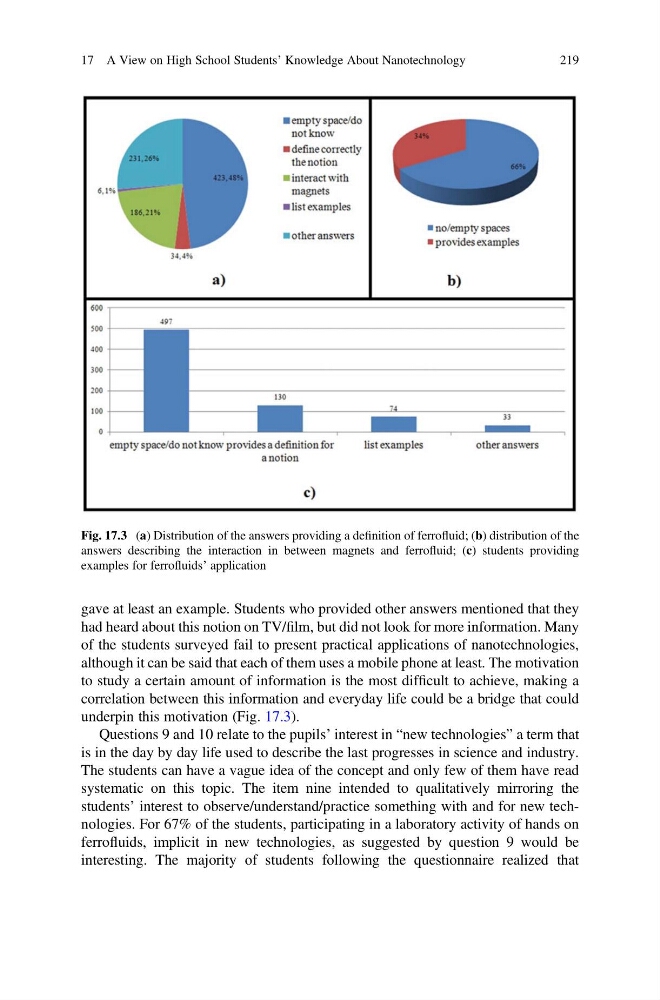
gave at least an example. Students who provided other answers mentioned that they
had heard about this notion on TV/film, but did not look for more information. Many
of the students surveyed fail to present practical applications of nanotechnologies,
although it can be said that each of them uses a mobile phone at least. The motivation
to study a certain amount of information is the most difficult to achieve, making a
correlation between this information and everyday life could be a bridge that could
underpin this motivation (Fig. 17.3).
Questions 9 and 10 relate to the pupils’ interest in “new technologies” a term that
is in the day by day life used to describe the last progresses in science and industry.
The students can have a vague idea of the concept and only few of them have read
systematic on this topic. The item nine intended to qualitatively mirroring the
students’ interest to observe/understand/practice something with and for new technologies. For 67% of the students, participating in a laboratory activity of hands on
ferrofluids, implicit in new technologies, as suggested by question 9 would be
interesting. The majority of students following the questionnaire realized that
Fig. 17.3 (a) Distribution of the answers providing a definition of ferrofluid; (b) distribution of the
answers describing the interaction in between magnets and ferrofluid; (c) students providing
examples for ferrofluids’ application
17 A View on High School Students’ Knowledge About Nanotechnology
219
had heard about this notion on TV/film, but did not look for more information. Many
of the students surveyed fail to present practical applications of nanotechnologies,
although it can be said that each of them uses a mobile phone at least. The motivation
to study a certain amount of information is the most difficult to achieve, making a
correlation between this information and everyday life could be a bridge that could
underpin this motivation (Fig. 17.3).
Questions 9 and 10 relate to the pupils’ interest in “new technologies” a term that
is in the day by day life used to describe the last progresses in science and industry.
The students can have a vague idea of the concept and only few of them have read
systematic on this topic. The item nine intended to qualitatively mirroring the
students’ interest to observe/understand/practice something with and for new technologies. For 67% of the students, participating in a laboratory activity of hands on
ferrofluids, implicit in new technologies, as suggested by question 9 would be
interesting. The majority of students following the questionnaire realized that
Fig. 17.3 (a) Distribution of the answers providing a definition of ferrofluid; (b) distribution of the
answers describing the interaction in between magnets and ferrofluid; (c) students providing
examples for ferrofluids’ application
17 A View on High School Students’ Knowledge About Nanotechnology
219