

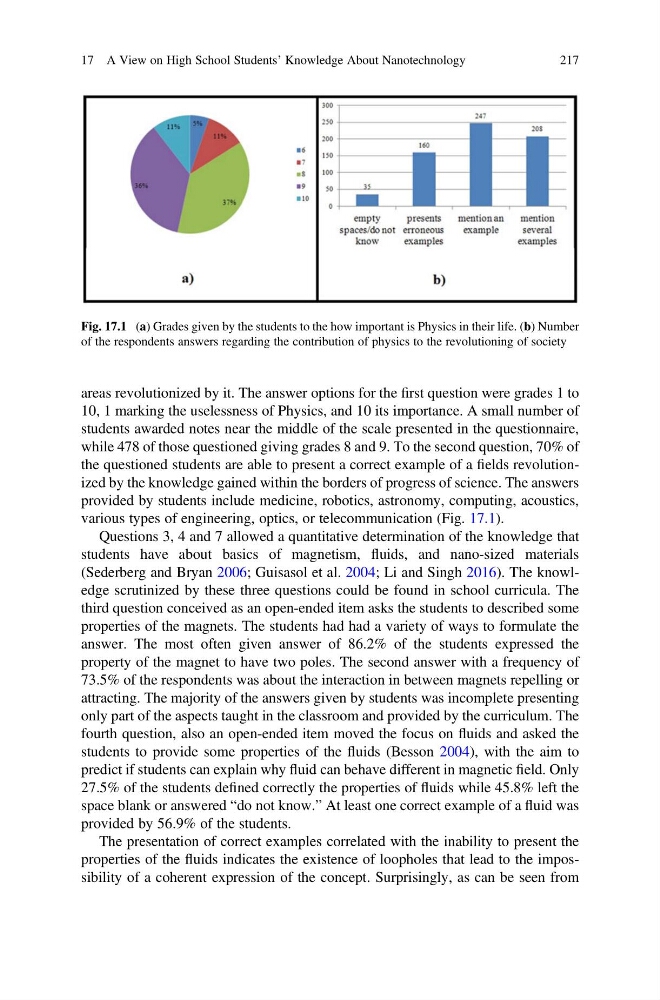
areas revolutionized by it. The answer options for the first question were grades 1 to
10, 1 marking the uselessness of Physics, and 10 its importance. A small number of
students awarded notes near the middle of the scale presented in the questionnaire,
while 478 of those questioned giving grades 8 and 9. To the second question, 70% of
the questioned students are able to present a correct example of a fields revolutionized by the knowledge gained within the borders of progress of science. The answers
provided by students include medicine, robotics, astronomy, computing, acoustics,
various types of engineering, optics, or telecommunication (Fig. 17.1).
Questions 3, 4 and 7 allowed a quantitative determination of the knowledge that
students have about basics of magnetism, fluids, and nano-sized materials
(Sederberg and Bryan 2006; Guisasol et al. 2004; Li and Singh 2016). The knowledge scrutinized by these three questions could be found in school curricula. The
third question conceived as an open-ended item asks the students to described some
properties of the magnets. The students had had a variety of ways to formulate the
answer. The most often given answer of 86.2% of the students expressed the
property of the magnet to have two poles. The second answer with a frequency of
73.5% of the respondents was about the interaction in between magnets repelling or
attracting. The majority of the answers given by students was incomplete presenting
only part of the aspects taught in the classroom and provided by the curriculum. The
fourth question, also an open-ended item moved the focus on fluids and asked the
students to provide some properties of the fluids (Besson 2004), with the aim to
predict if students can explain why fluid can behave different in magnetic field. Only
27.5% of the students defined correctly the properties of fluids while 45.8% left the
space blank or answered “do not know.” At least one correct example of a fluid was
provided by 56.9% of the students.
The presentation of correct examples correlated with the inability to present the
properties of the fluids indicates the existence of loopholes that lead to the impossibility of a coherent expression of the concept. Surprisingly, as can be seen from
Fig. 17.1 (a) Grades given by the students to the how important is Physics in their life. (b) Number
of the respondents answers regarding the contribution of physics to the revolutioning of society
17 A View on High School Students’ Knowledge About Nanotechnology
217
10, 1 marking the uselessness of Physics, and 10 its importance. A small number of
students awarded notes near the middle of the scale presented in the questionnaire,
while 478 of those questioned giving grades 8 and 9. To the second question, 70% of
the questioned students are able to present a correct example of a fields revolutionized by the knowledge gained within the borders of progress of science. The answers
provided by students include medicine, robotics, astronomy, computing, acoustics,
various types of engineering, optics, or telecommunication (Fig. 17.1).
Questions 3, 4 and 7 allowed a quantitative determination of the knowledge that
students have about basics of magnetism, fluids, and nano-sized materials
(Sederberg and Bryan 2006; Guisasol et al. 2004; Li and Singh 2016). The knowledge scrutinized by these three questions could be found in school curricula. The
third question conceived as an open-ended item asks the students to described some
properties of the magnets. The students had had a variety of ways to formulate the
answer. The most often given answer of 86.2% of the students expressed the
property of the magnet to have two poles. The second answer with a frequency of
73.5% of the respondents was about the interaction in between magnets repelling or
attracting. The majority of the answers given by students was incomplete presenting
only part of the aspects taught in the classroom and provided by the curriculum. The
fourth question, also an open-ended item moved the focus on fluids and asked the
students to provide some properties of the fluids (Besson 2004), with the aim to
predict if students can explain why fluid can behave different in magnetic field. Only
27.5% of the students defined correctly the properties of fluids while 45.8% left the
space blank or answered “do not know.” At least one correct example of a fluid was
provided by 56.9% of the students.
The presentation of correct examples correlated with the inability to present the
properties of the fluids indicates the existence of loopholes that lead to the impossibility of a coherent expression of the concept. Surprisingly, as can be seen from
Fig. 17.1 (a) Grades given by the students to the how important is Physics in their life. (b) Number
of the respondents answers regarding the contribution of physics to the revolutioning of society
17 A View on High School Students’ Knowledge About Nanotechnology
217