

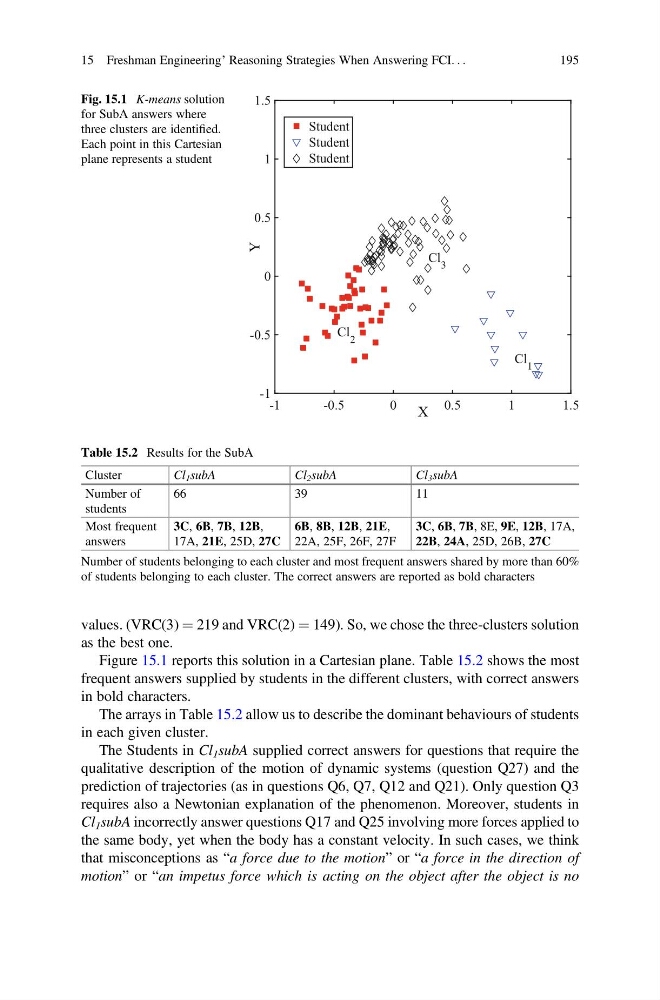
values. (VRC(3) ¼ 219 and VRC(2) ¼ 149). So, we chose the three-clusters solution
as the best one.
Figure 15.1 reports this solution in a Cartesian plane. Table 15.2 shows the most
frequent answers supplied by students in the different clusters, with correct answers
in bold characters.
The arrays in Table 15.2 allow us to describe the dominant behaviours of students
in each given cluster.
The Students in Cl 1 subA supplied correct answers for questions that require the
qualitative description of the motion of dynamic systems (question Q27) and the
prediction of trajectories (as in questions Q6, Q7, Q12 and Q21). Only question Q3
requires also a Newtonian explanation of the phenomenon. Moreover, students in
Cl 1 subA incorrectly answer questions Q17 and Q25 involving more forces applied to
the same body, yet when the body has a constant velocity. In such cases, we think
that misconceptions as “a force due to the motion” or “a force in the direction of
motion” or “an impetus force which is acting on the object after the object is no
-1
-0.5
0
0.5
1
1.5
X
-1
-0.5
0
0.5
1
1.5
Y
Student
Student
Student
Cl 2
Cl 3
Cl 1
Fig. 15.1 K-means solution
for SubA answers where
three clusters are identified.
Each point in this Cartesian
plane represents a student
Table 15.2 Results for the SubA
Cluster
Cl 1 subA
Cl 2 subA
Cl 3 subA
Number of
students
66
39
11
Most frequent
answers
3C, 6B, 7B, 12B,
17A, 21E, 25D, 27C
6B, 8B, 12B, 21E,
22A, 25F, 26F, 27F
3C, 6B, 7B, 8E, 9E, 12B, 17A,
22B, 24A, 25D, 26B, 27C
Number of students belonging to each cluster and most frequent answers shared by more than 60%
of students belonging to each cluster. The correct answers are reported as bold characters
15 Freshman Engineering’ Reasoning Strategies When Answering FCI. . .
195
as the best one.
Figure 15.1 reports this solution in a Cartesian plane. Table 15.2 shows the most
frequent answers supplied by students in the different clusters, with correct answers
in bold characters.
The arrays in Table 15.2 allow us to describe the dominant behaviours of students
in each given cluster.
The Students in Cl 1 subA supplied correct answers for questions that require the
qualitative description of the motion of dynamic systems (question Q27) and the
prediction of trajectories (as in questions Q6, Q7, Q12 and Q21). Only question Q3
requires also a Newtonian explanation of the phenomenon. Moreover, students in
Cl 1 subA incorrectly answer questions Q17 and Q25 involving more forces applied to
the same body, yet when the body has a constant velocity. In such cases, we think
that misconceptions as “a force due to the motion” or “a force in the direction of
motion” or “an impetus force which is acting on the object after the object is no
-1
-0.5
0
0.5
1
1.5
X
-1
-0.5
0
0.5
1
1.5
Y
Student
Student
Student
Cl 2
Cl 3
Cl 1
Fig. 15.1 K-means solution
for SubA answers where
three clusters are identified.
Each point in this Cartesian
plane represents a student
Table 15.2 Results for the SubA
Cluster
Cl 1 subA
Cl 2 subA
Cl 3 subA
Number of
students
66
39
11
Most frequent
answers
3C, 6B, 7B, 12B,
17A, 21E, 25D, 27C
6B, 8B, 12B, 21E,
22A, 25F, 26F, 27F
3C, 6B, 7B, 8E, 9E, 12B, 17A,
22B, 24A, 25D, 26B, 27C
Number of students belonging to each cluster and most frequent answers shared by more than 60%
of students belonging to each cluster. The correct answers are reported as bold characters
15 Freshman Engineering’ Reasoning Strategies When Answering FCI. . .
195