

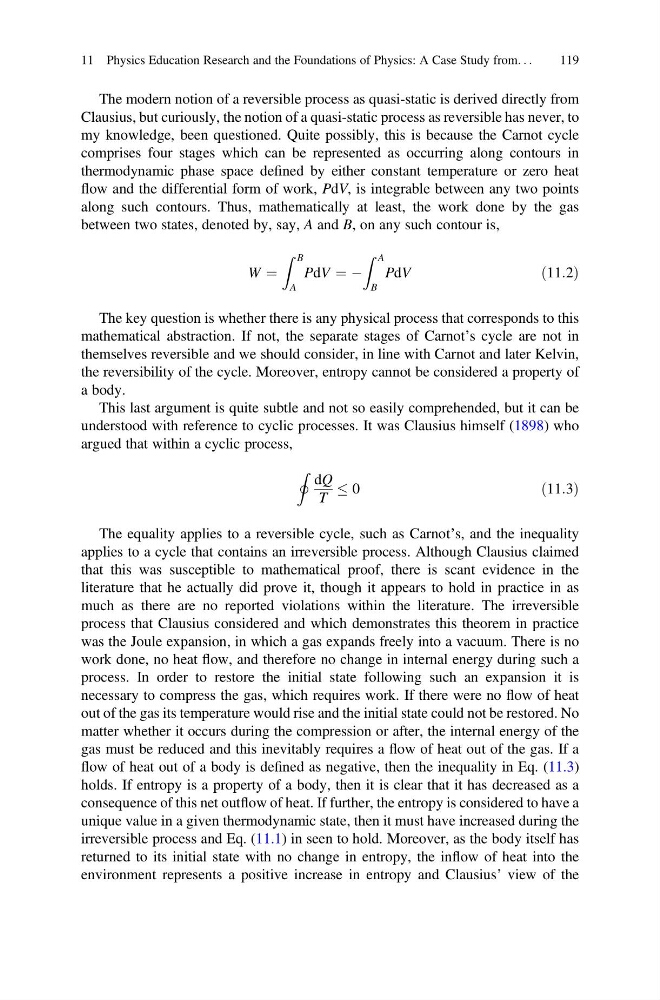
The modern notion of a reversible process as quasi-static is derived directly from
Clausius, but curiously, the notion of a quasi-static process as reversible has never, to
my knowledge, been questioned. Quite possibly, this is because the Carnot cycle
comprises four stages which can be represented as occurring along contours in
thermodynamic phase space defined by either constant temperature or zero heat
flow and the differential form of work, PdV, is integrable between any two points
along such contours. Thus, mathematically at least, the work done by the gas
between two states, denoted by, say, A and B, on any such contour is,
W ¼
Z B
A
PdV ¼ À
Z A
B
PdV
ð11:2Þ
The key question is whether there is any physical process that corresponds to this
mathematical abstraction. If not, the separate stages of Carnot’s cycle are not in
themselves reversible and we should consider, in line with Carnot and later Kelvin,
the reversibility of the cycle. Moreover, entropy cannot be considered a property of
a body.
This last argument is quite subtle and not so easily comprehended, but it can be
understood with reference to cyclic processes. It was Clausius himself (1898) who
argued that within a cyclic process,
I
dQ
T
0
ð11:3Þ
The equality applies to a reversible cycle, such as Carnot’s, and the inequality
applies to a cycle that contains an irreversible process. Although Clausius claimed
that this was susceptible to mathematical proof, there is scant evidence in the
literature that he actually did prove it, though it appears to hold in practice in as
much as there are no reported violations within the literature. The irreversible
process that Clausius considered and which demonstrates this theorem in practice
was the Joule expansion, in which a gas expands freely into a vacuum. There is no
work done, no heat flow, and therefore no change in internal energy during such a
process. In order to restore the initial state following such an expansion it is
necessary to compress the gas, which requires work. If there were no flow of heat
out of the gas its temperature would rise and the initial state could not be restored. No
matter whether it occurs during the compression or after, the internal energy of the
gas must be reduced and this inevitably requires a flow of heat out of the gas. If a
flow of heat out of a body is defined as negative, then the inequality in Eq. (11.3)
holds. If entropy is a property of a body, then it is clear that it has decreased as a
consequence of this net outflow of heat. If further, the entropy is considered to have a
unique value in a given thermodynamic state, then it must have increased during the
irreversible process and Eq. (11.1) in seen to hold. Moreover, as the body itself has
returned to its initial state with no change in entropy, the inflow of heat into the
environment represents a positive increase in entropy and Clausius’ view of the
11 Physics Education Research and the Foundations of Physics: A Case Study from. . .
119
Clausius, but curiously, the notion of a quasi-static process as reversible has never, to
my knowledge, been questioned. Quite possibly, this is because the Carnot cycle
comprises four stages which can be represented as occurring along contours in
thermodynamic phase space defined by either constant temperature or zero heat
flow and the differential form of work, PdV, is integrable between any two points
along such contours. Thus, mathematically at least, the work done by the gas
between two states, denoted by, say, A and B, on any such contour is,
W ¼
Z B
A
PdV ¼ À
Z A
B
PdV
ð11:2Þ
The key question is whether there is any physical process that corresponds to this
mathematical abstraction. If not, the separate stages of Carnot’s cycle are not in
themselves reversible and we should consider, in line with Carnot and later Kelvin,
the reversibility of the cycle. Moreover, entropy cannot be considered a property of
a body.
This last argument is quite subtle and not so easily comprehended, but it can be
understood with reference to cyclic processes. It was Clausius himself (1898) who
argued that within a cyclic process,
I
dQ
T
0
ð11:3Þ
The equality applies to a reversible cycle, such as Carnot’s, and the inequality
applies to a cycle that contains an irreversible process. Although Clausius claimed
that this was susceptible to mathematical proof, there is scant evidence in the
literature that he actually did prove it, though it appears to hold in practice in as
much as there are no reported violations within the literature. The irreversible
process that Clausius considered and which demonstrates this theorem in practice
was the Joule expansion, in which a gas expands freely into a vacuum. There is no
work done, no heat flow, and therefore no change in internal energy during such a
process. In order to restore the initial state following such an expansion it is
necessary to compress the gas, which requires work. If there were no flow of heat
out of the gas its temperature would rise and the initial state could not be restored. No
matter whether it occurs during the compression or after, the internal energy of the
gas must be reduced and this inevitably requires a flow of heat out of the gas. If a
flow of heat out of a body is defined as negative, then the inequality in Eq. (11.3)
holds. If entropy is a property of a body, then it is clear that it has decreased as a
consequence of this net outflow of heat. If further, the entropy is considered to have a
unique value in a given thermodynamic state, then it must have increased during the
irreversible process and Eq. (11.1) in seen to hold. Moreover, as the body itself has
returned to its initial state with no change in entropy, the inflow of heat into the
environment represents a positive increase in entropy and Clausius’ view of the
11 Physics Education Research and the Foundations of Physics: A Case Study from. . .
119