

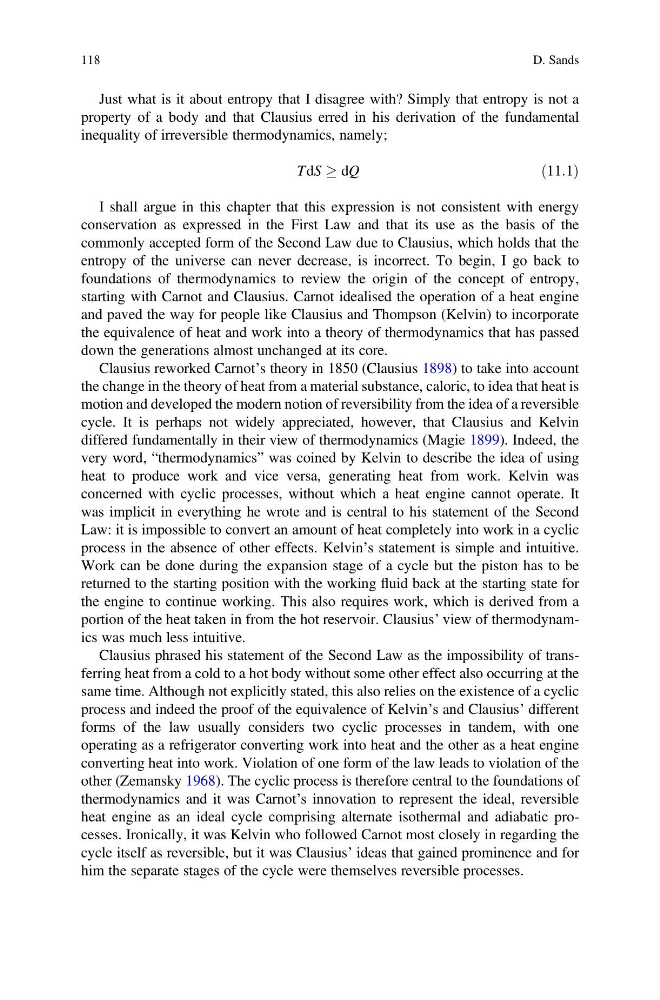
Just what is it about entropy that I disagree with? Simply that entropy is not a
property of a body and that Clausius erred in his derivation of the fundamental
inequality of irreversible thermodynamics, namely;
TdS ! dQ
ð11:1Þ
I shall argue in this chapter that this expression is not consistent with energy
conservation as expressed in the First Law and that its use as the basis of the
commonly accepted form of the Second Law due to Clausius, which holds that the
entropy of the universe can never decrease, is incorrect. To begin, I go back to
foundations of thermodynamics to review the origin of the concept of entropy,
starting with Carnot and Clausius. Carnot idealised the operation of a heat engine
and paved the way for people like Clausius and Thompson (Kelvin) to incorporate
the equivalence of heat and work into a theory of thermodynamics that has passed
down the generations almost unchanged at its core.
Clausius reworked Carnot’s theory in 1850 (Clausius 1898) to take into account
the change in the theory of heat from a material substance, caloric, to idea that heat is
motion and developed the modern notion of reversibility from the idea of a reversible
cycle. It is perhaps not widely appreciated, however, that Clausius and Kelvin
differed fundamentally in their view of thermodynamics (Magie 1899). Indeed, the
very word, “thermodynamics” was coined by Kelvin to describe the idea of using
heat to produce work and vice versa, generating heat from work. Kelvin was
concerned with cyclic processes, without which a heat engine cannot operate. It
was implicit in everything he wrote and is central to his statement of the Second
Law: it is impossible to convert an amount of heat completely into work in a cyclic
process in the absence of other effects. Kelvin’s statement is simple and intuitive.
Work can be done during the expansion stage of a cycle but the piston has to be
returned to the starting position with the working fluid back at the starting state for
the engine to continue working. This also requires work, which is derived from a
portion of the heat taken in from the hot reservoir. Clausius’ view of thermodynamics was much less intuitive.
Clausius phrased his statement of the Second Law as the impossibility of transferring heat from a cold to a hot body without some other effect also occurring at the
same time. Although not explicitly stated, this also relies on the existence of a cyclic
process and indeed the proof of the equivalence of Kelvin’s and Clausius’ different
forms of the law usually considers two cyclic processes in tandem, with one
operating as a refrigerator converting work into heat and the other as a heat engine
converting heat into work. Violation of one form of the law leads to violation of the
other (Zemansky 1968). The cyclic process is therefore central to the foundations of
thermodynamics and it was Carnot’s innovation to represent the ideal, reversible
heat engine as an ideal cycle comprising alternate isothermal and adiabatic processes. Ironically, it was Kelvin who followed Carnot most closely in regarding the
cycle itself as reversible, but it was Clausius’ ideas that gained prominence and for
him the separate stages of the cycle were themselves reversible processes.
118
D. Sands
property of a body and that Clausius erred in his derivation of the fundamental
inequality of irreversible thermodynamics, namely;
TdS ! dQ
ð11:1Þ
I shall argue in this chapter that this expression is not consistent with energy
conservation as expressed in the First Law and that its use as the basis of the
commonly accepted form of the Second Law due to Clausius, which holds that the
entropy of the universe can never decrease, is incorrect. To begin, I go back to
foundations of thermodynamics to review the origin of the concept of entropy,
starting with Carnot and Clausius. Carnot idealised the operation of a heat engine
and paved the way for people like Clausius and Thompson (Kelvin) to incorporate
the equivalence of heat and work into a theory of thermodynamics that has passed
down the generations almost unchanged at its core.
Clausius reworked Carnot’s theory in 1850 (Clausius 1898) to take into account
the change in the theory of heat from a material substance, caloric, to idea that heat is
motion and developed the modern notion of reversibility from the idea of a reversible
cycle. It is perhaps not widely appreciated, however, that Clausius and Kelvin
differed fundamentally in their view of thermodynamics (Magie 1899). Indeed, the
very word, “thermodynamics” was coined by Kelvin to describe the idea of using
heat to produce work and vice versa, generating heat from work. Kelvin was
concerned with cyclic processes, without which a heat engine cannot operate. It
was implicit in everything he wrote and is central to his statement of the Second
Law: it is impossible to convert an amount of heat completely into work in a cyclic
process in the absence of other effects. Kelvin’s statement is simple and intuitive.
Work can be done during the expansion stage of a cycle but the piston has to be
returned to the starting position with the working fluid back at the starting state for
the engine to continue working. This also requires work, which is derived from a
portion of the heat taken in from the hot reservoir. Clausius’ view of thermodynamics was much less intuitive.
Clausius phrased his statement of the Second Law as the impossibility of transferring heat from a cold to a hot body without some other effect also occurring at the
same time. Although not explicitly stated, this also relies on the existence of a cyclic
process and indeed the proof of the equivalence of Kelvin’s and Clausius’ different
forms of the law usually considers two cyclic processes in tandem, with one
operating as a refrigerator converting work into heat and the other as a heat engine
converting heat into work. Violation of one form of the law leads to violation of the
other (Zemansky 1968). The cyclic process is therefore central to the foundations of
thermodynamics and it was Carnot’s innovation to represent the ideal, reversible
heat engine as an ideal cycle comprising alternate isothermal and adiabatic processes. Ironically, it was Kelvin who followed Carnot most closely in regarding the
cycle itself as reversible, but it was Clausius’ ideas that gained prominence and for
him the separate stages of the cycle were themselves reversible processes.
118
D. Sands