

42
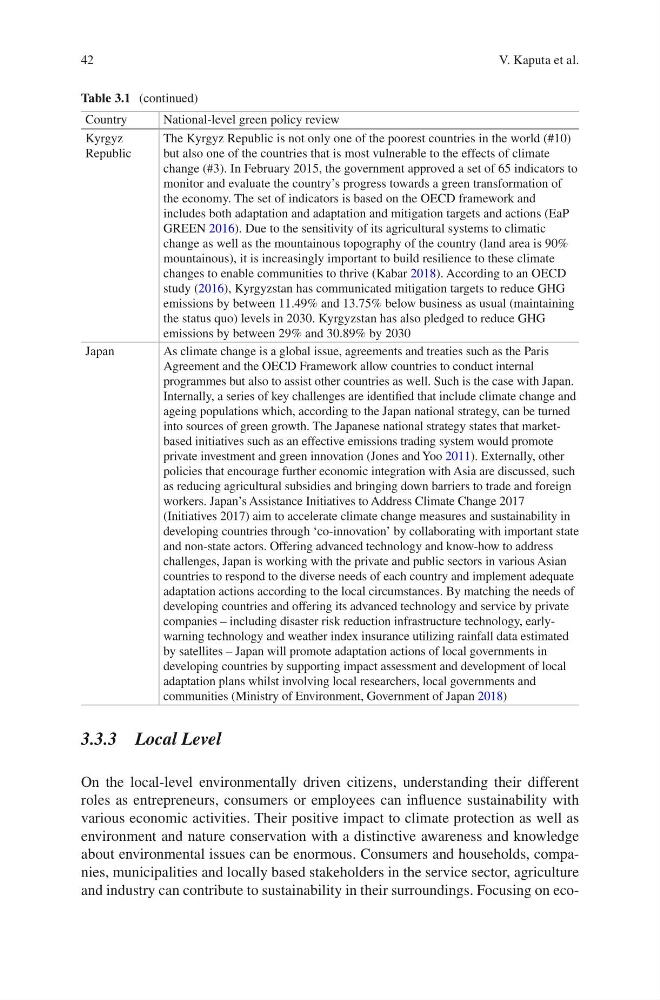
Table 3.1 (continued)
Country
National-level green policy review
Kyrgyz
Republic
The Kyrgyz Republic is not only one of the poorest countries in the world (#10)
but also one of the countries that is most vulnerable to the effects of climate
change (#3). In February 2015, the government approved a set of 65 indicators to
monitor and evaluate the country’s progress towards a green transformation of
the economy. The set of indicators is based on the OECD framework and
includes both adaptation and adaptation and mitigation targets and actions (EaP
GREEN 2016). Due to the sensitivity of its agricultural systems to climatic
change as well as the mountainous topography of the country (land area is 90%
mountainous), it is increasingly important to build resilience to these climate
changes to enable communities to thrive (Kabar 2018). According to an OECD
study (2016), Kyrgyzstan has communicated mitigation targets to reduce GHG
emissions by between 11.49% and 13.75% below business as usual (maintaining
the status quo) levels in 2030. Kyrgyzstan has also pledged to reduce GHG
emissions by between 29% and 30.89% by 2030
Japan
As climate change is a global issue, agreements and treaties such as the Paris
Agreement and the OECD Framework allow countries to conduct internal
programmes but also to assist other countries as well. Such is the case with Japan.
Internally, a series of key challenges are identified that include climate change and
ageing populations which, according to the Japan national strategy, can be turned
into sources of green growth. The Japanese national strategy states that marketbased initiatives such as an effective emissions trading system would promote
private investment and green innovation (Jones and Yoo 2011). Externally, other
policies that encourage further economic integration with Asia are discussed, such
as reducing agricultural subsidies and bringing down barriers to trade and foreign
workers. Japan’s Assistance Initiatives to Address Climate Change 2017
(Initiatives 2017) aim to accelerate climate change measures and sustainability in
developing countries through ‘co-innovation’ by collaborating with important state
and non-state actors. Offering advanced technology and know-how to address
challenges, Japan is working with the private and public sectors in various Asian
countries to respond to the diverse needs of each country and implement adequate
adaptation actions according to the local circumstances. By matching the needs of
developing countries and offering its advanced technology and service by private
companies – including disaster risk reduction infrastructure technology, earlywarning technology and weather index insurance utilizing rainfall data estimated
by satellites – Japan will promote adaptation actions of local governments in
developing countries by supporting impact assessment and development of local
adaptation plans whilst involving local researchers, local governments and
communities (Ministry of Environment, Government of Japan 2018)
3.3.3 Local Level
On the local-level environmentally driven citizens, understanding their different
roles as entrepreneurs, consumers or employees can influence sustainability with
various economic activities. Their positive impact to climate protection as well as
environment and nature conservation with a distinctive awareness and knowledge
about environmental issues can be enormous. Consumers and households, companies, municipalities and locally based stakeholders in the service sector, agriculture
and industry can contribute to sustainability in their surroundings. Focusing on ecoV. Kaputa et al.
Table 3.1 (continued)
Country
National-level green policy review
Kyrgyz
Republic
The Kyrgyz Republic is not only one of the poorest countries in the world (#10)
but also one of the countries that is most vulnerable to the effects of climate
change (#3). In February 2015, the government approved a set of 65 indicators to
monitor and evaluate the country’s progress towards a green transformation of
the economy. The set of indicators is based on the OECD framework and
includes both adaptation and adaptation and mitigation targets and actions (EaP
GREEN 2016). Due to the sensitivity of its agricultural systems to climatic
change as well as the mountainous topography of the country (land area is 90%
mountainous), it is increasingly important to build resilience to these climate
changes to enable communities to thrive (Kabar 2018). According to an OECD
study (2016), Kyrgyzstan has communicated mitigation targets to reduce GHG
emissions by between 11.49% and 13.75% below business as usual (maintaining
the status quo) levels in 2030. Kyrgyzstan has also pledged to reduce GHG
emissions by between 29% and 30.89% by 2030
Japan
As climate change is a global issue, agreements and treaties such as the Paris
Agreement and the OECD Framework allow countries to conduct internal
programmes but also to assist other countries as well. Such is the case with Japan.
Internally, a series of key challenges are identified that include climate change and
ageing populations which, according to the Japan national strategy, can be turned
into sources of green growth. The Japanese national strategy states that marketbased initiatives such as an effective emissions trading system would promote
private investment and green innovation (Jones and Yoo 2011). Externally, other
policies that encourage further economic integration with Asia are discussed, such
as reducing agricultural subsidies and bringing down barriers to trade and foreign
workers. Japan’s Assistance Initiatives to Address Climate Change 2017
(Initiatives 2017) aim to accelerate climate change measures and sustainability in
developing countries through ‘co-innovation’ by collaborating with important state
and non-state actors. Offering advanced technology and know-how to address
challenges, Japan is working with the private and public sectors in various Asian
countries to respond to the diverse needs of each country and implement adequate
adaptation actions according to the local circumstances. By matching the needs of
developing countries and offering its advanced technology and service by private
companies – including disaster risk reduction infrastructure technology, earlywarning technology and weather index insurance utilizing rainfall data estimated
by satellites – Japan will promote adaptation actions of local governments in
developing countries by supporting impact assessment and development of local
adaptation plans whilst involving local researchers, local governments and
communities (Ministry of Environment, Government of Japan 2018)
3.3.3 Local Level
On the local-level environmentally driven citizens, understanding their different
roles as entrepreneurs, consumers or employees can influence sustainability with
various economic activities. Their positive impact to climate protection as well as
environment and nature conservation with a distinctive awareness and knowledge
about environmental issues can be enormous. Consumers and households, companies, municipalities and locally based stakeholders in the service sector, agriculture
and industry can contribute to sustainability in their surroundings. Focusing on ecoV. Kaputa et al.