

41
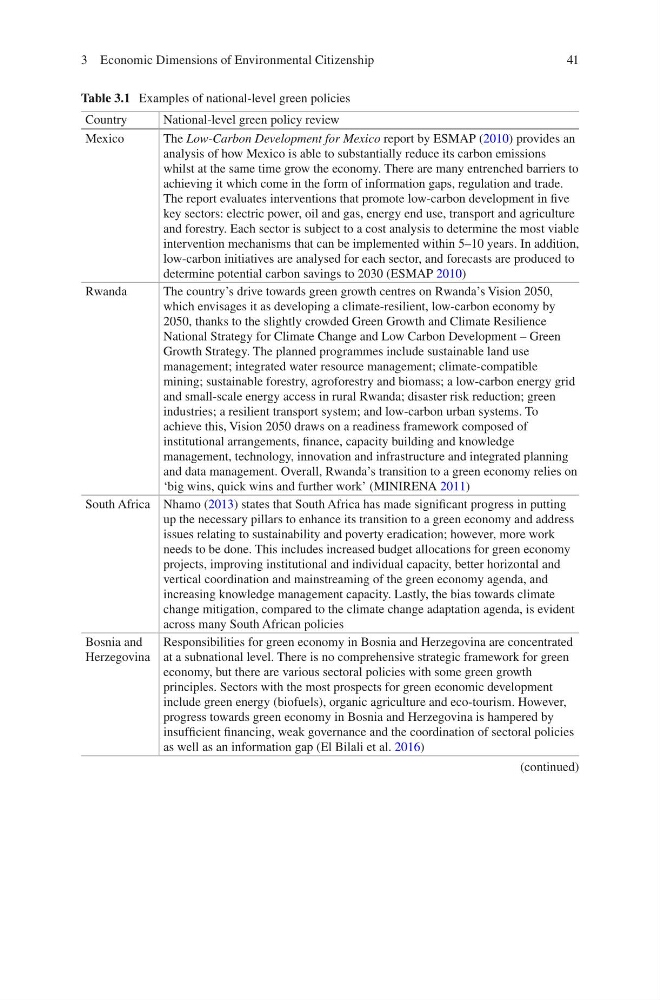
Table 3.1 Examples of national-level green policies
Country
National-level green policy review
Mexico
The Low-Carbon Development for Mexico report by ESMAP (2010) provides an
analysis of how Mexico is able to substantially reduce its carbon emissions
whilst at the same time grow the economy. There are many entrenched barriers to
achieving it which come in the form of information gaps, regulation and trade.
The report evaluates interventions that promote low-carbon development in five
key sectors: electric power, oil and gas, energy end use, transport and agriculture
and forestry. Each sector is subject to a cost analysis to determine the most viable
intervention mechanisms that can be implemented within 5–10 years. In addition,
low-carbon initiatives are analysed for each sector, and forecasts are produced to
determine potential carbon savings to 2030 (ESMAP 2010)
Rwanda
The country’s drive towards green growth centres on Rwanda’s Vision 2050,
which envisages it as developing a climate-resilient, low-carbon economy by
2050, thanks to the slightly crowded Green Growth and Climate Resilience
National Strategy for Climate Change and Low Carbon Development – Green
Growth Strategy. The planned programmes include sustainable land use
management; integrated water resource management; climate-compatible
mining; sustainable forestry, agroforestry and biomass; a low-carbon energy grid
and small-scale energy access in rural Rwanda; disaster risk reduction; green
industries; a resilient transport system; and low-carbon urban systems. To
achieve this, Vision 2050 draws on a readiness framework composed of
institutional arrangements, finance, capacity building and knowledge
management, technology, innovation and infrastructure and integrated planning
and data management. Overall, Rwanda’s transition to a green economy relies on
‘big wins, quick wins and further work’ (MINIRENA 2011)
South Africa Nhamo (2013) states that South Africa has made significant progress in putting
up the necessary pillars to enhance its transition to a green economy and address
issues relating to sustainability and poverty eradication; however, more work
needs to be done. This includes increased budget allocations for green economy
projects, improving institutional and individual capacity, better horizontal and
vertical coordination and mainstreaming of the green economy agenda, and
increasing knowledge management capacity. Lastly, the bias towards climate
change mitigation, compared to the climate change adaptation agenda, is evident
across many South African policies
Bosnia and
Herzegovina
Responsibilities for green economy in Bosnia and Herzegovina are concentrated
at a subnational level. There is no comprehensive strategic framework for green
economy, but there are various sectoral policies with some green growth
principles. Sectors with the most prospects for green economic development
include green energy (biofuels), organic agriculture and eco-tourism. However,
progress towards green economy in Bosnia and Herzegovina is hampered by
insufficient financing, weak governance and the coordination of sectoral policies
as well as an information gap (El Bilali et al. 2016)
(continued)
3 Economic Dimensions of Environmental Citizenship
Table 3.1 Examples of national-level green policies
Country
National-level green policy review
Mexico
The Low-Carbon Development for Mexico report by ESMAP (2010) provides an
analysis of how Mexico is able to substantially reduce its carbon emissions
whilst at the same time grow the economy. There are many entrenched barriers to
achieving it which come in the form of information gaps, regulation and trade.
The report evaluates interventions that promote low-carbon development in five
key sectors: electric power, oil and gas, energy end use, transport and agriculture
and forestry. Each sector is subject to a cost analysis to determine the most viable
intervention mechanisms that can be implemented within 5–10 years. In addition,
low-carbon initiatives are analysed for each sector, and forecasts are produced to
determine potential carbon savings to 2030 (ESMAP 2010)
Rwanda
The country’s drive towards green growth centres on Rwanda’s Vision 2050,
which envisages it as developing a climate-resilient, low-carbon economy by
2050, thanks to the slightly crowded Green Growth and Climate Resilience
National Strategy for Climate Change and Low Carbon Development – Green
Growth Strategy. The planned programmes include sustainable land use
management; integrated water resource management; climate-compatible
mining; sustainable forestry, agroforestry and biomass; a low-carbon energy grid
and small-scale energy access in rural Rwanda; disaster risk reduction; green
industries; a resilient transport system; and low-carbon urban systems. To
achieve this, Vision 2050 draws on a readiness framework composed of
institutional arrangements, finance, capacity building and knowledge
management, technology, innovation and infrastructure and integrated planning
and data management. Overall, Rwanda’s transition to a green economy relies on
‘big wins, quick wins and further work’ (MINIRENA 2011)
South Africa Nhamo (2013) states that South Africa has made significant progress in putting
up the necessary pillars to enhance its transition to a green economy and address
issues relating to sustainability and poverty eradication; however, more work
needs to be done. This includes increased budget allocations for green economy
projects, improving institutional and individual capacity, better horizontal and
vertical coordination and mainstreaming of the green economy agenda, and
increasing knowledge management capacity. Lastly, the bias towards climate
change mitigation, compared to the climate change adaptation agenda, is evident
across many South African policies
Bosnia and
Herzegovina
Responsibilities for green economy in Bosnia and Herzegovina are concentrated
at a subnational level. There is no comprehensive strategic framework for green
economy, but there are various sectoral policies with some green growth
principles. Sectors with the most prospects for green economic development
include green energy (biofuels), organic agriculture and eco-tourism. However,
progress towards green economy in Bosnia and Herzegovina is hampered by
insufficient financing, weak governance and the coordination of sectoral policies
as well as an information gap (El Bilali et al. 2016)
(continued)
3 Economic Dimensions of Environmental Citizenship