

239
individually and collectively) in the frames of a critical active Environmental
Citizenship and inter-generational equality (Hadjichambis et al. 2015).
According to the definition of Education for Environmental Citizenship (ENEC
2018) there are eight main intended outputs of the Education for Environmental
Citizenship in non-hierarchical order:
• Solving current environmental problems.
• Preventing new environmental problems.
• Achieving sustainability.
• Developing healthy relationships with nature.
• Practising environmental rights and duties.
• Identifying structural causes of environmental problems.
• Achieving critical & active engagement and civic participation.
• Promoting Inter- & Intra-generational justice.
Following the definition of Education for Environmental Citizenship, potential
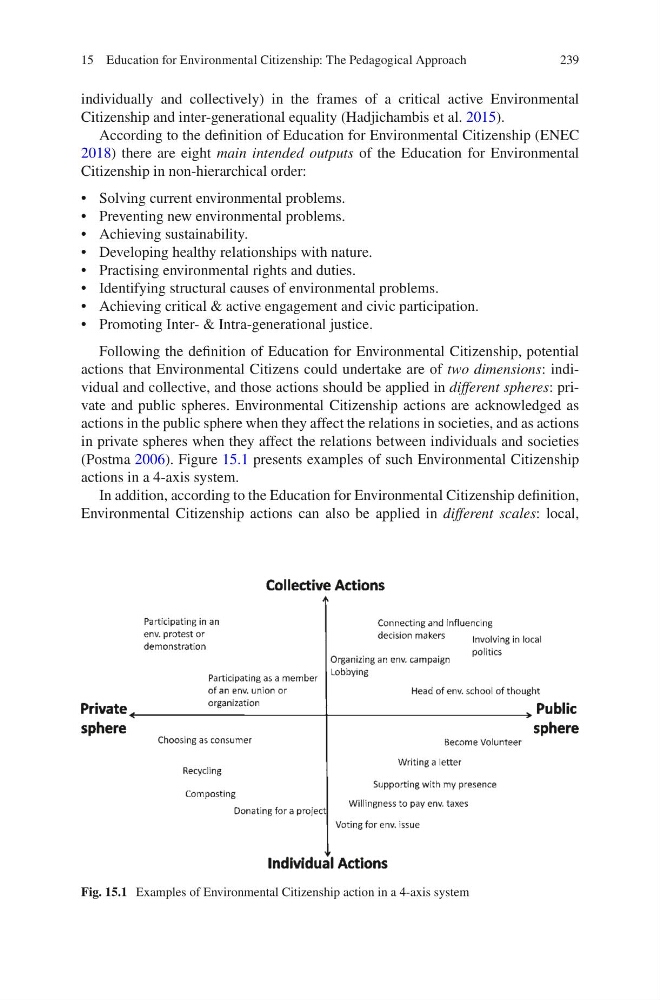
actions that Environmental Citizens could undertake are of two dimensions: individual and collective, and those actions should be applied in different spheres: private and public spheres. Environmental Citizenship actions are acknowledged as
actions in the public sphere when they affect the relations in societies, and as actions
in private spheres when they affect the relations between individuals and societies
(Postma 2006). Figure 15.1 presents examples of such Environmental Citizenship
actions in a 4-axis system.
In addition, according to the Education for Environmental Citizenship definition,
Environmental Citizenship actions can also be applied in different scales: local,
Fig. 15.1 Examples of Environmental Citizenship action in a 4-axis system
15 Education for Environmental Citizenship: The Pedagogical Approach
individually and collectively) in the frames of a critical active Environmental
Citizenship and inter-generational equality (Hadjichambis et al. 2015).
According to the definition of Education for Environmental Citizenship (ENEC
2018) there are eight main intended outputs of the Education for Environmental
Citizenship in non-hierarchical order:
• Solving current environmental problems.
• Preventing new environmental problems.
• Achieving sustainability.
• Developing healthy relationships with nature.
• Practising environmental rights and duties.
• Identifying structural causes of environmental problems.
• Achieving critical & active engagement and civic participation.
• Promoting Inter- & Intra-generational justice.
Following the definition of Education for Environmental Citizenship, potential
actions that Environmental Citizens could undertake are of two dimensions: individual and collective, and those actions should be applied in different spheres: private and public spheres. Environmental Citizenship actions are acknowledged as
actions in the public sphere when they affect the relations in societies, and as actions
in private spheres when they affect the relations between individuals and societies
(Postma 2006). Figure 15.1 presents examples of such Environmental Citizenship
actions in a 4-axis system.
In addition, according to the Education for Environmental Citizenship definition,
Environmental Citizenship actions can also be applied in different scales: local,
Fig. 15.1 Examples of Environmental Citizenship action in a 4-axis system
15 Education for Environmental Citizenship: The Pedagogical Approach