

181
content and through forms of achievement. Course content is organised within areas
of interest (not years of study or academic subjects) and is very diverse in terms of
duration, organisation or teaching. Non-formal education can be characterised by
concrete responses to fixed requirements, clearly defined interests, obtaining
abstractions by extracting knowledge from practical life, minimising teaching
functions, and leaving more room for learning. Non-formal could as such be defined
as the absence of something formal, and non-formal education could then be
interpreted as the absence of formal education. We argue that the absences of the
frameworks and structures of formal education are strengths of non-formal
education, especially when it comes to Education for Environmental Citizenship.
Indeed, non-formal learning provides an opportunity for education to rely on the
natural process of learning, by allowing it to be active, volitional and internally
mediated (Heimlich 1993).
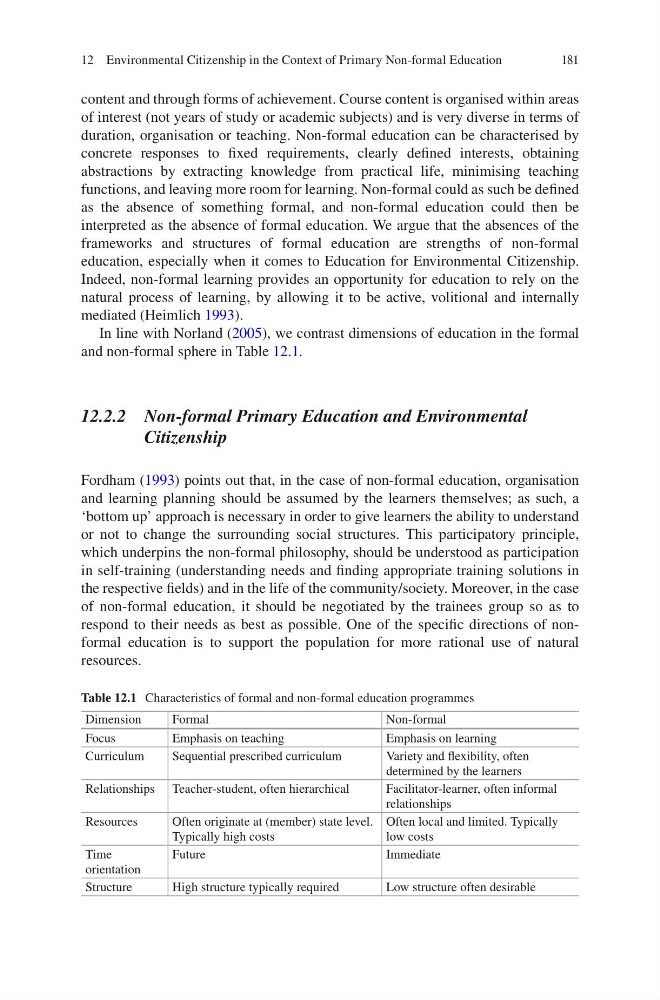
In line with Norland (2005), we contrast dimensions of education in the formal
and non-formal sphere in Table 12.1.
12.2.2 Non-formal Primary Education and Environmental
Citizenship
Fordham (1993) points out that, in the case of non-formal education, organisation
and learning planning should be assumed by the learners themselves; as such, a
‘bottom up’ approach is necessary in order to give learners the ability to understand
or not to change the surrounding social structures. This participatory principle,
which underpins the non-formal philosophy, should be understood as participation
in self-training (understanding needs and finding appropriate training solutions in
the respective fields) and in the life of the community/society. Moreover, in the case
of non-formal education, it should be negotiated by the trainees group so as to
respond to their needs as best as possible. One of the specific directions of nonformal education is to support the population for more rational use of natural
resources.
Table 12.1 Characteristics of formal and non-formal education programmes
Dimension
Formal
Non-formal
Focus
Emphasis on teaching
Emphasis on learning
Curriculum
Sequential prescribed curriculum
Variety and flexibility, often
determined by the learners
Relationships Teacher-student, often hierarchical
Facilitator-learner, often informal
relationships
Resources
Often originate at (member) state level.
Typically high costs
Often local and limited. Typically
low costs
Time
orientation
Future
Immediate
Structure
High structure typically required
Low structure often desirable
12 Environmental Citizenship in the Context of Primary Non-formal Education
content and through forms of achievement. Course content is organised within areas
of interest (not years of study or academic subjects) and is very diverse in terms of
duration, organisation or teaching. Non-formal education can be characterised by
concrete responses to fixed requirements, clearly defined interests, obtaining
abstractions by extracting knowledge from practical life, minimising teaching
functions, and leaving more room for learning. Non-formal could as such be defined
as the absence of something formal, and non-formal education could then be
interpreted as the absence of formal education. We argue that the absences of the
frameworks and structures of formal education are strengths of non-formal
education, especially when it comes to Education for Environmental Citizenship.
Indeed, non-formal learning provides an opportunity for education to rely on the
natural process of learning, by allowing it to be active, volitional and internally
mediated (Heimlich 1993).
In line with Norland (2005), we contrast dimensions of education in the formal
and non-formal sphere in Table 12.1.
12.2.2 Non-formal Primary Education and Environmental
Citizenship
Fordham (1993) points out that, in the case of non-formal education, organisation
and learning planning should be assumed by the learners themselves; as such, a
‘bottom up’ approach is necessary in order to give learners the ability to understand
or not to change the surrounding social structures. This participatory principle,
which underpins the non-formal philosophy, should be understood as participation
in self-training (understanding needs and finding appropriate training solutions in
the respective fields) and in the life of the community/society. Moreover, in the case
of non-formal education, it should be negotiated by the trainees group so as to
respond to their needs as best as possible. One of the specific directions of nonformal education is to support the population for more rational use of natural
resources.
Table 12.1 Characteristics of formal and non-formal education programmes
Dimension
Formal
Non-formal
Focus
Emphasis on teaching
Emphasis on learning
Curriculum
Sequential prescribed curriculum
Variety and flexibility, often
determined by the learners
Relationships Teacher-student, often hierarchical
Facilitator-learner, often informal
relationships
Resources
Often originate at (member) state level.
Typically high costs
Often local and limited. Typically
low costs
Time
orientation
Future
Immediate
Structure
High structure typically required
Low structure often desirable
12 Environmental Citizenship in the Context of Primary Non-formal Education