

131
as change starting points. Leveraging those ‘catalytic’ behaviours would bring
about desired behavioural changes.
A newly emerging area of study, relevant to understanding the determinants of
pro-environmental behaviour and with significant implications for educating for
Environmental Citizenship, is the area of Positive Psychology of Sustainability.
Pro-environmental behaviour is conventionally associated with negativity: negative
feelings (e.g. fear, guilt) that move people to pro-environmental actions or negative
feelings resulting from the efforts, perceived required sacrifices or trade-offs (e.g.
discomfort, inconvenience, time, financial) associated with conducting proenvironmental actions. Positive Psychology of Sustainability focuses on positive
emotions associated with pro-environmental behaviour. It assumes and asserts that
involvement in pro-environmental behaviour has personal psychological benefits
(e.g. a sense of achievement and satisfaction or sense of empowerment) and that
these positive psychological outcomes reinforce pro-environmental behaviour and
therefore lead to a reciprocal reinforcing process (Corral-Verdugo 2012). Kerret
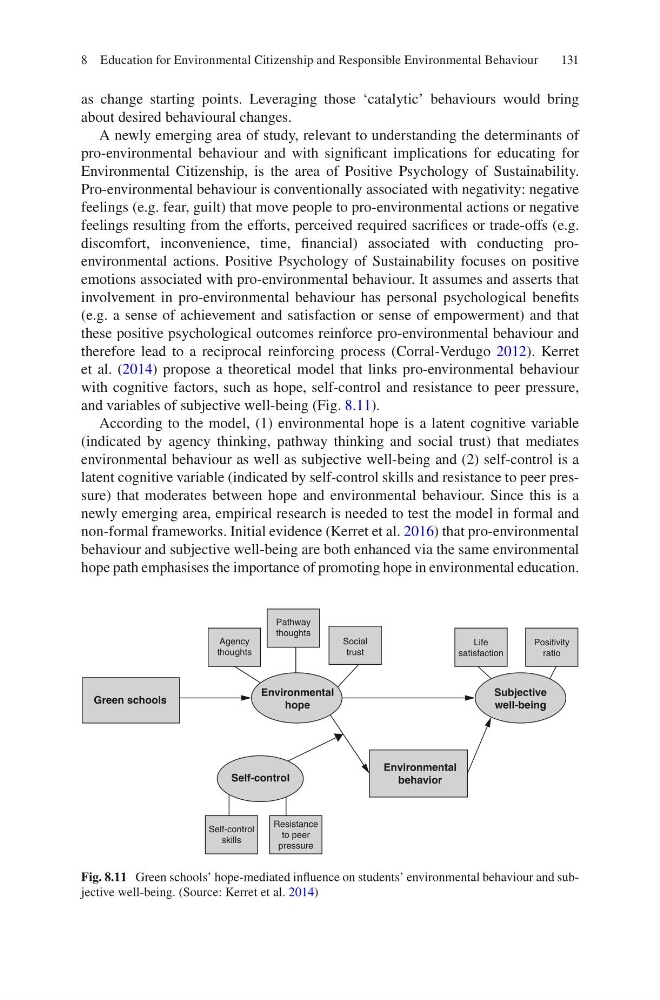
et al. (2014) propose a theoretical model that links pro-environmental behaviour
with cognitive factors, such as hope, self-control and resistance to peer pressure,
and variables of subjective well-being (Fig. 8.11).
According to the model, (1) environmental hope is a latent cognitive variable
(indicated by agency thinking, pathway thinking and social trust) that mediates
environmental behaviour as well as subjective well-being and (2) self-control is a
latent cognitive variable (indicated by self-control skills and resistance to peer pressure) that moderates between hope and environmental behaviour. Since this is a
newly emerging area, empirical research is needed to test the model in formal and
non-formal frameworks. Initial evidence (Kerret et al. 2016) that pro-environmental
behaviour and subjective well-being are both enhanced via the same environmental
hope path emphasises the importance of promoting hope in environmental education.
Agency
thoughts
Green schools
Environmental
hope
Environmental
behavior
Self-control
Subjective
well-being
Resistance
to peer
pressure
Self-control
skills
Pathway
thoughts
Social
trust
Life
satisfaction
Positivity
ratio
Fig. 8.11 Green schools’ hope-mediated influence on students’ environmental behaviour and subjective well-being. (Source: Kerret et al. 2014)
8 Education for Environmental Citizenship and Responsible Environmental Behaviour
as change starting points. Leveraging those ‘catalytic’ behaviours would bring
about desired behavioural changes.
A newly emerging area of study, relevant to understanding the determinants of
pro-environmental behaviour and with significant implications for educating for
Environmental Citizenship, is the area of Positive Psychology of Sustainability.
Pro-environmental behaviour is conventionally associated with negativity: negative
feelings (e.g. fear, guilt) that move people to pro-environmental actions or negative
feelings resulting from the efforts, perceived required sacrifices or trade-offs (e.g.
discomfort, inconvenience, time, financial) associated with conducting proenvironmental actions. Positive Psychology of Sustainability focuses on positive
emotions associated with pro-environmental behaviour. It assumes and asserts that
involvement in pro-environmental behaviour has personal psychological benefits
(e.g. a sense of achievement and satisfaction or sense of empowerment) and that
these positive psychological outcomes reinforce pro-environmental behaviour and
therefore lead to a reciprocal reinforcing process (Corral-Verdugo 2012). Kerret
et al. (2014) propose a theoretical model that links pro-environmental behaviour
with cognitive factors, such as hope, self-control and resistance to peer pressure,
and variables of subjective well-being (Fig. 8.11).
According to the model, (1) environmental hope is a latent cognitive variable
(indicated by agency thinking, pathway thinking and social trust) that mediates
environmental behaviour as well as subjective well-being and (2) self-control is a
latent cognitive variable (indicated by self-control skills and resistance to peer pressure) that moderates between hope and environmental behaviour. Since this is a
newly emerging area, empirical research is needed to test the model in formal and
non-formal frameworks. Initial evidence (Kerret et al. 2016) that pro-environmental
behaviour and subjective well-being are both enhanced via the same environmental
hope path emphasises the importance of promoting hope in environmental education.
Agency
thoughts
Green schools
Environmental
hope
Environmental
behavior
Self-control
Subjective
well-being
Resistance
to peer
pressure
Self-control
skills
Pathway
thoughts
Social
trust
Life
satisfaction
Positivity
ratio
Fig. 8.11 Green schools’ hope-mediated influence on students’ environmental behaviour and subjective well-being. (Source: Kerret et al. 2014)
8 Education for Environmental Citizenship and Responsible Environmental Behaviour