

enables us to realize the connection between the energy gap a between repulsive
states due to mixing and the matrix element of this interaction.
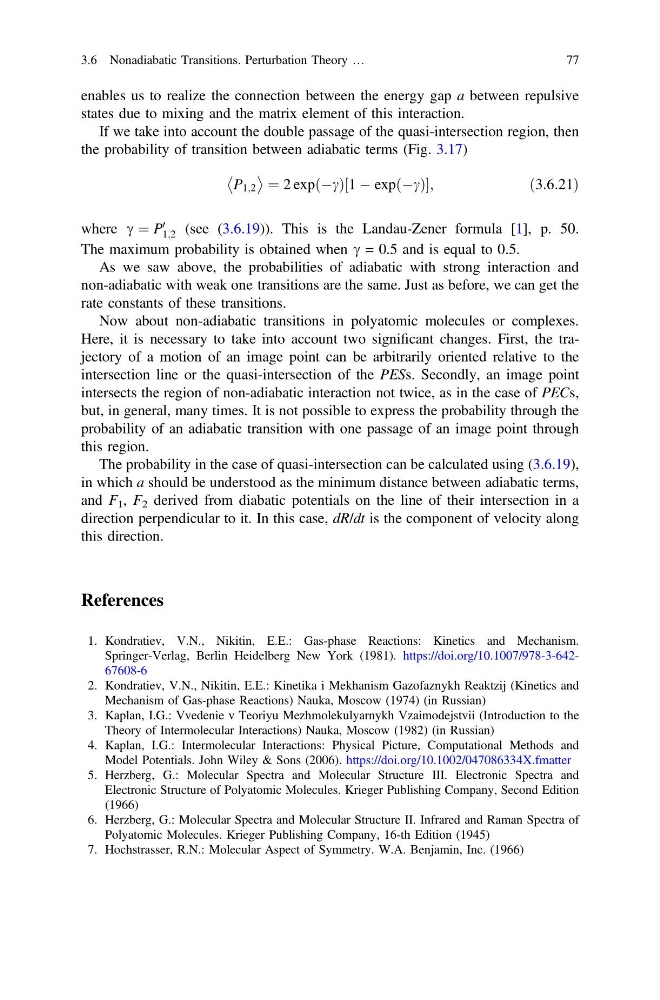
If we take into account the double passage of the quasi-intersection region, then
the probability of transition between adiabatic terms (Fig. 3.17)
P 1;2
¼ 2 expðÀcÞ½1 À expðÀcÞ;
ð3:6:21Þ
where c ¼ P
0
1;2 (see (3.6.19)). This is the Landau-Zener formula [1], p. 50.
The maximum probability is obtained when c = 0.5 and is equal to 0.5.
As we saw above, the probabilities of adiabatic with strong interaction and
non-adiabatic with weak one transitions are the same. Just as before, we can get the
rate constants of these transitions.
Now about non-adiabatic transitions in polyatomic molecules or complexes.
Here, it is necessary to take into account two significant changes. First, the trajectory of a motion of an image point can be arbitrarily oriented relative to the
intersection line or the quasi-intersection of the PESs. Secondly, an image point
intersects the region of non-adiabatic interaction not twice, as in the case of PECs,
but, in general, many times. It is not possible to express the probability through the
probability of an adiabatic transition with one passage of an image point through
this region.
The probability in the case of quasi-intersection can be calculated using (3.6.19),
in which a should be understood as the minimum distance between adiabatic terms,
and F 1 , F 2 derived from diabatic potentials on the line of their intersection in a
direction perpendicular to it. In this case, dR/dt is the component of velocity along
this direction.
References
1. Kondratiev, V.N., Nikitin, E.E.: Gas-phase Reactions: Kinetics and Mechanism.
Springer-Verlag, Berlin Heidelberg New York (1981). https://doi.org/10.1007/978-3-64267608-6
2. Kondratiev, V.N., Nikitin, E.E.: Kinetika i Mekhanism Gazofaznykh Reaktzij (Kinetics and
Mechanism of Gas-phase Reactions) Nauka, Moscow (1974) (in Russian)
3. Kaplan, I.G.: Vvedenie v Teoriyu Mezhmolekulyarnykh Vzaimodejstvii (Introduction to the
Theory of Intermolecular Interactions) Nauka, Moscow (1982) (in Russian)
4. Kaplan, I.G.: Intermolecular Interactions: Physical Picture, Computational Methods and
Model Potentials. John Wiley & Sons (2006). https://doi.org/10.1002/047086334X.fmatter
5. Herzberg, G.: Molecular Spectra and Molecular Structure III. Electronic Spectra and
Electronic Structure of Polyatomic Molecules. Krieger Publishing Company, Second Edition
(1966)
6. Herzberg, G.: Molecular Spectra and Molecular Structure II. Infrared and Raman Spectra of
Polyatomic Molecules. Krieger Publishing Company, 16-th Edition (1945)
7. Hochstrasser, R.N.: Molecular Aspect of Symmetry. W.A. Benjamin, Inc. (1966)
3.6 Nonadiabatic Transitions. Perturbation Theory …
77
states due to mixing and the matrix element of this interaction.
If we take into account the double passage of the quasi-intersection region, then
the probability of transition between adiabatic terms (Fig. 3.17)
P 1;2
¼ 2 expðÀcÞ½1 À expðÀcÞ;
ð3:6:21Þ
where c ¼ P
0
1;2 (see (3.6.19)). This is the Landau-Zener formula [1], p. 50.
The maximum probability is obtained when c = 0.5 and is equal to 0.5.
As we saw above, the probabilities of adiabatic with strong interaction and
non-adiabatic with weak one transitions are the same. Just as before, we can get the
rate constants of these transitions.
Now about non-adiabatic transitions in polyatomic molecules or complexes.
Here, it is necessary to take into account two significant changes. First, the trajectory of a motion of an image point can be arbitrarily oriented relative to the
intersection line or the quasi-intersection of the PESs. Secondly, an image point
intersects the region of non-adiabatic interaction not twice, as in the case of PECs,
but, in general, many times. It is not possible to express the probability through the
probability of an adiabatic transition with one passage of an image point through
this region.
The probability in the case of quasi-intersection can be calculated using (3.6.19),
in which a should be understood as the minimum distance between adiabatic terms,
and F 1 , F 2 derived from diabatic potentials on the line of their intersection in a
direction perpendicular to it. In this case, dR/dt is the component of velocity along
this direction.
References
1. Kondratiev, V.N., Nikitin, E.E.: Gas-phase Reactions: Kinetics and Mechanism.
Springer-Verlag, Berlin Heidelberg New York (1981). https://doi.org/10.1007/978-3-64267608-6
2. Kondratiev, V.N., Nikitin, E.E.: Kinetika i Mekhanism Gazofaznykh Reaktzij (Kinetics and
Mechanism of Gas-phase Reactions) Nauka, Moscow (1974) (in Russian)
3. Kaplan, I.G.: Vvedenie v Teoriyu Mezhmolekulyarnykh Vzaimodejstvii (Introduction to the
Theory of Intermolecular Interactions) Nauka, Moscow (1982) (in Russian)
4. Kaplan, I.G.: Intermolecular Interactions: Physical Picture, Computational Methods and
Model Potentials. John Wiley & Sons (2006). https://doi.org/10.1002/047086334X.fmatter
5. Herzberg, G.: Molecular Spectra and Molecular Structure III. Electronic Spectra and
Electronic Structure of Polyatomic Molecules. Krieger Publishing Company, Second Edition
(1966)
6. Herzberg, G.: Molecular Spectra and Molecular Structure II. Infrared and Raman Spectra of
Polyatomic Molecules. Krieger Publishing Company, 16-th Edition (1945)
7. Hochstrasser, R.N.: Molecular Aspect of Symmetry. W.A. Benjamin, Inc. (1966)
3.6 Nonadiabatic Transitions. Perturbation Theory …
77