

Before we begin to apply the knowledge we have obtained to the quantum–
mechanical description of spontaneous processes, energy exchange, and chemical
reactions, we will get acquainted with the modern quantum–mechanical concepts of
the nature of intermolecular interactions.
3.3 Intermolecular Interactions. Types of Intermolecular
Interactions
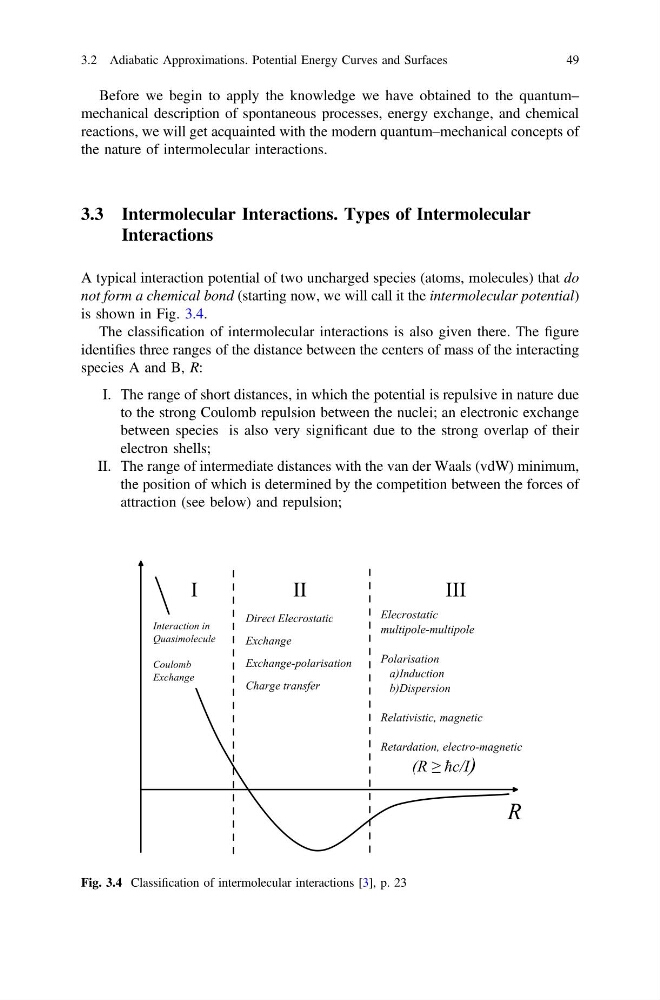
A typical interaction potential of two uncharged species (atoms, molecules) that do
not form a chemical bond (starting now, we will call it the intermolecular potential)
is shown in Fig. 3.4.
The classification of intermolecular interactions is also given there. The figure
identifies three ranges of the distance between the centers of mass of the interacting
species A and B, R:
I. The range of short distances, in which the potential is repulsive in nature due
to the strong Coulomb repulsion between the nuclei; an electronic exchange
between species is also very significant due to the strong overlap of their
electron shells;
II. The range of intermediate distances with the van der Waals (vdW) minimum,
the position of which is determined by the competition between the forces of
attraction (see below) and repulsion;
Fig. 3.4 Classification of intermolecular interactions [3], p. 23
3.2 Adiabatic Approximations. Potential Energy Curves and Surfaces
49
mechanical description of spontaneous processes, energy exchange, and chemical
reactions, we will get acquainted with the modern quantum–mechanical concepts of
the nature of intermolecular interactions.
3.3 Intermolecular Interactions. Types of Intermolecular
Interactions
A typical interaction potential of two uncharged species (atoms, molecules) that do
not form a chemical bond (starting now, we will call it the intermolecular potential)
is shown in Fig. 3.4.
The classification of intermolecular interactions is also given there. The figure
identifies three ranges of the distance between the centers of mass of the interacting
species A and B, R:
I. The range of short distances, in which the potential is repulsive in nature due
to the strong Coulomb repulsion between the nuclei; an electronic exchange
between species is also very significant due to the strong overlap of their
electron shells;
II. The range of intermediate distances with the van der Waals (vdW) minimum,
the position of which is determined by the competition between the forces of
attraction (see below) and repulsion;
Fig. 3.4 Classification of intermolecular interactions [3], p. 23
3.2 Adiabatic Approximations. Potential Energy Curves and Surfaces
49