

Equation (3.1.16) represents the detailed balance principle. It is equivalent to
actually asserting that the various degrees of freedom are equally probable, which
we have discussed, expressing the equilibrium constant via partition functions (see
Sect. 2.2). Using the detailed balance principle, one can obtain expressions for the
ratio of the cross-sections of direct and inverse processes or their rate constants,
taking into account the Boltzmann factor and statistical weights of the species.
If the species velocity distribution is Maxwellian (this is again a case of local
thermodynamic equilibrium over translational degrees of freedom), the ratio of
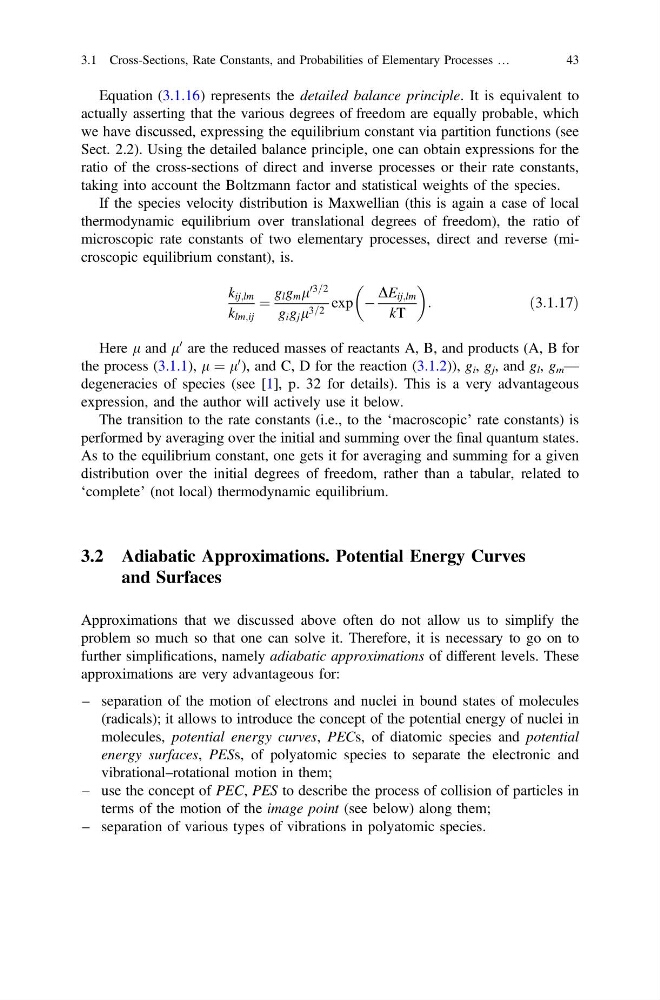
microscopic rate constants of two elementary processes, direct and reverse (microscopic equilibrium constant), is.
k ij;lm
k lm;ij
¼
g l g m l
03=2
g i g j l 3=2 exp À
DE ij;lm
kT
:
ð3:1:17Þ
Here l and l
0 are the reduced masses of reactants A, B, and products (A, B for
the process (3.1.1), l ¼ l
0 ), and C, D for the reaction (3.1.2)), g i , g j , and g l , g m —
degeneracies of species (see [1], p. 32 for details). This is a very advantageous
expression, and the author will actively use it below.
The transition to the rate constants (i.e., to the ‘macroscopic’ rate constants) is
performed by averaging over the initial and summing over the final quantum states.
As to the equilibrium constant, one gets it for averaging and summing for a given
distribution over the initial degrees of freedom, rather than a tabular, related to
‘complete’ (not local) thermodynamic equilibrium.
3.2 Adiabatic Approximations. Potential Energy Curves
and Surfaces
Approximations that we discussed above often do not allow us to simplify the
problem so much so that one can solve it. Therefore, it is necessary to go on to
further simplifications, namely adiabatic approximations of different levels. These
approximations are very advantageous for:
– separation of the motion of electrons and nuclei in bound states of molecules
(radicals); it allows to introduce the concept of the potential energy of nuclei in
molecules, potential energy curves, PECs, of diatomic species and potential
energy surfaces, PESs, of polyatomic species to separate the electronic and
vibrational–rotational motion in them;
– use the concept of PEC, PES to describe the process of collision of particles in
terms of the motion of the image point (see below) along them;
– separation of various types of vibrations in polyatomic species.
3.1 Cross-Sections, Rate Constants, and Probabilities of Elementary Processes …
43
actually asserting that the various degrees of freedom are equally probable, which
we have discussed, expressing the equilibrium constant via partition functions (see
Sect. 2.2). Using the detailed balance principle, one can obtain expressions for the
ratio of the cross-sections of direct and inverse processes or their rate constants,
taking into account the Boltzmann factor and statistical weights of the species.
If the species velocity distribution is Maxwellian (this is again a case of local
thermodynamic equilibrium over translational degrees of freedom), the ratio of
microscopic rate constants of two elementary processes, direct and reverse (microscopic equilibrium constant), is.
k ij;lm
k lm;ij
¼
g l g m l
03=2
g i g j l 3=2 exp À
DE ij;lm
kT
:
ð3:1:17Þ
Here l and l
0 are the reduced masses of reactants A, B, and products (A, B for
the process (3.1.1), l ¼ l
0 ), and C, D for the reaction (3.1.2)), g i , g j , and g l , g m —
degeneracies of species (see [1], p. 32 for details). This is a very advantageous
expression, and the author will actively use it below.
The transition to the rate constants (i.e., to the ‘macroscopic’ rate constants) is
performed by averaging over the initial and summing over the final quantum states.
As to the equilibrium constant, one gets it for averaging and summing for a given
distribution over the initial degrees of freedom, rather than a tabular, related to
‘complete’ (not local) thermodynamic equilibrium.
3.2 Adiabatic Approximations. Potential Energy Curves
and Surfaces
Approximations that we discussed above often do not allow us to simplify the
problem so much so that one can solve it. Therefore, it is necessary to go on to
further simplifications, namely adiabatic approximations of different levels. These
approximations are very advantageous for:
– separation of the motion of electrons and nuclei in bound states of molecules
(radicals); it allows to introduce the concept of the potential energy of nuclei in
molecules, potential energy curves, PECs, of diatomic species and potential
energy surfaces, PESs, of polyatomic species to separate the electronic and
vibrational–rotational motion in them;
– use the concept of PEC, PES to describe the process of collision of particles in
terms of the motion of the image point (see below) along them;
– separation of various types of vibrations in polyatomic species.
3.1 Cross-Sections, Rate Constants, and Probabilities of Elementary Processes …
43