

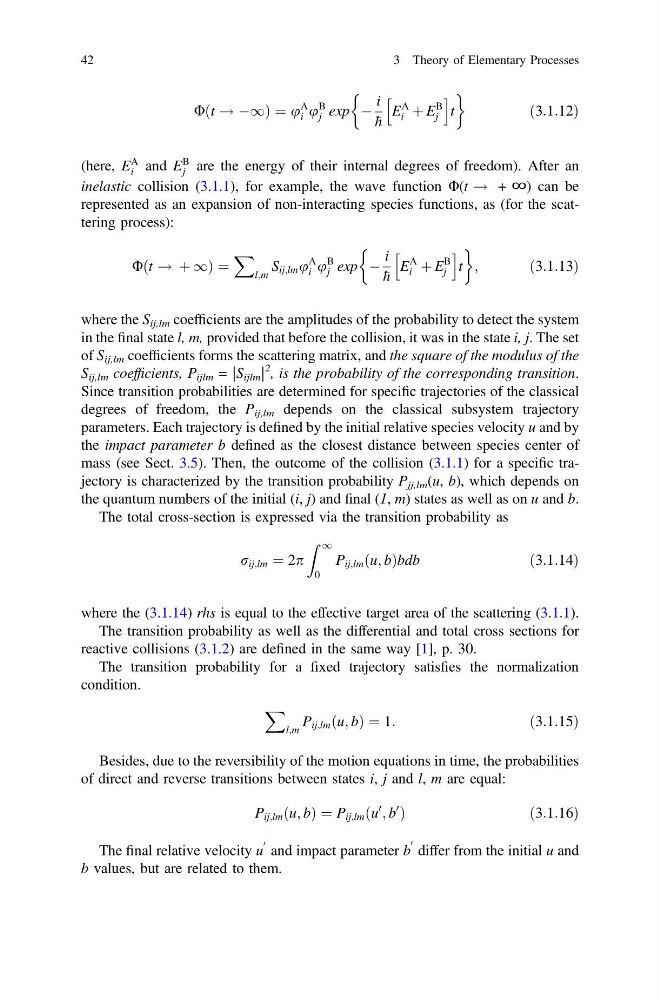
Uðt ! À1Þ ¼ u
A
i u
B
j exp À
i
h
E
A
i þ E
B
j
h
i
t
&
'
ð3:1:12Þ
(here, E
A
i and E
B
j are the energy of their internal degrees of freedom). After an
inelastic collision (3.1.1), for example, the wave function U(t ! + ∞) can be
represented as an expansion of non-interacting species functions, as (for the scattering process):
Uðt ! þ 1Þ ¼
X
l;m
S ij;lm u
A
i u
B
j exp À
i
h
E
A
i þ E
B
j
h
i
t
&
'
;
ð3:1:13Þ
where the S ij,lm coefficients are the amplitudes of the probability to detect the system
in the final state l, m, provided that before the collision, it was in the state i, j. The set
of S ij,lm coefficients forms the scattering matrix, and the square of the modulus of the
S ij,lm coefficients, P ijlm = |S ijlm |
2
, is the probability of the corresponding transition.
Since transition probabilities are determined for specific trajectories of the classical
degrees of freedom, the P ij,lm depends on the classical subsystem trajectory
parameters. Each trajectory is defined by the initial relative species velocity u and by
the impact parameter b defined as the closest distance between species center of
mass (see Sect. 3.5). Then, the outcome of the collision (3.1.1) for a specific trajectory is characterized by the transition probability P jj,lm (u, b), which depends on
the quantum numbers of the initial (i, j) and final (1, m) states as well as on u and b.
The total cross-section is expressed via the transition probability as
r ij;lm ¼ 2p
Z 1
0
P ij;lm ðu; bÞbdb
ð3:1:14Þ
where the (3.1.14) rhs is equal to the effective target area of the scattering (3.1.1).
The transition probability as well as the differential and total cross sections for
reactive collisions (3.1.2) are defined in the same way [1], p. 30.
The transition probability for a fixed trajectory satisfies the normalization
condition.
X
l;m
P ij;lm ðu; bÞ ¼ 1:
ð3:1:15Þ
Besides, due to the reversibility of the motion equations in time, the probabilities
of direct and reverse transitions between states i, j and l, m are equal:
P ij;lm ðu; bÞ ¼ P ij;lm u
0
; b
0
ð
Þ
ð3:1:16Þ
The final relative velocity u
0 and impact parameter b
0 differ from the initial u and
b values, but are related to them.
42
3 Theory of Elementary Processes
A
i u
B
j exp À
i
h
E
A
i þ E
B
j
h
i
t
&
'
ð3:1:12Þ
(here, E
A
i and E
B
j are the energy of their internal degrees of freedom). After an
inelastic collision (3.1.1), for example, the wave function U(t ! + ∞) can be
represented as an expansion of non-interacting species functions, as (for the scattering process):
Uðt ! þ 1Þ ¼
X
l;m
S ij;lm u
A
i u
B
j exp À
i
h
E
A
i þ E
B
j
h
i
t
&
'
;
ð3:1:13Þ
where the S ij,lm coefficients are the amplitudes of the probability to detect the system
in the final state l, m, provided that before the collision, it was in the state i, j. The set
of S ij,lm coefficients forms the scattering matrix, and the square of the modulus of the
S ij,lm coefficients, P ijlm = |S ijlm |
2
, is the probability of the corresponding transition.
Since transition probabilities are determined for specific trajectories of the classical
degrees of freedom, the P ij,lm depends on the classical subsystem trajectory
parameters. Each trajectory is defined by the initial relative species velocity u and by
the impact parameter b defined as the closest distance between species center of
mass (see Sect. 3.5). Then, the outcome of the collision (3.1.1) for a specific trajectory is characterized by the transition probability P jj,lm (u, b), which depends on
the quantum numbers of the initial (i, j) and final (1, m) states as well as on u and b.
The total cross-section is expressed via the transition probability as
r ij;lm ¼ 2p
Z 1
0
P ij;lm ðu; bÞbdb
ð3:1:14Þ
where the (3.1.14) rhs is equal to the effective target area of the scattering (3.1.1).
The transition probability as well as the differential and total cross sections for
reactive collisions (3.1.2) are defined in the same way [1], p. 30.
The transition probability for a fixed trajectory satisfies the normalization
condition.
X
l;m
P ij;lm ðu; bÞ ¼ 1:
ð3:1:15Þ
Besides, due to the reversibility of the motion equations in time, the probabilities
of direct and reverse transitions between states i, j and l, m are equal:
P ij;lm ðu; bÞ ¼ P ij;lm u
0
; b
0
ð
Þ
ð3:1:16Þ
The final relative velocity u
0 and impact parameter b
0 differ from the initial u and
b values, but are related to them.
42
3 Theory of Elementary Processes