

to the
A þ B þ M ! AB þ M
one.
The author wishes to note that this behavior of the dependence of the recombination
rate constant is typical for all recombination processes, and the values of the limits of
small and large pressures naturally depend on the complex lifetime, that is, mainly on
the number of atoms in it, and the magnitude of the stabilization rate constant; however, it is usually close to gas-kinetic. The same behavior is also characteristic of
termolecular recombination accompanied by radiation (see Sect. 7.2.3).
Problems
1. What is the physical meaning of the rate constant of a unimolecular process?
2. What is the physical meaning of the rate constant of a bimolecular process?
3. What is the physical meaning of the rate constant of the termolecular process?
4. Can the reaction order and reagent order be zero or fractional? Give examples.
5. The rate constant is 3 Á 10
14
∙exp(−4.8 (KJ/mol)/RT) cm
3
=mol Á 1.
Count the value of the constant in cm
3 /speciesÁs at T = 293 K.
6. The rate constant is 8 Á 10
14
∙exp(4.8 (KJ/mol)/RT) cm
6
=mol
2
Á s. Count the
value of the constant in cm
6 /species
2
∙s at T = 293 K.
7. What is the difference between the concepts of ‘stoihiometric’ and ‘kinetic
(real)’ reaction order?
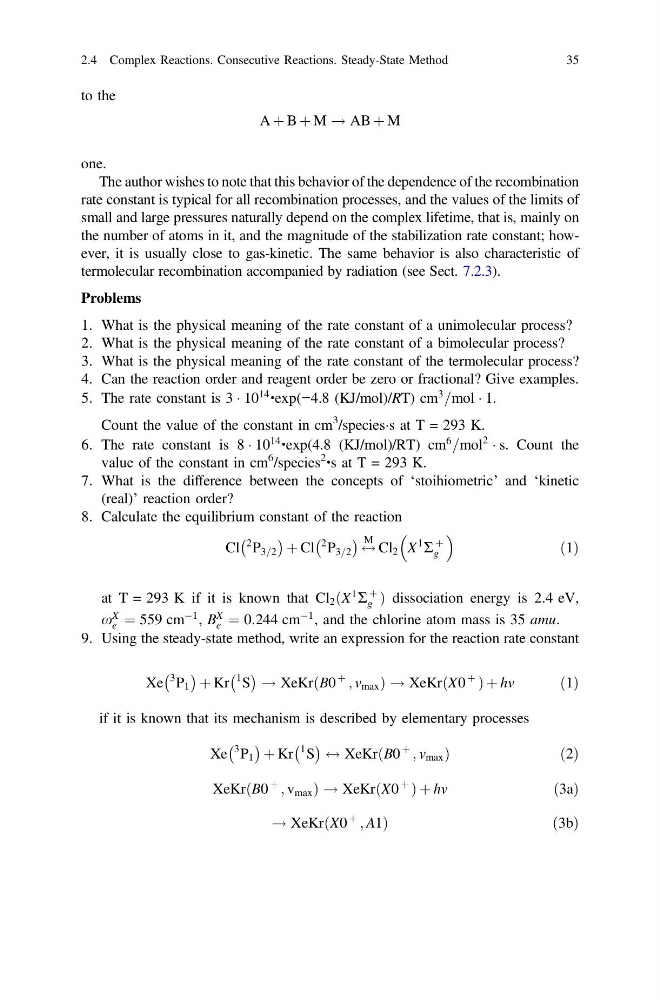
8. Calculate the equilibrium constant of the reaction
Cl
2 P 3=2
À
Á þ Cl
2 P 3=2
À
Á $
M Cl 2 X
1 R
þ
g
ð1Þ
at T = 293 K if it is known that Cl 2 ðX
1 R
þ
g Þ dissociation energy is 2.4 eV,
x
X
e ¼ 559 cm
À1 , B
X
e ¼ 0:244 cm
À1 , and the chlorine atom mass is 35 amu.
9. Using the steady-state method, write an expression for the reaction rate constant
Xe
3 P 1
À Á þ Kr
1 S
À Á ! XeKr B0
þ
; v max
ð
Þ!XeKr X0
þ
ð
Þþhv
ð1Þ
if it is known that its mechanism is described by elementary processes
Xe
3 P 1
À Á þ Kr
1 S
À Á $ XeKr B0
þ
; v max
ð
Þ
ð 2Þ
XeKr B0
þ
; v max
ð
Þ!XeKr X0
þ
ð
Þþhv
ð3aÞ
! XeKr X0
þ
; A1
ð
Þ
ð 3bÞ
2.4 Complex Reactions. Consecutive Reactions. Steady-State Method
35
A þ B þ M ! AB þ M
one.
The author wishes to note that this behavior of the dependence of the recombination
rate constant is typical for all recombination processes, and the values of the limits of
small and large pressures naturally depend on the complex lifetime, that is, mainly on
the number of atoms in it, and the magnitude of the stabilization rate constant; however, it is usually close to gas-kinetic. The same behavior is also characteristic of
termolecular recombination accompanied by radiation (see Sect. 7.2.3).
Problems
1. What is the physical meaning of the rate constant of a unimolecular process?
2. What is the physical meaning of the rate constant of a bimolecular process?
3. What is the physical meaning of the rate constant of the termolecular process?
4. Can the reaction order and reagent order be zero or fractional? Give examples.
5. The rate constant is 3 Á 10
14
∙exp(−4.8 (KJ/mol)/RT) cm
3
=mol Á 1.
Count the value of the constant in cm
3 /speciesÁs at T = 293 K.
6. The rate constant is 8 Á 10
14
∙exp(4.8 (KJ/mol)/RT) cm
6
=mol
2
Á s. Count the
value of the constant in cm
6 /species
2
∙s at T = 293 K.
7. What is the difference between the concepts of ‘stoihiometric’ and ‘kinetic
(real)’ reaction order?
8. Calculate the equilibrium constant of the reaction
Cl
2 P 3=2
À
Á þ Cl
2 P 3=2
À
Á $
M Cl 2 X
1 R
þ
g
ð1Þ
at T = 293 K if it is known that Cl 2 ðX
1 R
þ
g Þ dissociation energy is 2.4 eV,
x
X
e ¼ 559 cm
À1 , B
X
e ¼ 0:244 cm
À1 , and the chlorine atom mass is 35 amu.
9. Using the steady-state method, write an expression for the reaction rate constant
Xe
3 P 1
À Á þ Kr
1 S
À Á ! XeKr B0
þ
; v max
ð
Þ!XeKr X0
þ
ð
Þþhv
ð1Þ
if it is known that its mechanism is described by elementary processes
Xe
3 P 1
À Á þ Kr
1 S
À Á $ XeKr B0
þ
; v max
ð
Þ
ð 2Þ
XeKr B0
þ
; v max
ð
Þ!XeKr X0
þ
ð
Þþhv
ð3aÞ
! XeKr X0
þ
; A1
ð
Þ
ð 3bÞ
2.4 Complex Reactions. Consecutive Reactions. Steady-State Method
35