

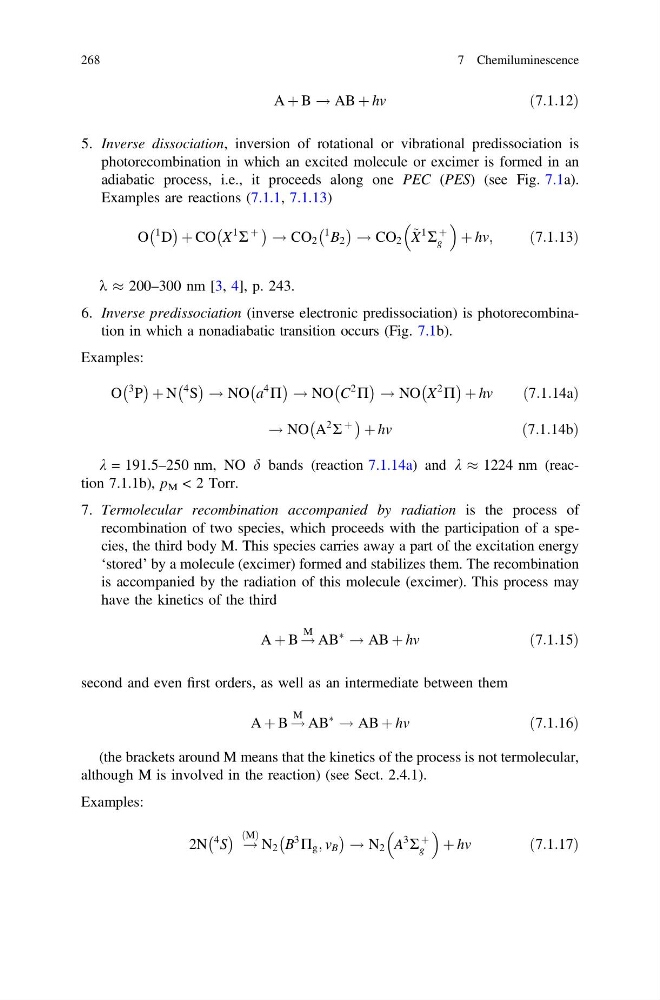
A þ B ! AB þ hv
ð7:1:12Þ
5. Inverse dissociation, inversion of rotational or vibrational predissociation is
photorecombination in which an excited molecule or excimer is formed in an
adiabatic process, i.e., it proceeds along one PEC (PES) (see Fig. 7.1a).
Examples are reactions (7.1.1, 7.1.13)
O
1 D
À Á þ CO X
1 R
þ
À
Á ! CO 2
1
B 2
À Á ! CO 2 ~
X
1 R
þ
g
þ hv;
ð7:1:13Þ
k % 200–300 nm [3, 4], p. 243.
6. Inverse predissociation (inverse electronic predissociation) is photorecombination in which a nonadiabatic transition occurs (Fig. 7.1b).
Examples:
O
3 P
À Á þ N
4 S
À Á ! NO a
4 P
À
Á ! NO C
2 P
À
Á ! NO X
2 P
À
Á þ hv
ð7:1:14aÞ
! NO A
2 R
þ
À
Á þ hv
ð7:1:14bÞ
k = 191.5–250 nm, NO d bands (reaction 7.1.14a) and k % 1224 nm (reaction 7.1.1b), p M < 2 Torr.
7. Termolecular recombination accompanied by radiation is the process of
recombination of two species, which proceeds with the participation of a species, the third body M. This species carries away a part of the excitation energy
‘stored’ by a molecule (excimer) formed and stabilizes them. The recombination
is accompanied by the radiation of this molecule (excimer). This process may
have the kinetics of the third
A þ B !
M AB
Ã
! AB þ hv
ð7:1:15Þ
second and even first orders, as well as an intermediate between them
A þ B !
M AB
Ã
! AB þ hv
ð7:1:16Þ
(the brackets around M means that the kinetics of the process is not termolecular,
although M is involved in the reaction) (see Sect. 2.4.1).
Examples:
2N
4
S
À Á !
ðMÞ
N 2 B
3 P g ; v B
À
Á ! N 2 A
3 R
þ
g
þ hv
ð7:1:17Þ
268
7 Chemiluminescence
ð7:1:12Þ
5. Inverse dissociation, inversion of rotational or vibrational predissociation is
photorecombination in which an excited molecule or excimer is formed in an
adiabatic process, i.e., it proceeds along one PEC (PES) (see Fig. 7.1a).
Examples are reactions (7.1.1, 7.1.13)
O
1 D
À Á þ CO X
1 R
þ
À
Á ! CO 2
1
B 2
À Á ! CO 2 ~
X
1 R
þ
g
þ hv;
ð7:1:13Þ
k % 200–300 nm [3, 4], p. 243.
6. Inverse predissociation (inverse electronic predissociation) is photorecombination in which a nonadiabatic transition occurs (Fig. 7.1b).
Examples:
O
3 P
À Á þ N
4 S
À Á ! NO a
4 P
À
Á ! NO C
2 P
À
Á ! NO X
2 P
À
Á þ hv
ð7:1:14aÞ
! NO A
2 R
þ
À
Á þ hv
ð7:1:14bÞ
k = 191.5–250 nm, NO d bands (reaction 7.1.14a) and k % 1224 nm (reaction 7.1.1b), p M < 2 Torr.
7. Termolecular recombination accompanied by radiation is the process of
recombination of two species, which proceeds with the participation of a species, the third body M. This species carries away a part of the excitation energy
‘stored’ by a molecule (excimer) formed and stabilizes them. The recombination
is accompanied by the radiation of this molecule (excimer). This process may
have the kinetics of the third
A þ B !
M AB
Ã
! AB þ hv
ð7:1:15Þ
second and even first orders, as well as an intermediate between them
A þ B !
M AB
Ã
! AB þ hv
ð7:1:16Þ
(the brackets around M means that the kinetics of the process is not termolecular,
although M is involved in the reaction) (see Sect. 2.4.1).
Examples:
2N
4
S
À Á !
ðMÞ
N 2 B
3 P g ; v B
À
Á ! N 2 A
3 R
þ
g
þ hv
ð7:1:17Þ
268
7 Chemiluminescence