

H
2 S
À Á þ Cl 2 X
1 R
þ
g
! HCl X
1 R
þ
; v X
À
Á þ Cl
2 P J
À Á
ð7:1:9Þ
I 2 B0
þ
u
À
Á þ F 2 X
1 R
þ
g
! IF B0
þ
; v B
ð
ÞþIF X0
þ
; v X
ð
Þ
ð 7:1:10Þ
O 3 ~
X
1 A 1
À
Á þ NO X
2 P
À
Á ! NO 2
1
B 2 ;
2
B 2
À
Á þ O 2 X
3 R
À
g
ð7:1:11Þ
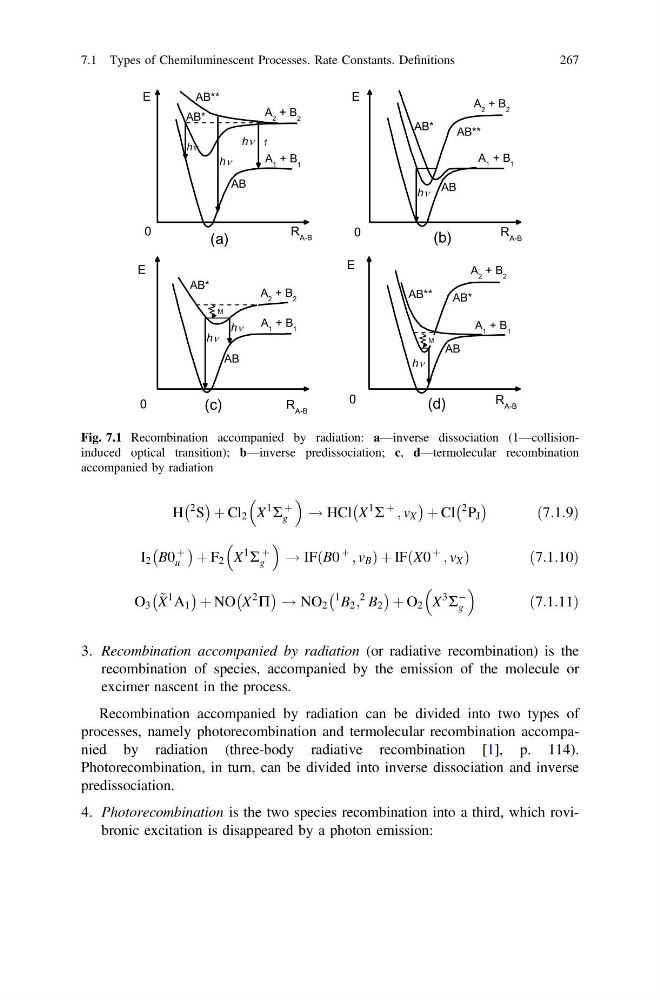
3. Recombination accompanied by radiation (or radiative recombination) is the
recombination of species, accompanied by the emission of the molecule or
excimer nascent in the process.
Recombination accompanied by radiation can be divided into two types of
processes, namely photorecombination and termolecular recombination accompanied by radiation (three-body radiative recombination [1], p. 114).
Photorecombination, in turn, can be divided into inverse dissociation and inverse
predissociation.
4. Photorecombination is the two species recombination into a third, which rovibronic excitation is disappeared by a photon emission:
(a)
(b)
(c)
(d)
Fig. 7.1 Recombination accompanied by radiation: a—inverse dissociation (1—collisioninduced optical transition); b—inverse predissociation; c, d—termolecular recombination
accompanied by radiation
7.1 Types of Chemiluminescent Processes. Rate Constants. Definitions
267
2 S
À Á þ Cl 2 X
1 R
þ
g
! HCl X
1 R
þ
; v X
À
Á þ Cl
2 P J
À Á
ð7:1:9Þ
I 2 B0
þ
u
À
Á þ F 2 X
1 R
þ
g
! IF B0
þ
; v B
ð
ÞþIF X0
þ
; v X
ð
Þ
ð 7:1:10Þ
O 3 ~
X
1 A 1
À
Á þ NO X
2 P
À
Á ! NO 2
1
B 2 ;
2
B 2
À
Á þ O 2 X
3 R
À
g
ð7:1:11Þ
3. Recombination accompanied by radiation (or radiative recombination) is the
recombination of species, accompanied by the emission of the molecule or
excimer nascent in the process.
Recombination accompanied by radiation can be divided into two types of
processes, namely photorecombination and termolecular recombination accompanied by radiation (three-body radiative recombination [1], p. 114).
Photorecombination, in turn, can be divided into inverse dissociation and inverse
predissociation.
4. Photorecombination is the two species recombination into a third, which rovibronic excitation is disappeared by a photon emission:
(a)
(b)
(c)
(d)
Fig. 7.1 Recombination accompanied by radiation: a—inverse dissociation (1—collisioninduced optical transition); b—inverse predissociation; c, d—termolecular recombination
accompanied by radiation
7.1 Types of Chemiluminescent Processes. Rate Constants. Definitions
267