

6.4.2 Rg 2 Hal 2 Clusters
6.4.2.1 The Ne 2 Br 2 Clusters
The authors of [133] have studied the Ne 2 Br 2 (B, v B = 16–23) cluster VP utilizing
time- and frequency-resolved pump-probe spectroscopy. After optical population of
the cluster, the authors have followed the flow of the Br 2 (B, v B )vibrational energy to
the vdW modes in real time by recording the time-dependent behavior of the
Ne 2 Br 2 (B, v B ), the NeBr 2 (B, v B -m) intermediates, and the Br 2 (B, v B -n) VP products.
The only NeBr 2 (B, v B -1) intermediate has been observed for the Ne 2 Br 2 (B,
v B = 16-18) clusters, and the majority of the final VP products product is Br 2 (B, v B -
2), i.e., the decay happens via two sequential direct VP steps. The authors have
fitted the time-dependent behavior of these species to the sequential Ne 2 Br 2 (B, v B )
!
s 1 NeBr 2 (B, v B -m) !
s 2 Br 2 (B, v B -n) mechanism and extracted time constants for
each step: s 1 = 32 ps, s 2 = 82 ps for Ne 2 Br 2 (B, v B = 17, and decrease with v B . The
decay occurs via multiple pathways for higher v B levels. The Br 2 (B, v B -Dv B ),
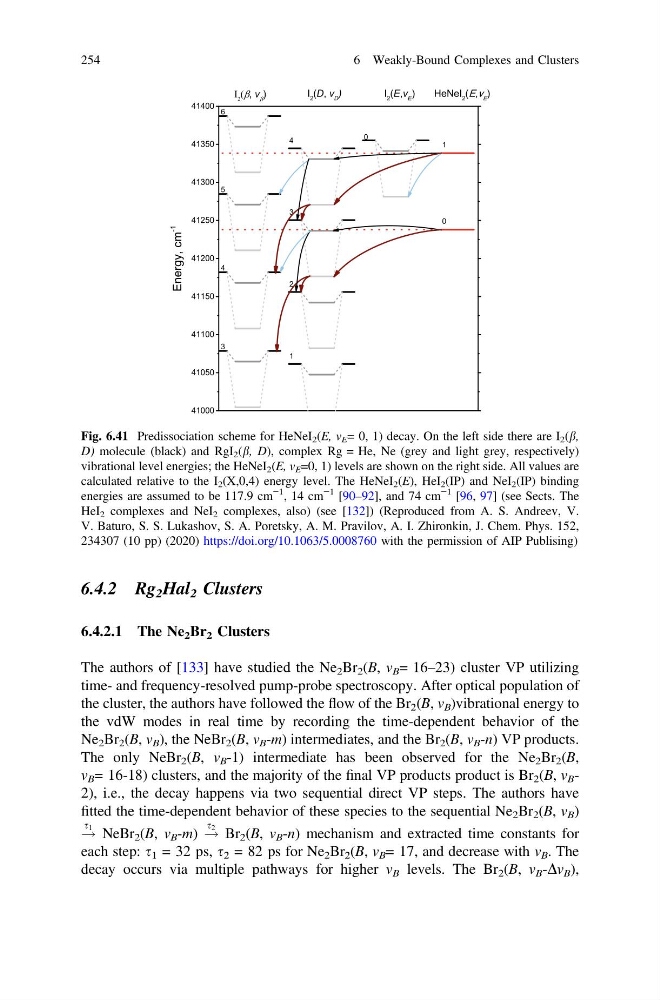
Fig. 6.41 Predissociation scheme for HeNeI 2 (E, v E = 0, 1) decay. On the left side there are I 2 (b,
D) molecule (black) and RgI 2 (b, D), complex Rg = He, Ne (grey and light grey, respectively)
vibrational level energies; the HeNeI 2 (E, v E =0, 1) levels are shown on the right side. All values are
calculated relative to the I 2 (X,0,4) energy level. The HeNeI 2 (E), HeI 2 (IP) and NeI 2 (IP) binding
energies are assumed to be 117.9 cm
−1
, 14 cm
−1 [90–92], and 74 cm
−1 [96, 97] (see Sects. The
HeI 2 complexes and NeI 2 complexes, also) (see [132]) (Reproduced from A. S. Andreev, V.
V. Baturo, S. S. Lukashov, S. A. Poretsky, A. M. Pravilov, A. I. Zhironkin, J. Chem. Phys. 152,
234307 (10 pp) (2020) https://doi.org/10.1063/5.0008760 with the permission of AIP Publising)
254
6 Weakly-Bound Complexes and Clusters
6.4.2.1 The Ne 2 Br 2 Clusters
The authors of [133] have studied the Ne 2 Br 2 (B, v B = 16–23) cluster VP utilizing
time- and frequency-resolved pump-probe spectroscopy. After optical population of
the cluster, the authors have followed the flow of the Br 2 (B, v B )vibrational energy to
the vdW modes in real time by recording the time-dependent behavior of the
Ne 2 Br 2 (B, v B ), the NeBr 2 (B, v B -m) intermediates, and the Br 2 (B, v B -n) VP products.
The only NeBr 2 (B, v B -1) intermediate has been observed for the Ne 2 Br 2 (B,
v B = 16-18) clusters, and the majority of the final VP products product is Br 2 (B, v B -
2), i.e., the decay happens via two sequential direct VP steps. The authors have
fitted the time-dependent behavior of these species to the sequential Ne 2 Br 2 (B, v B )
!
s 1 NeBr 2 (B, v B -m) !
s 2 Br 2 (B, v B -n) mechanism and extracted time constants for
each step: s 1 = 32 ps, s 2 = 82 ps for Ne 2 Br 2 (B, v B = 17, and decrease with v B . The
decay occurs via multiple pathways for higher v B levels. The Br 2 (B, v B -Dv B ),
Fig. 6.41 Predissociation scheme for HeNeI 2 (E, v E = 0, 1) decay. On the left side there are I 2 (b,
D) molecule (black) and RgI 2 (b, D), complex Rg = He, Ne (grey and light grey, respectively)
vibrational level energies; the HeNeI 2 (E, v E =0, 1) levels are shown on the right side. All values are
calculated relative to the I 2 (X,0,4) energy level. The HeNeI 2 (E), HeI 2 (IP) and NeI 2 (IP) binding
energies are assumed to be 117.9 cm
−1
, 14 cm
−1 [90–92], and 74 cm
−1 [96, 97] (see Sects. The
HeI 2 complexes and NeI 2 complexes, also) (see [132]) (Reproduced from A. S. Andreev, V.
V. Baturo, S. S. Lukashov, S. A. Poretsky, A. M. Pravilov, A. I. Zhironkin, J. Chem. Phys. 152,
234307 (10 pp) (2020) https://doi.org/10.1063/5.0008760 with the permission of AIP Publising)
254
6 Weakly-Bound Complexes and Clusters