

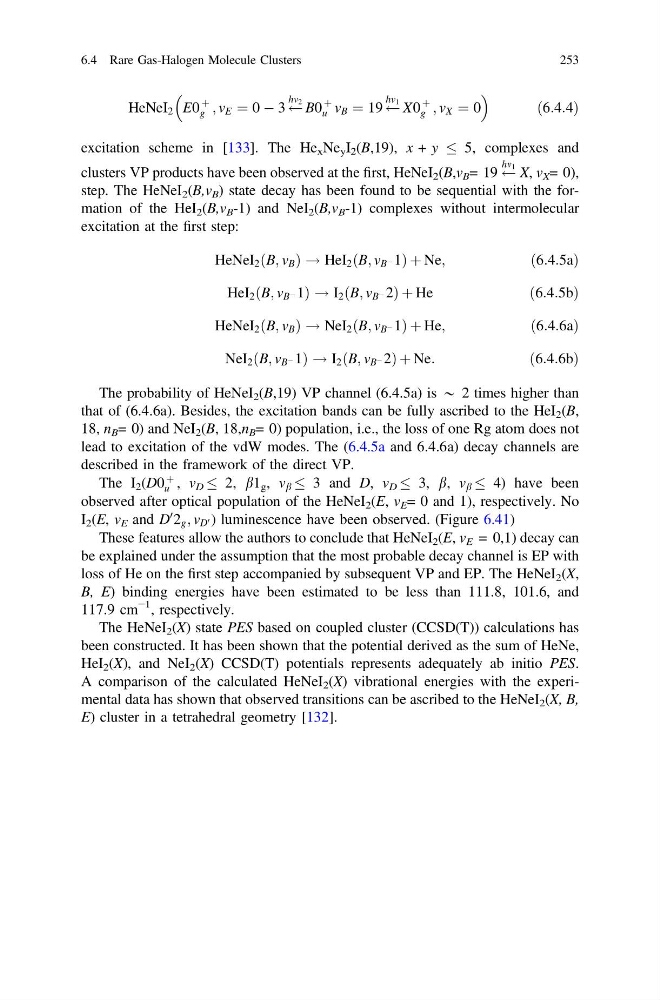
HeNeI 2 E0
þ
g ; v E ¼ 0 À 3
hv 2 B0
þ
u v B ¼ 19
hv 1 X0
þ
g ; v X ¼ 0
ð6:4:4Þ
excitation scheme in [133]. The He x Ne y I 2 (B,19), x + y
5, complexes and
clusters VP products have been observed at the first, HeNeI 2 (B,v B = 19
hm 1 X, v X = 0),
step. The HeNeI 2 (B,v B ) state decay has been found to be sequential with the formation of the HeI 2 (B,v B -1) and NeI 2 (B,v B -1) complexes without intermolecular
excitation at the first step:
HeNeI 2 B; v B
ð
Þ!HeI 2 B; v B À 1
ð
ÞþNe;
ð6:4:5aÞ
HeI 2 B; v B À 1
ð
Þ!I 2 B; v B À 2
ð
ÞþHe
ð6:4:5bÞ
HeNeI 2 B; v B
ð
Þ!NeI 2 B; v B À 1
ð
ÞþHe;
ð6:4:6aÞ
NeI 2 B; v B À 1
ð
Þ!I 2 B; v B À 2
ð
ÞþNe:
ð6:4:6bÞ
The probability of HeNeI 2 (B,19) VP channel (6.4.5a) is * 2 times higher than
that of (6.4.6a). Besides, the excitation bands can be fully ascribed to the HeI 2 (B,
18, n B = 0) and NeI 2 (B, 18,n B = 0) population, i.e., the loss of one Rg atom does not
lead to excitation of the vdW modes. The (6.4.5a and 6.4.6a) decay channels are
described in the framework of the direct VP.
The I 2 (D0
þ
u , v D 2, b1 g , v b 3 and D, v D 3, b, v b 4) have been
observed after optical population of the HeNeI 2 (E, v E = 0 and 1), respectively. No
I 2 (E, v E and D
0 2 g ; v D 0 ) luminescence have been observed. (Figure 6.41)
These features allow the authors to conclude that HeNeI 2 (E, v E = 0,1) decay can
be explained under the assumption that the most probable decay channel is EP with
loss of He on the first step accompanied by subsequent VP and EP. The HeNeI 2 (X,
B, E) binding energies have been estimated to be less than 111.8, 101.6, and
117.9 cm
−1 , respectively.
The HeNeI 2 (X) state PES based on coupled cluster (CCSD(T)) calculations has
been constructed. It has been shown that the potential derived as the sum of HeNe,
HeI 2 (X), and NeI 2 (X) CCSD(T) potentials represents adequately ab initio PES.
A comparison of the calculated HeNeI 2 (X) vibrational energies with the experimental data has shown that observed transitions can be ascribed to the HeNeI 2 (X, B,
E) cluster in a tetrahedral geometry [132].
6.4 Rare Gas-Halogen Molecule Clusters
253
þ
g ; v E ¼ 0 À 3
hv 2 B0
þ
u v B ¼ 19
hv 1 X0
þ
g ; v X ¼ 0
ð6:4:4Þ
excitation scheme in [133]. The He x Ne y I 2 (B,19), x + y
5, complexes and
clusters VP products have been observed at the first, HeNeI 2 (B,v B = 19
hm 1 X, v X = 0),
step. The HeNeI 2 (B,v B ) state decay has been found to be sequential with the formation of the HeI 2 (B,v B -1) and NeI 2 (B,v B -1) complexes without intermolecular
excitation at the first step:
HeNeI 2 B; v B
ð
Þ!HeI 2 B; v B À 1
ð
ÞþNe;
ð6:4:5aÞ
HeI 2 B; v B À 1
ð
Þ!I 2 B; v B À 2
ð
ÞþHe
ð6:4:5bÞ
HeNeI 2 B; v B
ð
Þ!NeI 2 B; v B À 1
ð
ÞþHe;
ð6:4:6aÞ
NeI 2 B; v B À 1
ð
Þ!I 2 B; v B À 2
ð
ÞþNe:
ð6:4:6bÞ
The probability of HeNeI 2 (B,19) VP channel (6.4.5a) is * 2 times higher than
that of (6.4.6a). Besides, the excitation bands can be fully ascribed to the HeI 2 (B,
18, n B = 0) and NeI 2 (B, 18,n B = 0) population, i.e., the loss of one Rg atom does not
lead to excitation of the vdW modes. The (6.4.5a and 6.4.6a) decay channels are
described in the framework of the direct VP.
The I 2 (D0
þ
u , v D 2, b1 g , v b 3 and D, v D 3, b, v b 4) have been
observed after optical population of the HeNeI 2 (E, v E = 0 and 1), respectively. No
I 2 (E, v E and D
0 2 g ; v D 0 ) luminescence have been observed. (Figure 6.41)
These features allow the authors to conclude that HeNeI 2 (E, v E = 0,1) decay can
be explained under the assumption that the most probable decay channel is EP with
loss of He on the first step accompanied by subsequent VP and EP. The HeNeI 2 (X,
B, E) binding energies have been estimated to be less than 111.8, 101.6, and
117.9 cm
−1 , respectively.
The HeNeI 2 (X) state PES based on coupled cluster (CCSD(T)) calculations has
been constructed. It has been shown that the potential derived as the sum of HeNe,
HeI 2 (X), and NeI 2 (X) CCSD(T) potentials represents adequately ab initio PES.
A comparison of the calculated HeNeI 2 (X) vibrational energies with the experimental data has shown that observed transitions can be ascribed to the HeNeI 2 (X, B,
E) cluster in a tetrahedral geometry [132].
6.4 Rare Gas-Halogen Molecule Clusters
253