

The best estimations of the binding energies are [126]:
284 D
X;0
0
313 cm
À1
255 D
B;19
0
284 cm
À1
449 D
E;v E
0
478 cm
À1
The
N 2 I 2 E; v E ; n E
ð
Þ!N 2 ðXÞ þ I 2 D
0
; v D
ð
Þ
ð6:3:21Þ
and
N 2 I 2 E; v E ; n E
ð
Þ!N 2 ðXÞ þ I 2 b; v b
À
Á
ð6:3:22Þ
EP channels have the greatest probability. The former is forbidden in the C ∞v
point group (0
+ - 2). Therefore, it proceeds in the C 2v point group, (A 1 – A 1 ⊕ B 1 (A 1
⊕ B 2 )) and C s point group, ðA
0
À A
0
È A
00
Þ (bent configuration). The latter is
allowed in the C s point group ðA
0
À A
00
È A
0
Þ.
The
N 2 I 2 E; v E ; n E
ð
Þ!N 2 ðXÞ þ I 2 D; v D
ð
Þ
ð6:3:23Þ
EP has very low probability; it is forbidden in the C 2v . point group (A 1 –B 2 (B 1 ))
[62].
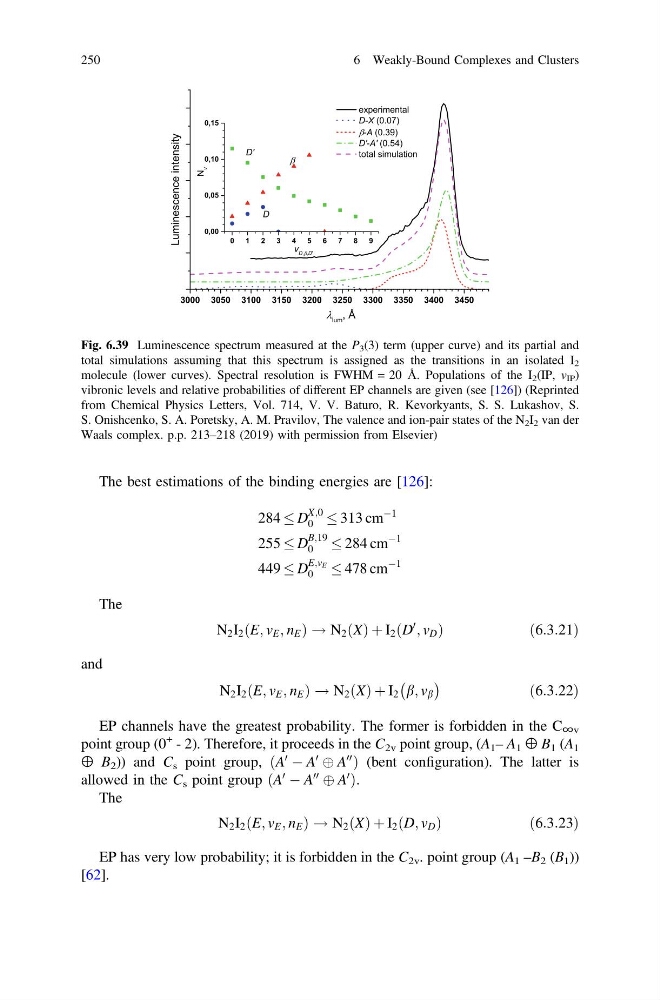
Fig. 6.39 Luminescence spectrum measured at the P 3 (3) term (upper curve) and its partial and
total simulations assuming that this spectrum is assigned as the transitions in an isolated I 2
molecule (lower curves). Spectral resolution is FWHM = 20 Å. Populations of the I 2 (IP, v IP )
vibronic levels and relative probabilities of different EP channels are given (see [126]) (Reprinted
from Chemical Physics Letters, Vol. 714, V. V. Baturo, R. Kevorkyants, S. S. Lukashov, S.
S. Onishcenko, S. A. Poretsky, A. M. Pravilov, The valence and ion-pair states of the N 2 I 2 van der
Waals complex. p.p. 213–218 (2019) with permission from Elsevier)
250
6 Weakly-Bound Complexes and Clusters
284 D
X;0
0
313 cm
À1
255 D
B;19
0
284 cm
À1
449 D
E;v E
0
478 cm
À1
The
N 2 I 2 E; v E ; n E
ð
Þ!N 2 ðXÞ þ I 2 D
0
; v D
ð
Þ
ð6:3:21Þ
and
N 2 I 2 E; v E ; n E
ð
Þ!N 2 ðXÞ þ I 2 b; v b
À
Á
ð6:3:22Þ
EP channels have the greatest probability. The former is forbidden in the C ∞v
point group (0
+ - 2). Therefore, it proceeds in the C 2v point group, (A 1 – A 1 ⊕ B 1 (A 1
⊕ B 2 )) and C s point group, ðA
0
À A
0
È A
00
Þ (bent configuration). The latter is
allowed in the C s point group ðA
0
À A
00
È A
0
Þ.
The
N 2 I 2 E; v E ; n E
ð
Þ!N 2 ðXÞ þ I 2 D; v D
ð
Þ
ð6:3:23Þ
EP has very low probability; it is forbidden in the C 2v . point group (A 1 –B 2 (B 1 ))
[62].
Fig. 6.39 Luminescence spectrum measured at the P 3 (3) term (upper curve) and its partial and
total simulations assuming that this spectrum is assigned as the transitions in an isolated I 2
molecule (lower curves). Spectral resolution is FWHM = 20 Å. Populations of the I 2 (IP, v IP )
vibronic levels and relative probabilities of different EP channels are given (see [126]) (Reprinted
from Chemical Physics Letters, Vol. 714, V. V. Baturo, R. Kevorkyants, S. S. Lukashov, S.
S. Onishcenko, S. A. Poretsky, A. M. Pravilov, The valence and ion-pair states of the N 2 I 2 van der
Waals complex. p.p. 213–218 (2019) with permission from Elsevier)
250
6 Weakly-Bound Complexes and Clusters