

other RgXY complexes, ground state RgClF, Rg = He, Ar, and ArBrCl complexes
have been studied (see [30, 31] and references).
Mutual perturbation of the B0
+ and YO
+ states is strong enough to cause avoided
crossing of the states in ICl and IBr molecules. This perturbation forces the B state
to correlate with ground-state products, and a new B
0 (0
+ ) bound-state is formed
above the crossing point (Fig. 6.33).
The interactions within RgXY complexes are slightly different than those within
the RgX 2 complexes due to the influences of the asymmetric electron distributions
and, to some extent, the dipole-induced dipole forces arising from the XY permanent dipole moment, 1.207 D for ICl(X) (see [111] and references). Up to three
wells with varying depths are anticipated for the RgXY complexes with the deepest
well, being in the h = 0
o , RgÁÁÁX–Y, orientation, where X is the larger, more
polarizable halogen atom. The three wells, h = 0
o , near T-shaped and h = 180
o ,
RgÁÁÁY–X, orientations are separated by isomerization barriers.
6.3.3.1 The RgICl vdW Complexes
The HeICl vdW complexes are most well researched, and we start with them.
The HeICl complexes. Data on some spectroscopic characteristics of the HeI
35 Cl
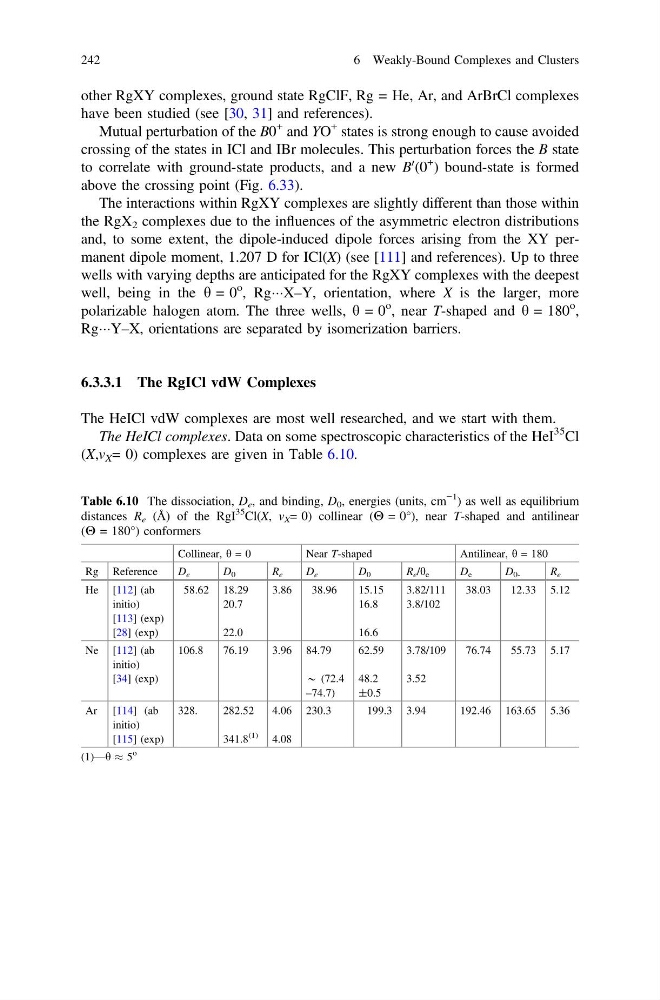
(X,v X = 0) complexes are given in Table 6.10.
Table 6.10 The dissociation, D e , and binding, D 0 , energies (units, cm
−1
) as well as equilibrium
distances R e (Å) of the RgI
35
Cl(X, v X = 0) collinear (H = 0°), near T-shaped and antilinear
(H = 180°) conformers
Collinear, h = 0
Near T-shaped
Antilinear, h = 180
Rg Reference
D e
D 0
R e
D e
D 0
R e /h e
D e
D 0R e
He [112] (ab
initio)
[113] (exp)
[28] (exp)
58.62 18.29
20.7
22.0
3.86
38.96
15.15
16.8
16.6
3.82/111
3.8/102
38.03
12.33 5.12
Ne [112] (ab
initio)
[34] (exp)
106.8
76.19
3.96 84.79
* (72.4
–74.7)
62.59
48.2
±0.5
3.78/109
3.52
76.74
55.73 5.17
Ar [114] (ab
initio)
[115] (exp)
328.
282.52
341.8
(1)
4.06
4.08
230.3
199.3 3.94
192.46 163.65 5.36
(1)—h % 5
o
242
6 Weakly-Bound Complexes and Clusters
have been studied (see [30, 31] and references).
Mutual perturbation of the B0
+ and YO
+ states is strong enough to cause avoided
crossing of the states in ICl and IBr molecules. This perturbation forces the B state
to correlate with ground-state products, and a new B
0 (0
+ ) bound-state is formed
above the crossing point (Fig. 6.33).
The interactions within RgXY complexes are slightly different than those within
the RgX 2 complexes due to the influences of the asymmetric electron distributions
and, to some extent, the dipole-induced dipole forces arising from the XY permanent dipole moment, 1.207 D for ICl(X) (see [111] and references). Up to three
wells with varying depths are anticipated for the RgXY complexes with the deepest
well, being in the h = 0
o , RgÁÁÁX–Y, orientation, where X is the larger, more
polarizable halogen atom. The three wells, h = 0
o , near T-shaped and h = 180
o ,
RgÁÁÁY–X, orientations are separated by isomerization barriers.
6.3.3.1 The RgICl vdW Complexes
The HeICl vdW complexes are most well researched, and we start with them.
The HeICl complexes. Data on some spectroscopic characteristics of the HeI
35 Cl
(X,v X = 0) complexes are given in Table 6.10.
Table 6.10 The dissociation, D e , and binding, D 0 , energies (units, cm
−1
) as well as equilibrium
distances R e (Å) of the RgI
35
Cl(X, v X = 0) collinear (H = 0°), near T-shaped and antilinear
(H = 180°) conformers
Collinear, h = 0
Near T-shaped
Antilinear, h = 180
Rg Reference
D e
D 0
R e
D e
D 0
R e /h e
D e
D 0R e
He [112] (ab
initio)
[113] (exp)
[28] (exp)
58.62 18.29
20.7
22.0
3.86
38.96
15.15
16.8
16.6
3.82/111
3.8/102
38.03
12.33 5.12
Ne [112] (ab
initio)
[34] (exp)
106.8
76.19
3.96 84.79
* (72.4
–74.7)
62.59
48.2
±0.5
3.78/109
3.52
76.74
55.73 5.17
Ar [114] (ab
initio)
[115] (exp)
328.
282.52
341.8
(1)
4.06
4.08
230.3
199.3 3.94
192.46 163.65 5.36
(1)—h % 5
o
242
6 Weakly-Bound Complexes and Clusters