

D e ¼ A
C 6
R 6
e
;
ð6:3:19Þ
A is the correlation coefficient, A = 0.72, usually, and R e is the equilibrium Rg–
I 2 (IP) distance (see [97] and references).
6.3.3 The RgXY vdW Complexes
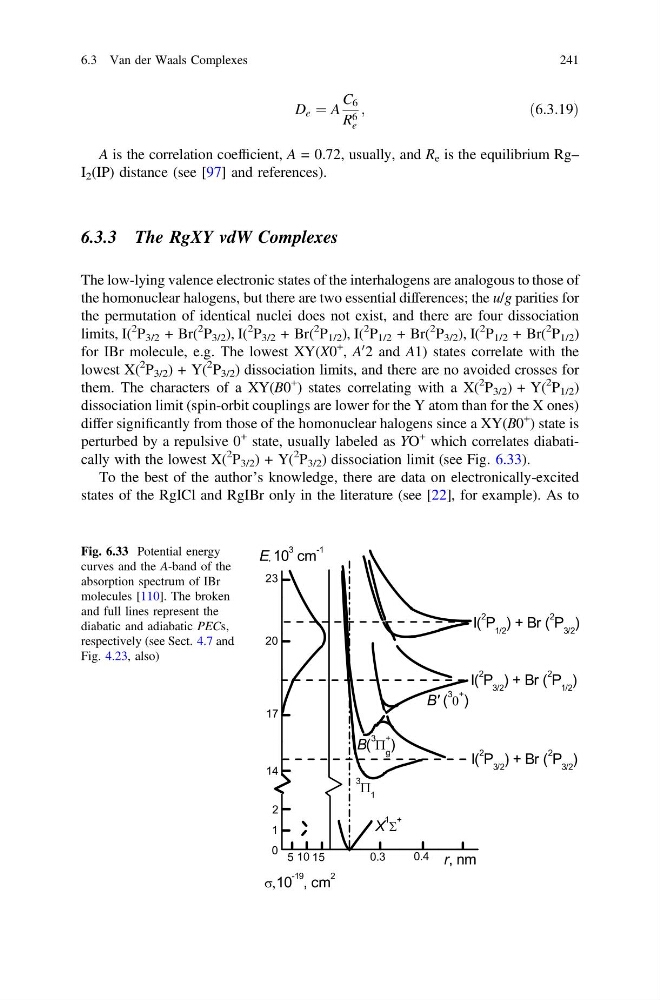
The low-lying valence electronic states of the interhalogens are analogous to those of
the homonuclear halogens, but there are two essential differences; the u/g parities for
the permutation of identical nuclei does not exist, and there are four dissociation
limits, I(
2 P 3/2 + Br(
2 P 3/2 ), I(
2 P 3/2 + Br(
2 P 1/2 ), I(
2 P 1/2 + Br(
2 P 3/2 ), I(
2 P 1/2 + Br(
2 P 1/2 )
for IBr molecule, e.g. The lowest XY(X0
+ , A
0 2 and A1) states correlate with the
lowest X(
2 P 3/2 ) + Y(
2 P 3/2 ) dissociation limits, and there are no avoided crosses for
them. The characters of a XY(B0
+ ) states correlating with a X(
2 P 3/2 ) + Y(
2 P 1/2 )
dissociation limit (spin-orbit couplings are lower for the Y atom than for the X ones)
differ significantly from those of the homonuclear halogens since a XY(B0
+
) state is
perturbed by a repulsive 0
+ state, usually labeled as YO
+ which correlates diabatically with the lowest X(
2 P 3/2 ) + Y(
2 P 3/2 ) dissociation limit (see Fig. 6.33).
To the best of the author’s knowledge, there are data on electronically-excited
states of the RgICl and RgIBr only in the literature (see [22], for example). As to
Fig. 6.33 Potential energy
curves and the A-band of the
absorption spectrum of IBr
molecules [110]. The broken
and full lines represent the
diabatic and adiabatic PECs,
respectively (see Sect. 4.7 and
Fig. 4.23, also)
6.3 Van der Waals Complexes
241
C 6
R 6
e
;
ð6:3:19Þ
A is the correlation coefficient, A = 0.72, usually, and R e is the equilibrium Rg–
I 2 (IP) distance (see [97] and references).
6.3.3 The RgXY vdW Complexes
The low-lying valence electronic states of the interhalogens are analogous to those of
the homonuclear halogens, but there are two essential differences; the u/g parities for
the permutation of identical nuclei does not exist, and there are four dissociation
limits, I(
2 P 3/2 + Br(
2 P 3/2 ), I(
2 P 3/2 + Br(
2 P 1/2 ), I(
2 P 1/2 + Br(
2 P 3/2 ), I(
2 P 1/2 + Br(
2 P 1/2 )
for IBr molecule, e.g. The lowest XY(X0
+ , A
0 2 and A1) states correlate with the
lowest X(
2 P 3/2 ) + Y(
2 P 3/2 ) dissociation limits, and there are no avoided crosses for
them. The characters of a XY(B0
+ ) states correlating with a X(
2 P 3/2 ) + Y(
2 P 1/2 )
dissociation limit (spin-orbit couplings are lower for the Y atom than for the X ones)
differ significantly from those of the homonuclear halogens since a XY(B0
+
) state is
perturbed by a repulsive 0
+ state, usually labeled as YO
+ which correlates diabatically with the lowest X(
2 P 3/2 ) + Y(
2 P 3/2 ) dissociation limit (see Fig. 6.33).
To the best of the author’s knowledge, there are data on electronically-excited
states of the RgICl and RgIBr only in the literature (see [22], for example). As to
Fig. 6.33 Potential energy
curves and the A-band of the
absorption spectrum of IBr
molecules [110]. The broken
and full lines represent the
diabatic and adiabatic PECs,
respectively (see Sect. 4.7 and
Fig. 4.23, also)
6.3 Van der Waals Complexes
241