

To assign observed transitions in excitation spectra to specific vdW bending and
stretching modes, the PESs of both, NeI 2 (B, E), states have been constructed, and
the energies of the vdW states have been calculated in [97]. The pairwise potential
energy curves within the intermolecular DIM PT1 model (see details in [62, 96])
have been utilized.
The DIM model predicts one minimum of the T-shaped configurations for both
E, B states. The PESs of the B and E states are similar and have almost the same
equilibrium intermolecular distances, R
B
e ¼ 3:69 ˚
A, R
E
e ¼ 3:7 ˚
A, that explains a
small number of bands in all the v E groups observed in the experiment. The model
predicts no linear isomer for both states.
The calculated FCFs for the v E = 0 group and the energies of the NeI 2 (E,v E = 0,
n
str
E , n
b
E
hm 2 B,19, n B = 0) transitions are in excellent agreement with experimental
data (Fig. 6.17a).
It has been found that three states (n
str
E ¼ 0, n
b
E ¼ 0), (1,0) and (0,2) are populated from the lowest (n
str
E ¼ 0, n
b
E ¼ 0) vdW level of the B state. The assignment is
given in Fig. 6.17a. The species of the T-shaped NeI 2 (B, E) states (C 2v symmetry
point group) are B 2 and A 1 , respectively, and those of the stretching and bending
modes are A 1 and B 1 . The species of the transition moments are A 1 (M z ), B 1 (M x ),
and B 2 (M z ). A transition is electric dipole allowed if l ¼ B ^
l
j jE 6 ¼ 0, that is valid if
the product B ^
l
j jE is totally symmetric for at least one orientation of ^
l, i.e., the
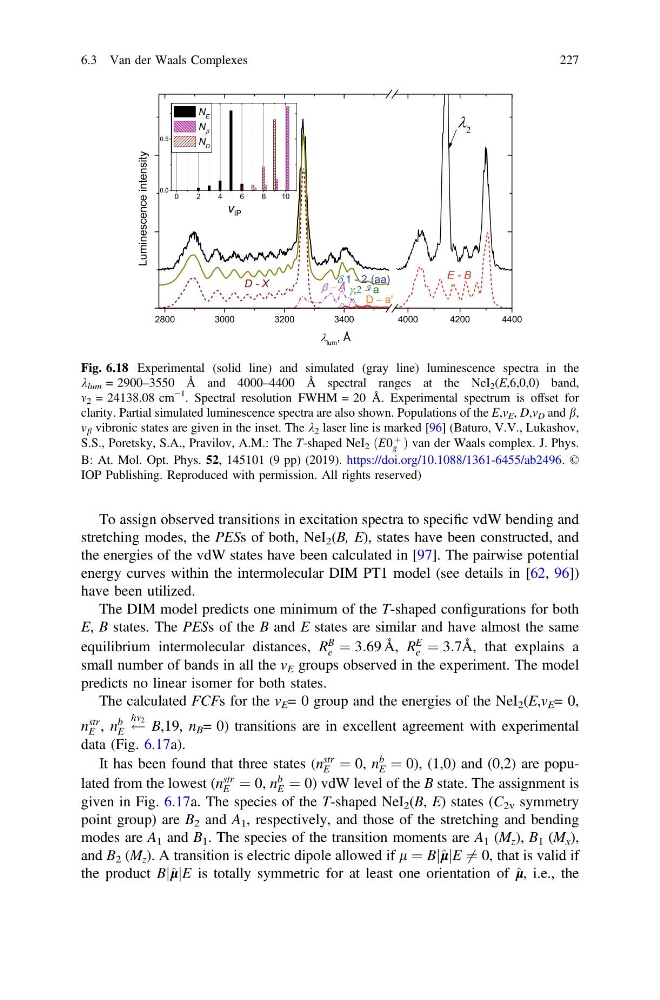
Fig. 6.18 Experimental (solid line) and simulated (gray line) luminescence spectra in the
k lum = 2900–3550 Å and 4000–4400 Å spectral ranges at the NeI 2 (E,6,0,0) band,
m 2 = 24138.08 cm
−1
. Spectral resolution FWHM = 20 Å. Experimental spectrum is offset for
clarity. Partial simulated luminescence spectra are also shown. Populations of the E,v E , D,v D and b,
v b vibronic states are given in the inset. The k 2 laser line is marked [96] (Baturo, V.V., Lukashov,
S.S., Poretsky, S.A., Pravilov, A.M.: The T-shaped NeI 2 ðE0
þ
g Þ van der Waals complex. J. Phys.
B: At. Mol. Opt. Phys. 52, 145101 (9 pp) (2019). https://doi.org/10.1088/1361-6455/ab2496. ©
IOP Publishing. Reproduced with permission. All rights reserved)
6.3 Van der Waals Complexes
227
stretching modes, the PESs of both, NeI 2 (B, E), states have been constructed, and
the energies of the vdW states have been calculated in [97]. The pairwise potential
energy curves within the intermolecular DIM PT1 model (see details in [62, 96])
have been utilized.
The DIM model predicts one minimum of the T-shaped configurations for both
E, B states. The PESs of the B and E states are similar and have almost the same
equilibrium intermolecular distances, R
B
e ¼ 3:69 ˚
A, R
E
e ¼ 3:7 ˚
A, that explains a
small number of bands in all the v E groups observed in the experiment. The model
predicts no linear isomer for both states.
The calculated FCFs for the v E = 0 group and the energies of the NeI 2 (E,v E = 0,
n
str
E , n
b
E
hm 2 B,19, n B = 0) transitions are in excellent agreement with experimental
data (Fig. 6.17a).
It has been found that three states (n
str
E ¼ 0, n
b
E ¼ 0), (1,0) and (0,2) are populated from the lowest (n
str
E ¼ 0, n
b
E ¼ 0) vdW level of the B state. The assignment is
given in Fig. 6.17a. The species of the T-shaped NeI 2 (B, E) states (C 2v symmetry
point group) are B 2 and A 1 , respectively, and those of the stretching and bending
modes are A 1 and B 1 . The species of the transition moments are A 1 (M z ), B 1 (M x ),
and B 2 (M z ). A transition is electric dipole allowed if l ¼ B ^
l
j jE 6 ¼ 0, that is valid if
the product B ^
l
j jE is totally symmetric for at least one orientation of ^
l, i.e., the
Fig. 6.18 Experimental (solid line) and simulated (gray line) luminescence spectra in the
k lum = 2900–3550 Å and 4000–4400 Å spectral ranges at the NeI 2 (E,6,0,0) band,
m 2 = 24138.08 cm
−1
. Spectral resolution FWHM = 20 Å. Experimental spectrum is offset for
clarity. Partial simulated luminescence spectra are also shown. Populations of the E,v E , D,v D and b,
v b vibronic states are given in the inset. The k 2 laser line is marked [96] (Baturo, V.V., Lukashov,
S.S., Poretsky, S.A., Pravilov, A.M.: The T-shaped NeI 2 ðE0
þ
g Þ van der Waals complex. J. Phys.
B: At. Mol. Opt. Phys. 52, 145101 (9 pp) (2019). https://doi.org/10.1088/1361-6455/ab2496. ©
IOP Publishing. Reproduced with permission. All rights reserved)
6.3 Van der Waals Complexes
227