

so the reliability of the calculation results is low (n
str , n
b are the vdW quantum
numbers).
6.3.2.2 The RgCl 2 vdW Complexes
The bound-bound Cl 2 A
3 P 1 u
ð Þ
X
1 R 0
þ
g
transition takes place, but there is
no evidence in the absorption spectrum of C1 2 for bands which could be assigned to
the A ← X transition. The dipole moment of the Cl 2 (A–X) transition is much less
than that of the Cl 2 B
3 P 0
þ
u
À Á À X
1 R 0
þ
g
, radiative lifetime of the Cl 2 (A) state
is (0.02–0.08) s [50], whereas that of Cl 2 (B) is 3.05Á10
−4 s [51], and FCFs of the
bound-bound Cl 2 (A ← X,0) transitions are extremely small. Therefore, the information on spectroscopic characteristics of the Cl 2 (A) state has been obtained after
analysis of the Cl 2 (b1 g ! A) transitions and recombination of Cl atoms accompanied by the Cl 2 (A,v A ! X,v X ) radiation (see [50, 52] and references).
The RgCl 2 (B ← X), Rg = He, Ne, Ar transitions have been observed, and some
spectroscopic characteristics of the RgCl 2 (B, X) complexes as well as the
RgCl 2 (B) dynamics have been studied.
There are
35 Cl 2 (57%),
35 Cl
37 Cl (37%), and
37 Cl 2 (7%) isotopes in the nature
[51].
The HeCl 2 Complexes. Experimental data on spectroscopic characteristics of the
HeCl 2 (X) complexes is scarce. It has been shown that the HeCl 2 (X) is T-shaped, and
R X = (3.8 ± 0.4) Å [53]. The binding energies of the n
b = 0– 4 vdW levels are
(12.83 Ä 0.77) cm
−1 . It has also been shown that there are no bound levels in which
the vdW stretch is excited for the X states [54]. Some spectroscopic characteristics
of the RgCl 2 (X, v X = 0) linear and T-shaped complexes are calculated in [55] (see
[23, 49, 56] and references, also).
One sees, that calculated binding energy of lowest, n
str
= 0, n
b = 0 vdW levels,
D 0 ¼ D e À
1
2 x
b
e (see above) for T-shaped HeCl 2 (X,v X = 0) is 29.3 cm
−1 , more than
two times higher than the experimental value, 12.83 cm
−1 .
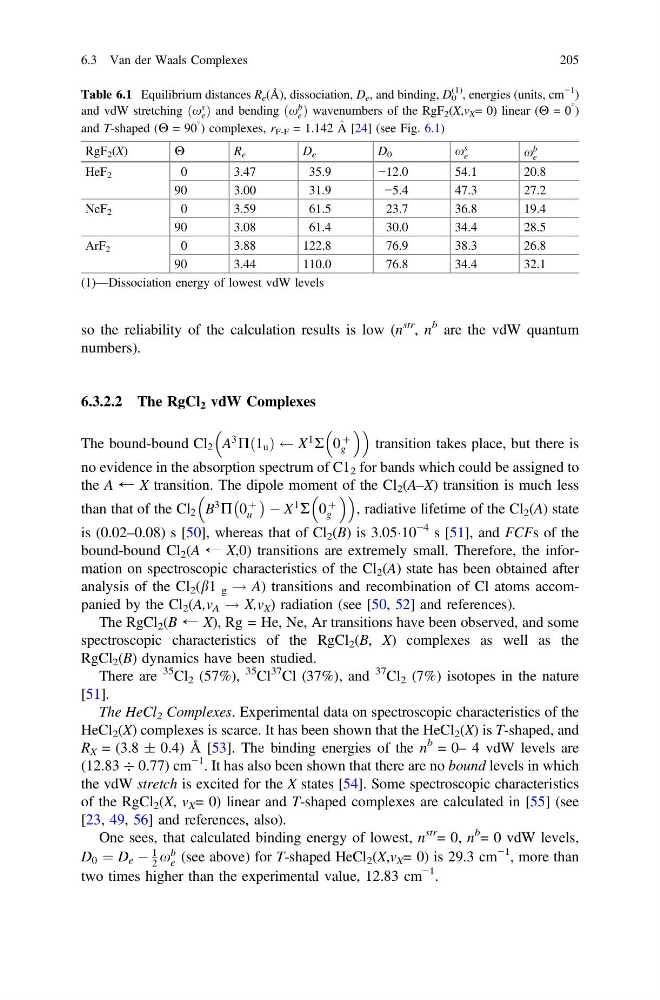
Table 6.1 Equilibrium distances R e (Å), dissociation, D e , and binding, D 0
(1)
, energies (units, cm
−1
)
and vdW stretching ðx
s
e Þ and bending ðx
b
e Þ wavenumbers of the RgF 2 (X,v X = 0) linear (H = 0
° )
and T-shaped (H = 90
°
) complexes, r F-F = 1.142 ^
A [24] (see Fig. 6.1)
RgF 2 (X)
H
R e
D e
D 0
x
s
e
x
b
e
HeF 2
0
3.47
35.9
−12.0
54.1
20.8
90
3.00
31.9
−5.4
47.3
27.2
NeF 2
0
3.59
61.5
23.7
36.8
19.4
90
3.08
61.4
30.0
34.4
28.5
ArF 2
0
3.88
122.8
76.9
38.3
26.8
90
3.44
110.0
76.8
34.4
32.1
(1)—Dissociation energy of lowest vdW levels
6.3 Van der Waals Complexes
205
str , n
b are the vdW quantum
numbers).
6.3.2.2 The RgCl 2 vdW Complexes
The bound-bound Cl 2 A
3 P 1 u
ð Þ
X
1 R 0
þ
g
transition takes place, but there is
no evidence in the absorption spectrum of C1 2 for bands which could be assigned to
the A ← X transition. The dipole moment of the Cl 2 (A–X) transition is much less
than that of the Cl 2 B
3 P 0
þ
u
À Á À X
1 R 0
þ
g
, radiative lifetime of the Cl 2 (A) state
is (0.02–0.08) s [50], whereas that of Cl 2 (B) is 3.05Á10
−4 s [51], and FCFs of the
bound-bound Cl 2 (A ← X,0) transitions are extremely small. Therefore, the information on spectroscopic characteristics of the Cl 2 (A) state has been obtained after
analysis of the Cl 2 (b1 g ! A) transitions and recombination of Cl atoms accompanied by the Cl 2 (A,v A ! X,v X ) radiation (see [50, 52] and references).
The RgCl 2 (B ← X), Rg = He, Ne, Ar transitions have been observed, and some
spectroscopic characteristics of the RgCl 2 (B, X) complexes as well as the
RgCl 2 (B) dynamics have been studied.
There are
35 Cl 2 (57%),
35 Cl
37 Cl (37%), and
37 Cl 2 (7%) isotopes in the nature
[51].
The HeCl 2 Complexes. Experimental data on spectroscopic characteristics of the
HeCl 2 (X) complexes is scarce. It has been shown that the HeCl 2 (X) is T-shaped, and
R X = (3.8 ± 0.4) Å [53]. The binding energies of the n
b = 0– 4 vdW levels are
(12.83 Ä 0.77) cm
−1 . It has also been shown that there are no bound levels in which
the vdW stretch is excited for the X states [54]. Some spectroscopic characteristics
of the RgCl 2 (X, v X = 0) linear and T-shaped complexes are calculated in [55] (see
[23, 49, 56] and references, also).
One sees, that calculated binding energy of lowest, n
str
= 0, n
b = 0 vdW levels,
D 0 ¼ D e À
1
2 x
b
e (see above) for T-shaped HeCl 2 (X,v X = 0) is 29.3 cm
−1 , more than
two times higher than the experimental value, 12.83 cm
−1 .
Table 6.1 Equilibrium distances R e (Å), dissociation, D e , and binding, D 0
(1)
, energies (units, cm
−1
)
and vdW stretching ðx
s
e Þ and bending ðx
b
e Þ wavenumbers of the RgF 2 (X,v X = 0) linear (H = 0
° )
and T-shaped (H = 90
°
) complexes, r F-F = 1.142 ^
A [24] (see Fig. 6.1)
RgF 2 (X)
H
R e
D e
D 0
x
s
e
x
b
e
HeF 2
0
3.47
35.9
−12.0
54.1
20.8
90
3.00
31.9
−5.4
47.3
27.2
NeF 2
0
3.59
61.5
23.7
36.8
19.4
90
3.08
61.4
30.0
34.4
28.5
ArF 2
0
3.88
122.8
76.9
38.3
26.8
90
3.44
110.0
76.8
34.4
32.1
(1)—Dissociation energy of lowest vdW levels
6.3 Van der Waals Complexes
205