

Me = Al [41], Cd, Zn, Hg (see [40–43] and references), and Ni [44], vdW complexes have weakly bound electronically-excited states. Electronically-excited state
of the RgX 2 and RgXY vdW complexes have been studied most detailed.
Therefore, we start with the RgX 2 complexes.
6.3.2 RgX 2 vdW Complexes
The lowest electronically-excited states of the X 2 molecules is
1 P u and
3 P u (in
terms of Hund’s cases (a), (b), see Sect. 4.2.3). The perpendicular X 2 ð
1 P u À
X
1 R
þ
g Þ transitions are weak (see [45] and references), and the X 2 ð
3 P u À X
1 R
þ
g Þ
electric dipole transitions can be allowed due to spin-orbit coupling which increases
as * Z
4 (Z is X nuclear charge, see Sect. 4.6.1and Table 4.1). Therefore, maximal
cross-sections of the X 2 A absorption bands are 2.4Á10
−20 cm
2 , k max = 290 nm (F 2 ),
2.4Á10
−19 cm
2 , k max % 330 nm (Cl 2 ), 6.1Á10
−19 cm
2 , k max % 410 nm (Br 2 ) and
2.0Á10
−18 cm
2 , k max % 500 nm (I 2 ), see [46, 47] and references). The
electronically-excited valence state RgX 2 complexes can be populated in optical
transitions from the RgX 2 (X) state if transitions occur to bound parts of the upper
states.
6.3.2.1 The RgF 2 vdW Complexes
Both F 2 (
3 Pð0
þ
u Þ and
1 P u ) states are repulsive in the Franck-Condon zone of
transitions from the F 2 (X,v X = 0) state (see [48] and references), and RgF 2 (
3 Pð0
þ
u Þ,
1 P u ) complexes cannot be populated in optical transitions. There are theoretical
data on some spectroscopic parameters of the RgF 2 (X) state in the literature [24, 49]
(Table 6.1).
One sees, that binding energy of lowest, n
str
= 0, n
b = 0 vdW levels, D 0 ¼
D e À
1
2 x
str
e þ 2x
b
e
À
Á
H ¼ 0
À
Á
and D 0 ¼ D e À
1
2 x
str
e þ x
b
e
À
Á
H ¼ 90
À
Á
is negative,
r
θ
Y
X
Rg
R
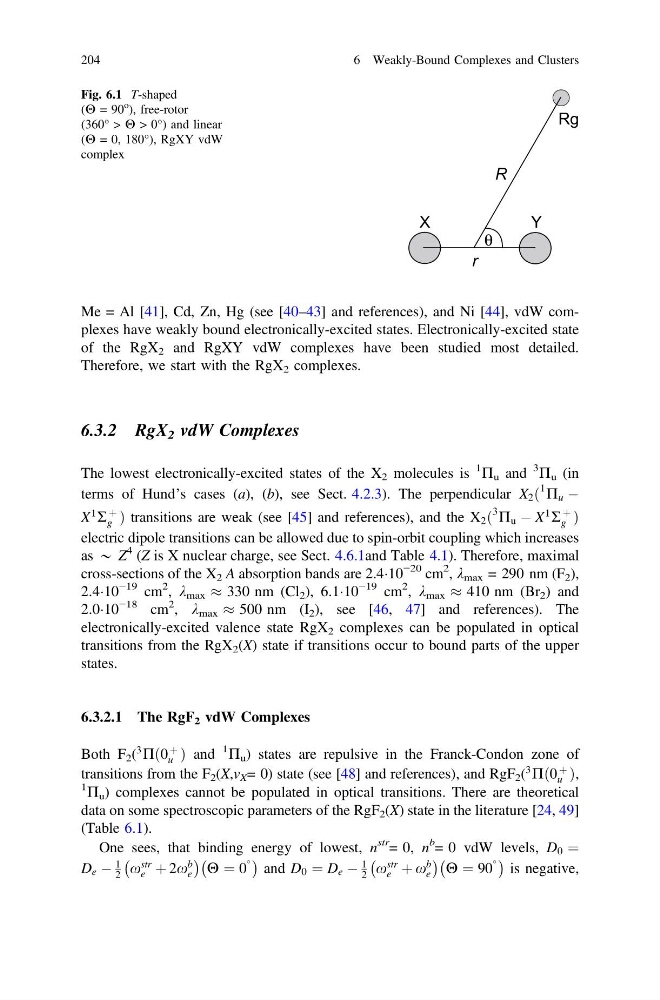
Fig. 6.1 T-shaped
(H = 90
o
), free-rotor
(360° > H > 0°) and linear
(H = 0, 180°), RgXY vdW
complex
204
6 Weakly-Bound Complexes and Clusters
of the RgX 2 and RgXY vdW complexes have been studied most detailed.
Therefore, we start with the RgX 2 complexes.
6.3.2 RgX 2 vdW Complexes
The lowest electronically-excited states of the X 2 molecules is
1 P u and
3 P u (in
terms of Hund’s cases (a), (b), see Sect. 4.2.3). The perpendicular X 2 ð
1 P u À
X
1 R
þ
g Þ transitions are weak (see [45] and references), and the X 2 ð
3 P u À X
1 R
þ
g Þ
electric dipole transitions can be allowed due to spin-orbit coupling which increases
as * Z
4 (Z is X nuclear charge, see Sect. 4.6.1and Table 4.1). Therefore, maximal
cross-sections of the X 2 A absorption bands are 2.4Á10
−20 cm
2 , k max = 290 nm (F 2 ),
2.4Á10
−19 cm
2 , k max % 330 nm (Cl 2 ), 6.1Á10
−19 cm
2 , k max % 410 nm (Br 2 ) and
2.0Á10
−18 cm
2 , k max % 500 nm (I 2 ), see [46, 47] and references). The
electronically-excited valence state RgX 2 complexes can be populated in optical
transitions from the RgX 2 (X) state if transitions occur to bound parts of the upper
states.
6.3.2.1 The RgF 2 vdW Complexes
Both F 2 (
3 Pð0
þ
u Þ and
1 P u ) states are repulsive in the Franck-Condon zone of
transitions from the F 2 (X,v X = 0) state (see [48] and references), and RgF 2 (
3 Pð0
þ
u Þ,
1 P u ) complexes cannot be populated in optical transitions. There are theoretical
data on some spectroscopic parameters of the RgF 2 (X) state in the literature [24, 49]
(Table 6.1).
One sees, that binding energy of lowest, n
str
= 0, n
b = 0 vdW levels, D 0 ¼
D e À
1
2 x
str
e þ 2x
b
e
À
Á
H ¼ 0
À
Á
and D 0 ¼ D e À
1
2 x
str
e þ x
b
e
À
Á
H ¼ 90
À
Á
is negative,
r
θ
Y
X
Rg
R
Fig. 6.1 T-shaped
(H = 90
o
), free-rotor
(360° > H > 0°) and linear
(H = 0, 180°), RgXY vdW
complex
204
6 Weakly-Bound Complexes and Clusters