

5.5.1 Perturbation-Facilitated Processes
Gateway (doorway) model (see [21], p. 313, [22], p. 445, [23] and references). This
model is the simplest to understand, but not to confirm in an experiment. Gateway
(doorway) is the way through the gate (door). The term describes the essence of the
model very accurately. What does it consist?
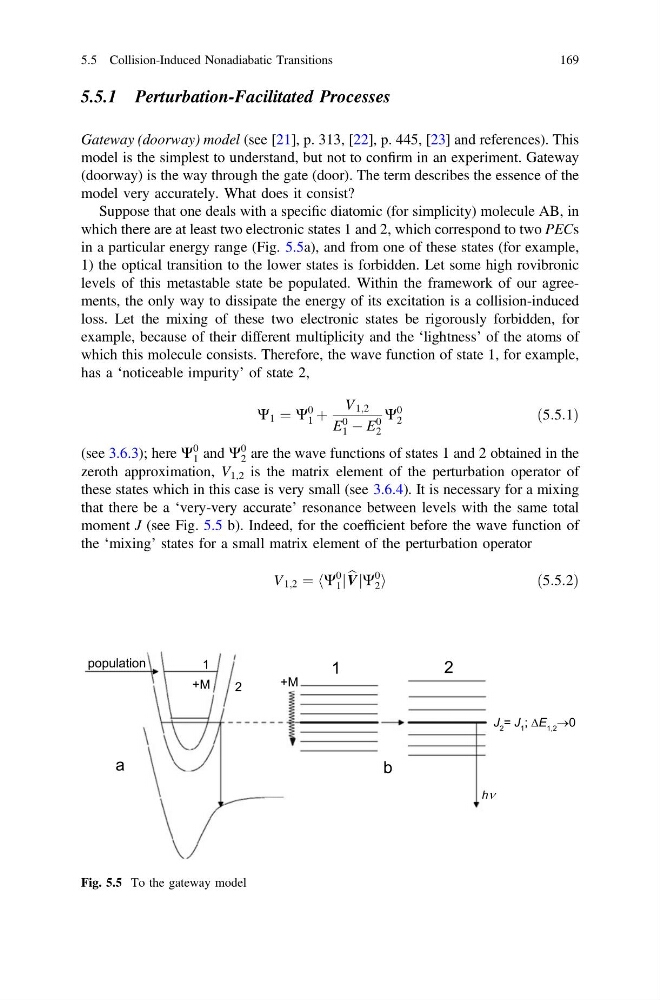
Suppose that one deals with a specific diatomic (for simplicity) molecule AB, in
which there are at least two electronic states 1 and 2, which correspond to two PECs
in a particular energy range (Fig. 5.5a), and from one of these states (for example,
1) the optical transition to the lower states is forbidden. Let some high rovibronic
levels of this metastable state be populated. Within the framework of our agreements, the only way to dissipate the energy of its excitation is a collision-induced
loss. Let the mixing of these two electronic states be rigorously forbidden, for
example, because of their different multiplicity and the ‘lightness’ of the atoms of
which this molecule consists. Therefore, the wave function of state 1, for example,
has a ‘noticeable impurity’ of state 2,
W 1 ¼ W
0
1 þ
V 1;2
E
0
1 À E
0
2
W
0
2
ð5:5:1Þ
(see 3.6.3); here W
0
1 and W
0
2 are the wave functions of states 1 and 2 obtained in the
zeroth approximation, V 1,2 is the matrix element of the perturbation operator of
these states which in this case is very small (see 3.6.4). It is necessary for a mixing
that there be a ‘very-very accurate’ resonance between levels with the same total
moment J (see Fig. 5.5 b). Indeed, for the coefficient before the wave function of
the ‘mixing’ states for a small matrix element of the perturbation operator
V 1;2 ¼ hW
0
1 j b
V jW
0
2 i
ð 5:5:2Þ
Fig. 5.5 To the gateway model
5.5 Collision-Induced Nonadiabatic Transitions
169
Gateway (doorway) model (see [21], p. 313, [22], p. 445, [23] and references). This
model is the simplest to understand, but not to confirm in an experiment. Gateway
(doorway) is the way through the gate (door). The term describes the essence of the
model very accurately. What does it consist?
Suppose that one deals with a specific diatomic (for simplicity) molecule AB, in
which there are at least two electronic states 1 and 2, which correspond to two PECs
in a particular energy range (Fig. 5.5a), and from one of these states (for example,
1) the optical transition to the lower states is forbidden. Let some high rovibronic
levels of this metastable state be populated. Within the framework of our agreements, the only way to dissipate the energy of its excitation is a collision-induced
loss. Let the mixing of these two electronic states be rigorously forbidden, for
example, because of their different multiplicity and the ‘lightness’ of the atoms of
which this molecule consists. Therefore, the wave function of state 1, for example,
has a ‘noticeable impurity’ of state 2,
W 1 ¼ W
0
1 þ
V 1;2
E
0
1 À E
0
2
W
0
2
ð5:5:1Þ
(see 3.6.3); here W
0
1 and W
0
2 are the wave functions of states 1 and 2 obtained in the
zeroth approximation, V 1,2 is the matrix element of the perturbation operator of
these states which in this case is very small (see 3.6.4). It is necessary for a mixing
that there be a ‘very-very accurate’ resonance between levels with the same total
moment J (see Fig. 5.5 b). Indeed, for the coefficient before the wave function of
the ‘mixing’ states for a small matrix element of the perturbation operator
V 1;2 ¼ hW
0
1 j b
V jW
0
2 i
ð 5:5:2Þ
Fig. 5.5 To the gateway model
5.5 Collision-Induced Nonadiabatic Transitions
169