

vibrational relaxation. These studies can be carried out directly if the conditions of
single collisions are satisfied, i.e., for example, in molecular beams.
5.3.4 V-T Processes at High Vibrational Levels
The vast majority of data on the probabilities of vibrational relaxation refers to the
v = 1 vibrational levels. As we have seen more than once, in the problems that we
solve, very often there is no local thermodynamic equilibrium in terms of vibrational degrees of freedom; therefore, information on the value of transition probabilities for high vibrational levels is of importance. It must be remembered that if
the vibrational quantum is hm < < kT, then, according to the semiclassical
approximation, the vibrational motion is very similar to the translational one with
all the ensuing consequences: when such a species collides with M, energy of the
order of kT is transferred with a probability close to 1. In this case, the selection rule
Dv = 1 is violated.
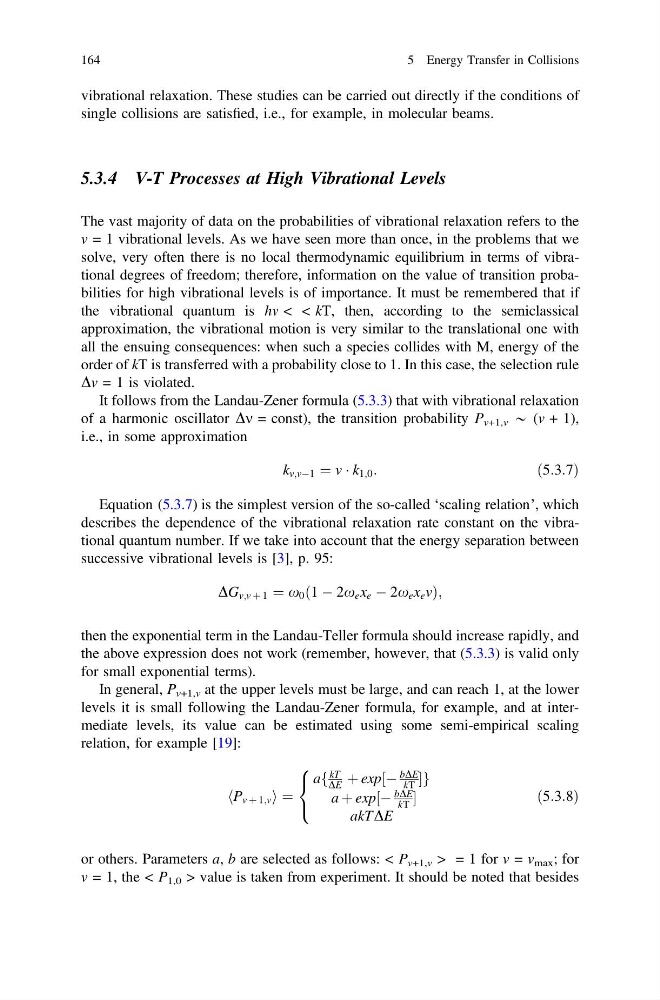
It follows from the Landau-Zener formula (5.3.3) that with vibrational relaxation
of a harmonic oscillator Dm = const), the transition probability P v+1,v * (v + 1),
i.e., in some approximation
k v;vÀ1 ¼ v Á k 1;0 :
ð5:3:7Þ
Equation (5.3.7) is the simplest version of the so-called ‘scaling relation’, which
describes the dependence of the vibrational relaxation rate constant on the vibrational quantum number. If we take into account that the energy separation between
successive vibrational levels is [3], p. 95:
DG v;v þ 1 ¼ x 0 1 À 2x e x e À 2x e x e v
ð
Þ ;
then the exponential term in the Landau-Teller formula should increase rapidly, and
the above expression does not work (remember, however, that (5.3.3) is valid only
for small exponential terms).
In general, P v+1,v at the upper levels must be large, and can reach 1, at the lower
levels it is small following the Landau-Zener formula, for example, and at intermediate levels, its value can be estimated using some semi-empirical scaling
relation, for example [19]:
hP v þ 1;v i ¼
af
kT
DE þ exp½À
bDE
kT g
a þ exp½À
bDE
kT
akTDE
8
<
:
ð5:3:8Þ
or others. Parameters a, b are selected as follows: < P v+1,v > = 1 for v = v max ; for
v = 1, the < P 1,0 > value is taken from experiment. It should be noted that besides
164
5 Energy Transfer in Collisions
single collisions are satisfied, i.e., for example, in molecular beams.
5.3.4 V-T Processes at High Vibrational Levels
The vast majority of data on the probabilities of vibrational relaxation refers to the
v = 1 vibrational levels. As we have seen more than once, in the problems that we
solve, very often there is no local thermodynamic equilibrium in terms of vibrational degrees of freedom; therefore, information on the value of transition probabilities for high vibrational levels is of importance. It must be remembered that if
the vibrational quantum is hm < < kT, then, according to the semiclassical
approximation, the vibrational motion is very similar to the translational one with
all the ensuing consequences: when such a species collides with M, energy of the
order of kT is transferred with a probability close to 1. In this case, the selection rule
Dv = 1 is violated.
It follows from the Landau-Zener formula (5.3.3) that with vibrational relaxation
of a harmonic oscillator Dm = const), the transition probability P v+1,v * (v + 1),
i.e., in some approximation
k v;vÀ1 ¼ v Á k 1;0 :
ð5:3:7Þ
Equation (5.3.7) is the simplest version of the so-called ‘scaling relation’, which
describes the dependence of the vibrational relaxation rate constant on the vibrational quantum number. If we take into account that the energy separation between
successive vibrational levels is [3], p. 95:
DG v;v þ 1 ¼ x 0 1 À 2x e x e À 2x e x e v
ð
Þ ;
then the exponential term in the Landau-Teller formula should increase rapidly, and
the above expression does not work (remember, however, that (5.3.3) is valid only
for small exponential terms).
In general, P v+1,v at the upper levels must be large, and can reach 1, at the lower
levels it is small following the Landau-Zener formula, for example, and at intermediate levels, its value can be estimated using some semi-empirical scaling
relation, for example [19]:
hP v þ 1;v i ¼
af
kT
DE þ exp½À
bDE
kT g
a þ exp½À
bDE
kT
akTDE
8
<
:
ð5:3:8Þ
or others. Parameters a, b are selected as follows: < P v+1,v > = 1 for v = v max ; for
v = 1, the < P 1,0 > value is taken from experiment. It should be noted that besides
164
5 Energy Transfer in Collisions