

5.3.3 V-R Exchange
That such processes take place is beyond doubt. You can understand this if you
imagine a noncollinear collision of two molecules, one of which oscillates. The
presence of such processes is evidenced, for example, by a different relaxation
efficiency of CO(X,v = 1) in a collision with p-H 2 and o-H 2 having different
equilibrium rotational energies: p
pÀH 2
1;0 =p
oÀH 2
1;0
¼ 2. A higher probability of relaxation
in a collision with p-H 2 is explained, apparently, due to resonance of the
p-H 2 (J = 2 ! J = 6) and CO(v = 1 ! v = 0) transitions (see [17, 18] and
references).
It is complicated to study such processes, since the probability of rotational
relaxation, as a rule, is orders of magnitude higher than the probability of
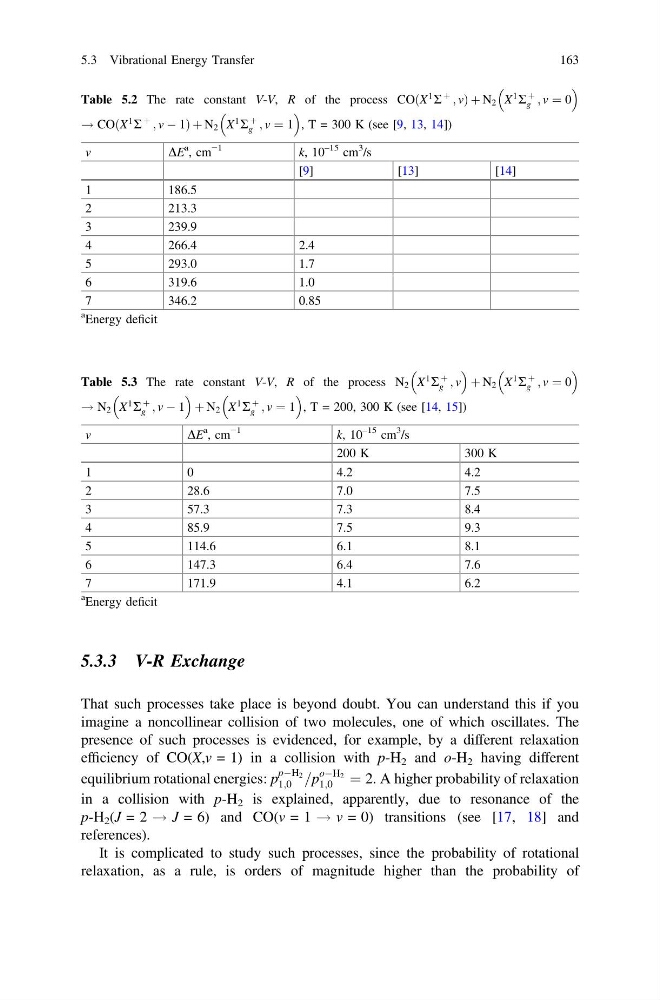
Table 5.2 The rate constant V-V, R of the process CO X
1 R
þ ; v
ð
ÞþN 2 X
1 R
þ
g ; v ¼ 0
! CO X
1 R
þ ; v À 1
ð
Þ þ N 2 X
1 R
þ
g ; v ¼ 1
, T = 300 K (see [9, 13, 14])
v
DE
a , cm
−1
k, 10
–15 cm
3
/s
[9]
[ 13]
[ 14]
1
186.5
2
213.3
3
239.9
4
266.4
2.4
5
293.0
1.7
6
319.6
1.0
7
346.2
0.85
a Energy deficit
Table 5.3 The rate constant V-V, R of the process N 2 X
1 R
þ
g ; v
þ N 2 X
1 R
þ
g ; v ¼ 0
! N 2 X
1 R
þ
g ; v À 1
þ N 2 X
1 R
þ
g ; v ¼ 1
, T = 200, 300 K (see [14, 15])
v
DE
a , cm
−1
k, 10
–15 cm
3
/s
200 K
300 K
1
0
4.2
4.2
2
28.6
7.0
7.5
3
57.3
7.3
8.4
4
85.9
7.5
9.3
5
114.6
6.1
8.1
6
147.3
6.4
7.6
7
171.9
4.1
6.2
a Energy deficit
5.3 Vibrational Energy Transfer
163
That such processes take place is beyond doubt. You can understand this if you
imagine a noncollinear collision of two molecules, one of which oscillates. The
presence of such processes is evidenced, for example, by a different relaxation
efficiency of CO(X,v = 1) in a collision with p-H 2 and o-H 2 having different
equilibrium rotational energies: p
pÀH 2
1;0 =p
oÀH 2
1;0
¼ 2. A higher probability of relaxation
in a collision with p-H 2 is explained, apparently, due to resonance of the
p-H 2 (J = 2 ! J = 6) and CO(v = 1 ! v = 0) transitions (see [17, 18] and
references).
It is complicated to study such processes, since the probability of rotational
relaxation, as a rule, is orders of magnitude higher than the probability of
Table 5.2 The rate constant V-V, R of the process CO X
1 R
þ ; v
ð
ÞþN 2 X
1 R
þ
g ; v ¼ 0
! CO X
1 R
þ ; v À 1
ð
Þ þ N 2 X
1 R
þ
g ; v ¼ 1
, T = 300 K (see [9, 13, 14])
v
DE
a , cm
−1
k, 10
–15 cm
3
/s
[9]
[ 13]
[ 14]
1
186.5
2
213.3
3
239.9
4
266.4
2.4
5
293.0
1.7
6
319.6
1.0
7
346.2
0.85
a Energy deficit
Table 5.3 The rate constant V-V, R of the process N 2 X
1 R
þ
g ; v
þ N 2 X
1 R
þ
g ; v ¼ 0
! N 2 X
1 R
þ
g ; v À 1
þ N 2 X
1 R
þ
g ; v ¼ 1
, T = 200, 300 K (see [14, 15])
v
DE
a , cm
−1
k, 10
–15 cm
3
/s
200 K
300 K
1
0
4.2
4.2
2
28.6
7.0
7.5
3
57.3
7.3
8.4
4
85.9
7.5
9.3
5
114.6
6.1
8.1
6
147.3
6.4
7.6
7
171.9
4.1
6.2
a Energy deficit
5.3 Vibrational Energy Transfer
163