

1=s ¼ k gk ½Bm A =m E
ð5:1:5Þ
We see again that the relaxation time is the shorter, the closer m A is to m B .
Although this equation was obtained for m A < < m B , it gives the correct order of
magnitude for m A % m B , as well. It follows from this equation, in particular, that the
‘rate constant’ of the relaxation of translational energy is close to gas-kinetic. If
p B = 1 Torr, i.e., [B] = 3.3Á10
16 cm
−3 , then for m A = m B , s = (310
–10
3.3Á10
16 )
−1 = 10
–7 s.
5.2 Rotational-Translational Energy Transfer
(R $ T Exchange)
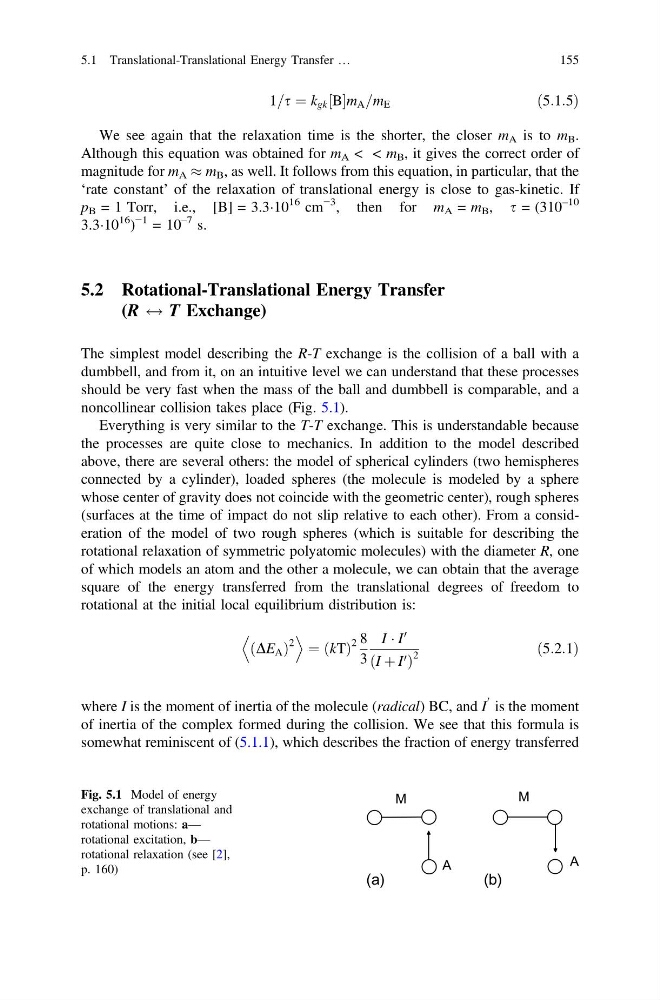
The simplest model describing the R-T exchange is the collision of a ball with a
dumbbell, and from it, on an intuitive level we can understand that these processes
should be very fast when the mass of the ball and dumbbell is comparable, and a
noncollinear collision takes place (Fig. 5.1).
Everything is very similar to the T-T exchange. This is understandable because
the processes are quite close to mechanics. In addition to the model described
above, there are several others: the model of spherical cylinders (two hemispheres
connected by a cylinder), loaded spheres (the molecule is modeled by a sphere
whose center of gravity does not coincide with the geometric center), rough spheres
(surfaces at the time of impact do not slip relative to each other). From a consideration of the model of two rough spheres (which is suitable for describing the
rotational relaxation of symmetric polyatomic molecules) with the diameter R, one
of which models an atom and the other a molecule, we can obtain that the average
square of the energy transferred from the translational degrees of freedom to
rotational at the initial local equilibrium distribution is:
DE A
ð
Þ
2
D
E
¼ ðkTÞ
2 8
3
I Á I
0
I þ I 0
ð
Þ
2
ð5:2:1Þ
where I is the moment of inertia of the molecule (radical) BC, and I
0 is the moment
of inertia of the complex formed during the collision. We see that this formula is
somewhat reminiscent of (5.1.1), which describes the fraction of energy transferred
M
M
A
(b)
A
(a)
Fig. 5.1 Model of energy
exchange of translational and
rotational motions: a—
rotational excitation, b—
rotational relaxation (see [2],
p. 160)
5.1 Translational-Translational Energy Transfer …
155
ð5:1:5Þ
We see again that the relaxation time is the shorter, the closer m A is to m B .
Although this equation was obtained for m A < < m B , it gives the correct order of
magnitude for m A % m B , as well. It follows from this equation, in particular, that the
‘rate constant’ of the relaxation of translational energy is close to gas-kinetic. If
p B = 1 Torr, i.e., [B] = 3.3Á10
16 cm
−3 , then for m A = m B , s = (310
–10
3.3Á10
16 )
−1 = 10
–7 s.
5.2 Rotational-Translational Energy Transfer
(R $ T Exchange)
The simplest model describing the R-T exchange is the collision of a ball with a
dumbbell, and from it, on an intuitive level we can understand that these processes
should be very fast when the mass of the ball and dumbbell is comparable, and a
noncollinear collision takes place (Fig. 5.1).
Everything is very similar to the T-T exchange. This is understandable because
the processes are quite close to mechanics. In addition to the model described
above, there are several others: the model of spherical cylinders (two hemispheres
connected by a cylinder), loaded spheres (the molecule is modeled by a sphere
whose center of gravity does not coincide with the geometric center), rough spheres
(surfaces at the time of impact do not slip relative to each other). From a consideration of the model of two rough spheres (which is suitable for describing the
rotational relaxation of symmetric polyatomic molecules) with the diameter R, one
of which models an atom and the other a molecule, we can obtain that the average
square of the energy transferred from the translational degrees of freedom to
rotational at the initial local equilibrium distribution is:
DE A
ð
Þ
2
D
E
¼ ðkTÞ
2 8
3
I Á I
0
I þ I 0
ð
Þ
2
ð5:2:1Þ
where I is the moment of inertia of the molecule (radical) BC, and I
0 is the moment
of inertia of the complex formed during the collision. We see that this formula is
somewhat reminiscent of (5.1.1), which describes the fraction of energy transferred
M
M
A
(b)
A
(a)
Fig. 5.1 Model of energy
exchange of translational and
rotational motions: a—
rotational excitation, b—
rotational relaxation (see [2],
p. 160)
5.1 Translational-Translational Energy Transfer …
155