

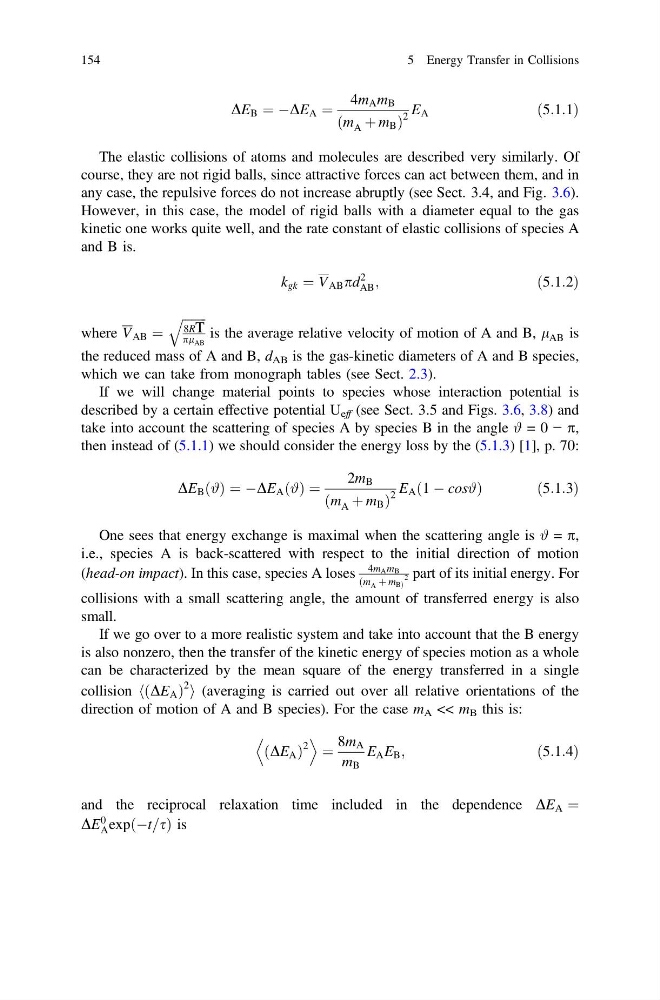
DE B ¼ ÀDE A ¼
4m A m B
ðm A þ m B Þ
2
E A
ð5:1:1Þ
The elastic collisions of atoms and molecules are described very similarly. Of
course, they are not rigid balls, since attractive forces can act between them, and in
any case, the repulsive forces do not increase abruptly (see Sect. 3.4, and Fig. 3.6).
However, in this case, the model of rigid balls with a diameter equal to the gas
kinetic one works quite well, and the rate constant of elastic collisions of species A
and B is.
k gk ¼ V AB pd
2
AB ;
ð5:1:2Þ
where V AB ¼
ffiffiffiffiffiffiffi ffi
8RT
pl AB
q
is the average relative velocity of motion of A and B, l AB is
the reduced mass of A and B, d AB is the gas-kinetic diameters of A and B species,
which we can take from monograph tables (see Sect. 2.3).
If we will change material points to species whose interaction potential is
described by a certain effective potential U eff (see Sect. 3.5 and Figs. 3.6, 3.8) and
take into account the scattering of species A by species B in the angle # = 0 − p,
then instead of (5.1.1) we should consider the energy loss by the (5.1.3) [1], p. 70:
DE B #
ð Þ ¼ ÀDE A #
ð Þ ¼
2m B
ðm A þ m B Þ
2
E A ð1 À cos#Þ
ð 5:1:3Þ
One sees that energy exchange is maximal when the scattering angle is # = p,
i.e., species A is back-scattered with respect to the initial direction of motion
(head-on impact). In this case, species A loses
4m A m B
ðm A þ m BÞ
2 part of its initial energy. For
collisions with a small scattering angle, the amount of transferred energy is also
small.
If we go over to a more realistic system and take into account that the B energy
is also nonzero, then the transfer of the kinetic energy of species motion as a whole
can be characterized by the mean square of the energy transferred in a single
collision hðDE A Þ
2 i (averaging is carried out over all relative orientations of the
direction of motion of A and B species). For the case m A << m B this is:
DE A
ð
Þ
2
D
E
¼
8m A
m B
E A E B ;
ð5:1:4Þ
and the reciprocal relaxation time included in the dependence DE A ¼
DE
0
A expðÀt=sÞ is
154
5 Energy Transfer in Collisions
4m A m B
ðm A þ m B Þ
2
E A
ð5:1:1Þ
The elastic collisions of atoms and molecules are described very similarly. Of
course, they are not rigid balls, since attractive forces can act between them, and in
any case, the repulsive forces do not increase abruptly (see Sect. 3.4, and Fig. 3.6).
However, in this case, the model of rigid balls with a diameter equal to the gas
kinetic one works quite well, and the rate constant of elastic collisions of species A
and B is.
k gk ¼ V AB pd
2
AB ;
ð5:1:2Þ
where V AB ¼
ffiffiffiffiffiffiffi ffi
8RT
pl AB
q
is the average relative velocity of motion of A and B, l AB is
the reduced mass of A and B, d AB is the gas-kinetic diameters of A and B species,
which we can take from monograph tables (see Sect. 2.3).
If we will change material points to species whose interaction potential is
described by a certain effective potential U eff (see Sect. 3.5 and Figs. 3.6, 3.8) and
take into account the scattering of species A by species B in the angle # = 0 − p,
then instead of (5.1.1) we should consider the energy loss by the (5.1.3) [1], p. 70:
DE B #
ð Þ ¼ ÀDE A #
ð Þ ¼
2m B
ðm A þ m B Þ
2
E A ð1 À cos#Þ
ð 5:1:3Þ
One sees that energy exchange is maximal when the scattering angle is # = p,
i.e., species A is back-scattered with respect to the initial direction of motion
(head-on impact). In this case, species A loses
4m A m B
ðm A þ m BÞ
2 part of its initial energy. For
collisions with a small scattering angle, the amount of transferred energy is also
small.
If we go over to a more realistic system and take into account that the B energy
is also nonzero, then the transfer of the kinetic energy of species motion as a whole
can be characterized by the mean square of the energy transferred in a single
collision hðDE A Þ
2 i (averaging is carried out over all relative orientations of the
direction of motion of A and B species). For the case m A << m B this is:
DE A
ð
Þ
2
D
E
¼
8m A
m B
E A E B ;
ð5:1:4Þ
and the reciprocal relaxation time included in the dependence DE A ¼
DE
0
A expðÀt=sÞ is
154
5 Energy Transfer in Collisions