

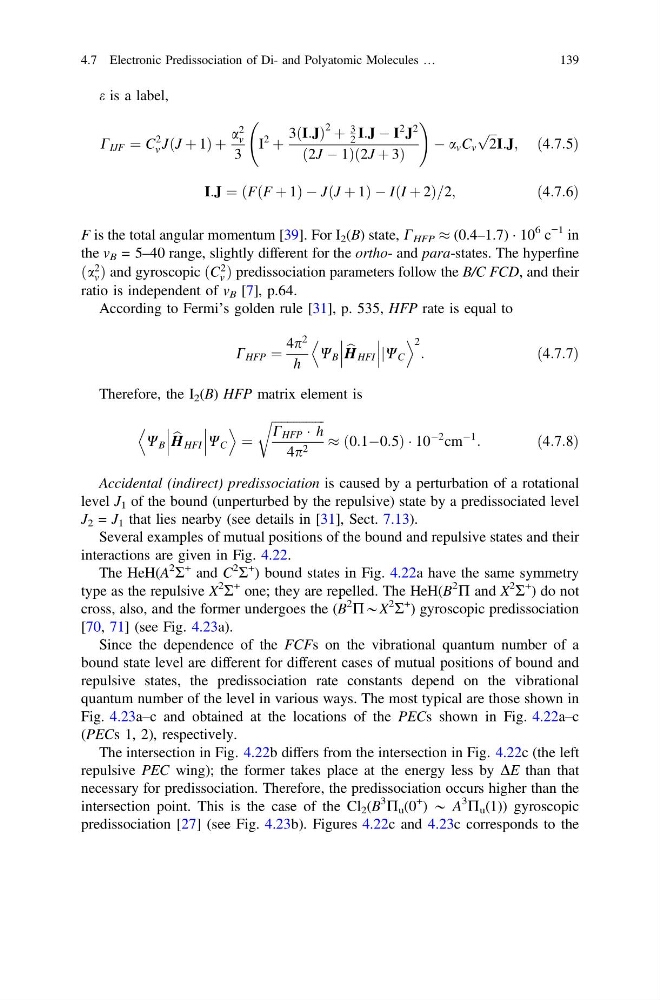
e is a label,
C IJF ¼ C
2
v J J þ 1
ð
Þþ
a
2
v
3
I
2
þ
3 I:J
ð Þ
2 þ
3
2 I:J À I
2 J
2
2J À 1
ð
Þ 2J þ 3
ð
Þ
!
À a v C v
ffiffi ffi
2
p
I:J; ð4:7:5Þ
I:J ¼ ðF F þ 1
ð
ÞÀJ J þ 1
ð
ÞÀI I þ 2
ð
Þ=2;
ð4:7:6Þ
F is the total angular momentum [39]. For I 2 (B) state, C HFP % (0.4–1.7) Á 10
6 c
−1 in
the v B = 5–40 range, slightly different for the ortho- and para-states. The hyperfine
ða
2
v Þ and gyroscopic ðC
2
v Þ predissociation parameters follow the B/C FCD, and their
ratio is independent of v B [7], p.64.
According to Fermi’s golden rule [31], p. 535, HFP rate is equal to
C HFP ¼
4p
2
h
W B b
H HFI
jW C
D
E 2 :
ð4:7:7Þ
Therefore, the I 2 (B) HFP matrix element is
W B b
H HFI
W C
D
E
¼
ffiffiffiffiffiffiffiffiffiffiffiffiffiffiffiffiffi
C HFP Á h
4p 2
r
% 0:1À0:5
ð
ÞÁ10
À2 cm
À1
:
ð4:7:8Þ
Accidental (indirect) predissociation is caused by a perturbation of a rotational
level J 1 of the bound (unperturbed by the repulsive) state by a predissociated level
J 2 = J 1 that lies nearby (see details in [31], Sect. 7.13).
Several examples of mutual positions of the bound and repulsive states and their
interactions are given in Fig. 4.22.
The HeH(A
2 R
+ and C
2 R
+
) bound states in Fig. 4.22a have the same symmetry
type as the repulsive X
2 R
+ one; they are repelled. The HeH(B
2 P and X
2 R
+
) do not
cross, also, and the former undergoes the (B
2 P*X
2 R
+
) gyroscopic predissociation
[70, 71] (see Fig. 4.23a).
Since the dependence of the FCFs on the vibrational quantum number of a
bound state level are different for different cases of mutual positions of bound and
repulsive states, the predissociation rate constants depend on the vibrational
quantum number of the level in various ways. The most typical are those shown in
Fig. 4.23a–c and obtained at the locations of the PECs shown in Fig. 4.22a–c
(PECs 1, 2), respectively.
The intersection in Fig. 4.22b differs from the intersection in Fig. 4.22c (the left
repulsive PEC wing); the former takes place at the energy less by DE than that
necessary for predissociation. Therefore, the predissociation occurs higher than the
intersection point. This is the case of the Cl 2 (B
3 P u (0
+
) * A
3 P u (1)) gyroscopic
predissociation [27] (see Fig. 4.23b). Figures 4.22c and 4.23c corresponds to the
4.7 Electronic Predissociation of Di- and Polyatomic Molecules …
139
C IJF ¼ C
2
v J J þ 1
ð
Þþ
a
2
v
3
I
2
þ
3 I:J
ð Þ
2 þ
3
2 I:J À I
2 J
2
2J À 1
ð
Þ 2J þ 3
ð
Þ
!
À a v C v
ffiffi ffi
2
p
I:J; ð4:7:5Þ
I:J ¼ ðF F þ 1
ð
ÞÀJ J þ 1
ð
ÞÀI I þ 2
ð
Þ=2;
ð4:7:6Þ
F is the total angular momentum [39]. For I 2 (B) state, C HFP % (0.4–1.7) Á 10
6 c
−1 in
the v B = 5–40 range, slightly different for the ortho- and para-states. The hyperfine
ða
2
v Þ and gyroscopic ðC
2
v Þ predissociation parameters follow the B/C FCD, and their
ratio is independent of v B [7], p.64.
According to Fermi’s golden rule [31], p. 535, HFP rate is equal to
C HFP ¼
4p
2
h
W B b
H HFI
jW C
D
E 2 :
ð4:7:7Þ
Therefore, the I 2 (B) HFP matrix element is
W B b
H HFI
W C
D
E
¼
ffiffiffiffiffiffiffiffiffiffiffiffiffiffiffiffiffi
C HFP Á h
4p 2
r
% 0:1À0:5
ð
ÞÁ10
À2 cm
À1
:
ð4:7:8Þ
Accidental (indirect) predissociation is caused by a perturbation of a rotational
level J 1 of the bound (unperturbed by the repulsive) state by a predissociated level
J 2 = J 1 that lies nearby (see details in [31], Sect. 7.13).
Several examples of mutual positions of the bound and repulsive states and their
interactions are given in Fig. 4.22.
The HeH(A
2 R
+ and C
2 R
+
) bound states in Fig. 4.22a have the same symmetry
type as the repulsive X
2 R
+ one; they are repelled. The HeH(B
2 P and X
2 R
+
) do not
cross, also, and the former undergoes the (B
2 P*X
2 R
+
) gyroscopic predissociation
[70, 71] (see Fig. 4.23a).
Since the dependence of the FCFs on the vibrational quantum number of a
bound state level are different for different cases of mutual positions of bound and
repulsive states, the predissociation rate constants depend on the vibrational
quantum number of the level in various ways. The most typical are those shown in
Fig. 4.23a–c and obtained at the locations of the PECs shown in Fig. 4.22a–c
(PECs 1, 2), respectively.
The intersection in Fig. 4.22b differs from the intersection in Fig. 4.22c (the left
repulsive PEC wing); the former takes place at the energy less by DE than that
necessary for predissociation. Therefore, the predissociation occurs higher than the
intersection point. This is the case of the Cl 2 (B
3 P u (0
+
) * A
3 P u (1)) gyroscopic
predissociation [27] (see Fig. 4.23b). Figures 4.22c and 4.23c corresponds to the
4.7 Electronic Predissociation of Di- and Polyatomic Molecules …
139