

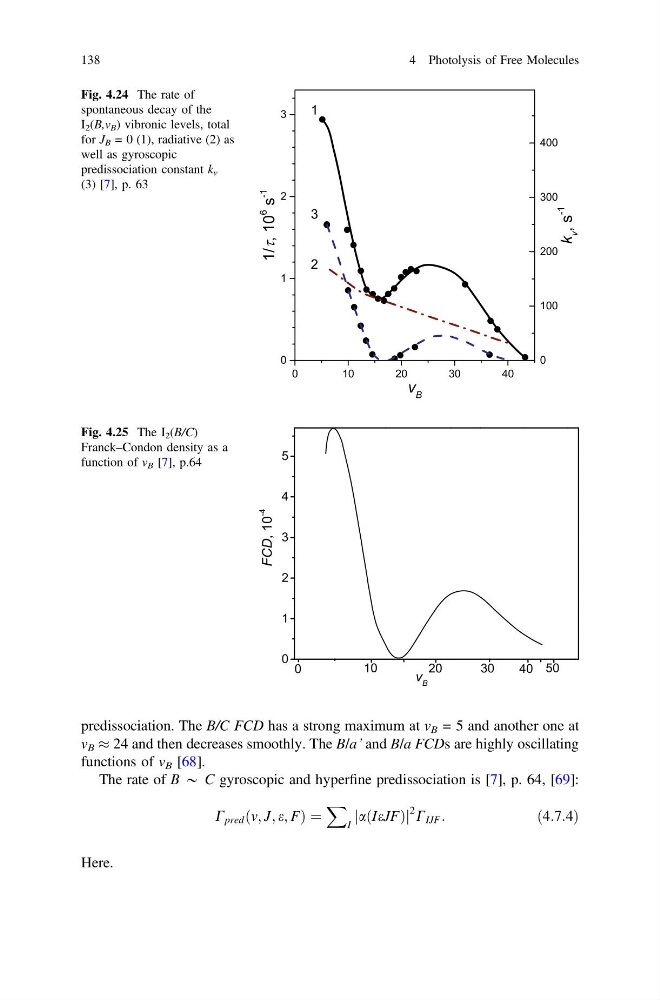
predissociation. The B/C FCD has a strong maximum at v B = 5 and another one at
v B % 24 and then decreases smoothly. The B/a’ and B/a FCDs are highly oscillating
functions of v B [68].
The rate of B * C gyroscopic and hyperfine predissociation is [7], p. 64, [69]:
C pred v; J; e; F
ð
Þ¼
X
I
a IeJF
ð
Þ
j
j
2 C IJF :
ð4:7:4Þ
Here.
Fig. 4.24 The rate of
spontaneous decay of the
I 2 (B,v B ) vibronic levels, total
for J B = 0 (1), radiative (2) as
well as gyroscopic
predissociation constant k v
(3) [7], p. 63
Fig. 4.25 The I 2 (B/C)
Franck–Condon density as a
function of v B [7], p.64
138
4 Photolysis of Free Molecules
v B % 24 and then decreases smoothly. The B/a’ and B/a FCDs are highly oscillating
functions of v B [68].
The rate of B * C gyroscopic and hyperfine predissociation is [7], p. 64, [69]:
C pred v; J; e; F
ð
Þ¼
X
I
a IeJF
ð
Þ
j
j
2 C IJF :
ð4:7:4Þ
Here.
Fig. 4.24 The rate of
spontaneous decay of the
I 2 (B,v B ) vibronic levels, total
for J B = 0 (1), radiative (2) as
well as gyroscopic
predissociation constant k v
(3) [7], p. 63
Fig. 4.25 The I 2 (B/C)
Franck–Condon density as a
function of v B [7], p.64
138
4 Photolysis of Free Molecules