

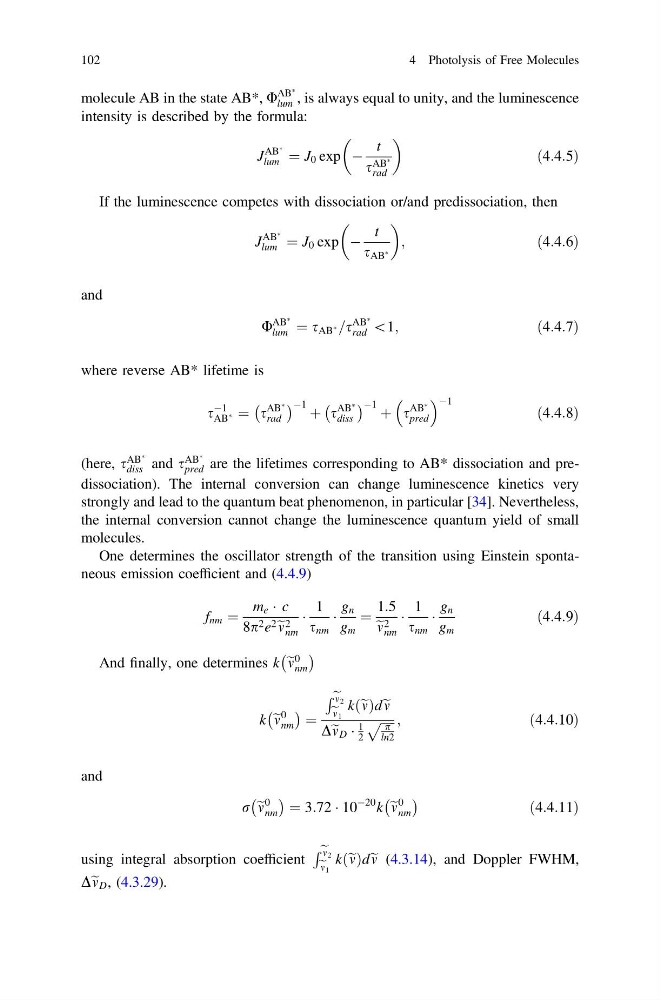
molecule AB in the state AB*, U
AB
Ã
lum , is always equal to unity, and the luminescence
intensity is described by the formula:
J
AB
Ã
lum ¼ J 0 exp À
t
s AB
Ã
rad
ð4:4:5Þ
If the luminescence competes with dissociation or/and predissociation, then
J
AB
Ã
lum ¼ J 0 exp À
t
s AB
Ã
;
ð4:4:6Þ
and
U
AB
Ã
lum ¼ s AB
à =s
AB
Ã
rad \1;
ð4:4:7Þ
where reverse AB* lifetime is
s
À1
AB
à ¼ s
AB
Ã
rad
À
Á À1 þ s
AB
Ã
diss
À
Á À1 þ s
AB
Ã
pred
À1
ð4:4:8Þ
(here, s
AB
Ã
diss and s
AB
Ã
pred are the lifetimes corresponding to AB* dissociation and predissociation). The internal conversion can change luminescence kinetics very
strongly and lead to the quantum beat phenomenon, in particular [34]. Nevertheless,
the internal conversion cannot change the luminescence quantum yield of small
molecules.
One determines the oscillator strength of the transition using Einstein spontaneous emission coefficient and (4.4.9)
f nm ¼
m e Á c
8p 2 e 2 e m 2
nm
Á
1
s nm
Á
g n
g m
¼
1:5
e m 2
nm
Á
1
s nm
Á
g n
g m
ð4:4:9Þ
And finally, one determines k e m
0
nm
À Á
k e m
0
nm
À Á ¼
R e m 2
e m 1
k e m
ð Þde m
De m D Á
1
2
ffiffiffiffi ffi
p
ln2
p ;
ð4:4:10Þ
and
r e m
0
nm
À Á ¼ 3:72 Á 10
À20
k e m
0
nm
À Á
ð4:4:11Þ
using integral absorption coefficient
R e m 2
e m 1
k e m
ð Þde m (4.3.14), and Doppler FWHM,
De m D , (4.3.29).
102
4 Photolysis of Free Molecules
AB
Ã
lum , is always equal to unity, and the luminescence
intensity is described by the formula:
J
AB
Ã
lum ¼ J 0 exp À
t
s AB
Ã
rad
ð4:4:5Þ
If the luminescence competes with dissociation or/and predissociation, then
J
AB
Ã
lum ¼ J 0 exp À
t
s AB
Ã
;
ð4:4:6Þ
and
U
AB
Ã
lum ¼ s AB
à =s
AB
Ã
rad \1;
ð4:4:7Þ
where reverse AB* lifetime is
s
À1
AB
à ¼ s
AB
Ã
rad
À
Á À1 þ s
AB
Ã
diss
À
Á À1 þ s
AB
Ã
pred
À1
ð4:4:8Þ
(here, s
AB
Ã
diss and s
AB
Ã
pred are the lifetimes corresponding to AB* dissociation and predissociation). The internal conversion can change luminescence kinetics very
strongly and lead to the quantum beat phenomenon, in particular [34]. Nevertheless,
the internal conversion cannot change the luminescence quantum yield of small
molecules.
One determines the oscillator strength of the transition using Einstein spontaneous emission coefficient and (4.4.9)
f nm ¼
m e Á c
8p 2 e 2 e m 2
nm
Á
1
s nm
Á
g n
g m
¼
1:5
e m 2
nm
Á
1
s nm
Á
g n
g m
ð4:4:9Þ
And finally, one determines k e m
0
nm
À Á
k e m
0
nm
À Á ¼
R e m 2
e m 1
k e m
ð Þde m
De m D Á
1
2
ffiffiffiffi ffi
p
ln2
p ;
ð4:4:10Þ
and
r e m
0
nm
À Á ¼ 3:72 Á 10
À20
k e m
0
nm
À Á
ð4:4:11Þ
using integral absorption coefficient
R e m 2
e m 1
k e m
ð Þde m (4.3.14), and Doppler FWHM,
De m D , (4.3.29).
102
4 Photolysis of Free Molecules