

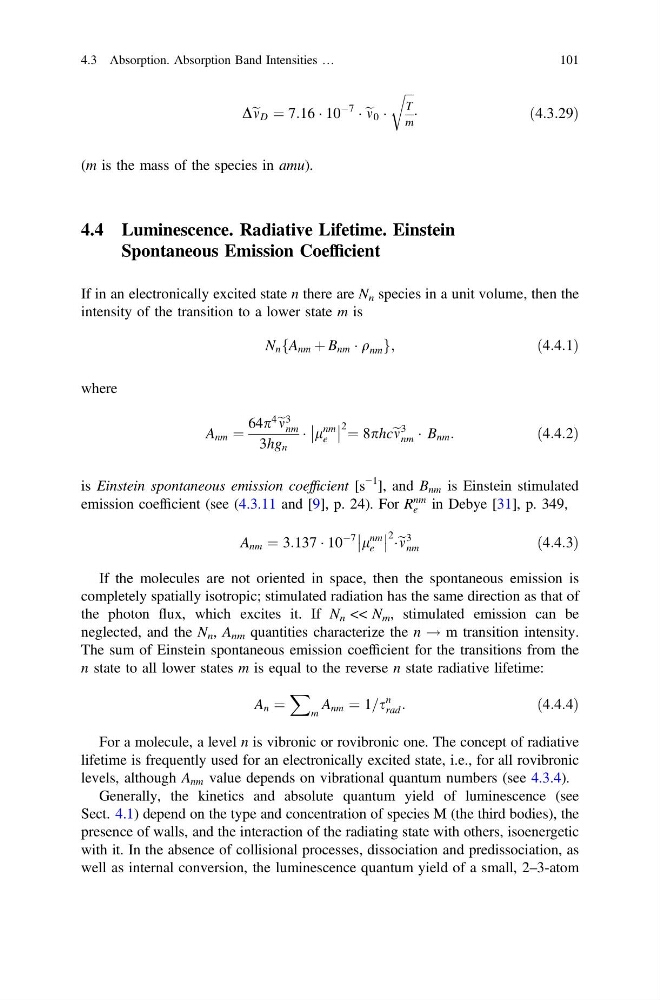
De m D ¼ 7:16 Á 10
À7
Á e m 0 Á
ffiffiffi
T
m
r
Á
ð 4:3:29Þ
(m is the mass of the species in amu).
4.4 Luminescence. Radiative Lifetime. Einstein
Spontaneous Emission Coefficient
If in an electronically excited state n there are N n species in a unit volume, then the
intensity of the transition to a lower state m is
N n A nm þ B nm Á q nm
f
g ;
ð4:4:1Þ
where
A nm ¼
64p
4 e m
3
nm
3hg n
Á l
nm
e
2 ¼ 8phce m
3
nm Á B nm :
ð4:4:2Þ
is Einstein spontaneous emission coefficient [s
−1 ], and B nm is Einstein stimulated
emission coefficient (see (4.3.11 and [9], p. 24). For R
nm
e in Debye [31], p. 349,
A nm ¼ 3:137 Á 10
À7
l
nm
e
2 Áe m
3
nm
ð4:4:3Þ
If the molecules are not oriented in space, then the spontaneous emission is
completely spatially isotropic; stimulated radiation has the same direction as that of
the photon flux, which excites it. If N n << N m , stimulated emission can be
neglected, and the N n , A nm quantities characterize the n ! m transition intensity.
The sum of Einstein spontaneous emission coefficient for the transitions from the
n state to all lower states m is equal to the reverse n state radiative lifetime:
A n ¼
X
m
A nm ¼ 1=s
n
rad :
ð4:4:4Þ
For a molecule, a level n is vibronic or rovibronic one. The concept of radiative
lifetime is frequently used for an electronically excited state, i.e., for all rovibronic
levels, although A nm value depends on vibrational quantum numbers (see 4.3.4).
Generally, the kinetics and absolute quantum yield of luminescence (see
Sect. 4.1) depend on the type and concentration of species M (the third bodies), the
presence of walls, and the interaction of the radiating state with others, isoenergetic
with it. In the absence of collisional processes, dissociation and predissociation, as
well as internal conversion, the luminescence quantum yield of a small, 2–3-atom
4.3 Absorption. Absorption Band Intensities …
101
À7
Á e m 0 Á
ffiffiffi
T
m
r
Á
ð 4:3:29Þ
(m is the mass of the species in amu).
4.4 Luminescence. Radiative Lifetime. Einstein
Spontaneous Emission Coefficient
If in an electronically excited state n there are N n species in a unit volume, then the
intensity of the transition to a lower state m is
N n A nm þ B nm Á q nm
f
g ;
ð4:4:1Þ
where
A nm ¼
64p
4 e m
3
nm
3hg n
Á l
nm
e
2 ¼ 8phce m
3
nm Á B nm :
ð4:4:2Þ
is Einstein spontaneous emission coefficient [s
−1 ], and B nm is Einstein stimulated
emission coefficient (see (4.3.11 and [9], p. 24). For R
nm
e in Debye [31], p. 349,
A nm ¼ 3:137 Á 10
À7
l
nm
e
2 Áe m
3
nm
ð4:4:3Þ
If the molecules are not oriented in space, then the spontaneous emission is
completely spatially isotropic; stimulated radiation has the same direction as that of
the photon flux, which excites it. If N n << N m , stimulated emission can be
neglected, and the N n , A nm quantities characterize the n ! m transition intensity.
The sum of Einstein spontaneous emission coefficient for the transitions from the
n state to all lower states m is equal to the reverse n state radiative lifetime:
A n ¼
X
m
A nm ¼ 1=s
n
rad :
ð4:4:4Þ
For a molecule, a level n is vibronic or rovibronic one. The concept of radiative
lifetime is frequently used for an electronically excited state, i.e., for all rovibronic
levels, although A nm value depends on vibrational quantum numbers (see 4.3.4).
Generally, the kinetics and absolute quantum yield of luminescence (see
Sect. 4.1) depend on the type and concentration of species M (the third bodies), the
presence of walls, and the interaction of the radiating state with others, isoenergetic
with it. In the absence of collisional processes, dissociation and predissociation, as
well as internal conversion, the luminescence quantum yield of a small, 2–3-atom
4.3 Absorption. Absorption Band Intensities …
101