

3 P 1 ,
3 P 2 (in terms of K-s coupling) (see left part of Fig. 4.2). The HI(r
2
p
3
r*
1 P,
3 P 1 ← r
2
p
4
X
1 R
+ ) transitions have to be observed, and the intensity of that of the
former state has to be ‘transferred’ to the (
3 P 1 ← X
1 R
+
) one. If additional (c), type
I coupling exist, the
3 P
þ
0 ← X
1 R
+ (0
+
← 0
+ in terms of (c) coupling) should be
observed as a result of the mixing of both states involved in transitions with higher
0
+ states. Mulliken’s predictions have been partially confirmed in experiments. All
three transitions were discovered, though relative strengths of the transitions and
splittings of the
1 P,
3 P
þ
0 and
3
P 1 curves do not seem to be consistent with the
strong case (c), type I effect. The HI(
1 P,
3 P
þ
0 and
3
P 1 ← X
1 R
+
) transition
probabilities are l e
j j
2 = 0.126, 0.160 and 0.038, inits, D
2 [26]. Note that transition
probability to the ‘triplet’
3 P
þ
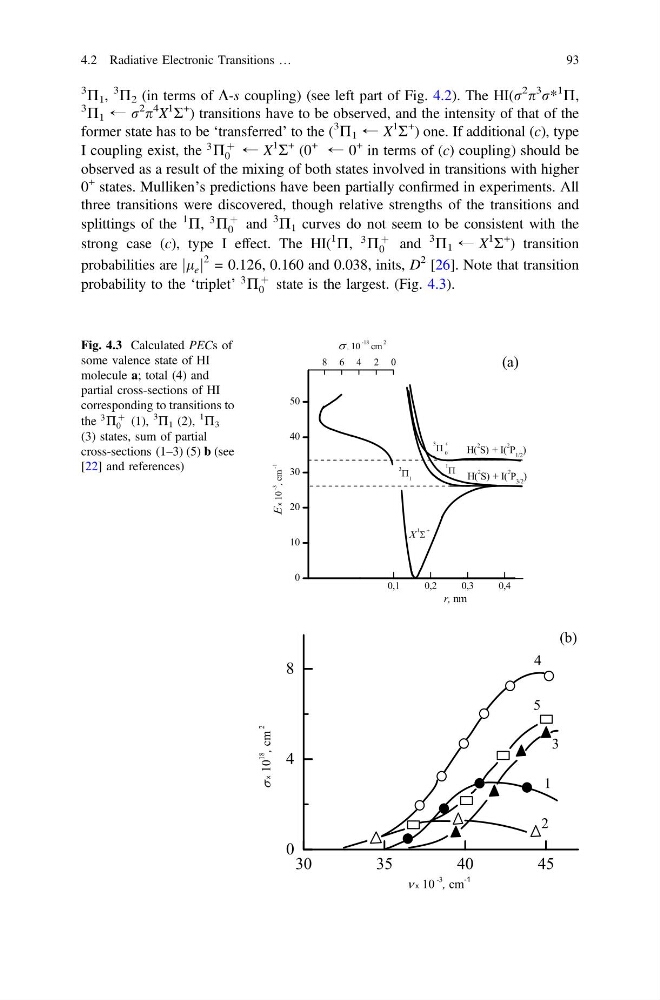
0 state is the largest. (Fig. 4.3).
(a)
(b)
Fig. 4.3 Calculated PECs of
some valence state of HI
molecule a; total (4) and
partial cross-sections of HI
corresponding to transitions to
the
3 P
þ
0 (1),
3
P 1 (2),
1
P 3
(3) states, sum of partial
cross-sections (1–3) (5) b (see
[22] and references)
4.2 Radiative Electronic Transitions …
93
3 P 2 (in terms of K-s coupling) (see left part of Fig. 4.2). The HI(r
2
p
3
r*
1 P,
3 P 1 ← r
2
p
4
X
1 R
+ ) transitions have to be observed, and the intensity of that of the
former state has to be ‘transferred’ to the (
3 P 1 ← X
1 R
+
) one. If additional (c), type
I coupling exist, the
3 P
þ
0 ← X
1 R
+ (0
+
← 0
+ in terms of (c) coupling) should be
observed as a result of the mixing of both states involved in transitions with higher
0
+ states. Mulliken’s predictions have been partially confirmed in experiments. All
three transitions were discovered, though relative strengths of the transitions and
splittings of the
1 P,
3 P
þ
0 and
3
P 1 curves do not seem to be consistent with the
strong case (c), type I effect. The HI(
1 P,
3 P
þ
0 and
3
P 1 ← X
1 R
+
) transition
probabilities are l e
j j
2 = 0.126, 0.160 and 0.038, inits, D
2 [26]. Note that transition
probability to the ‘triplet’
3 P
þ
0 state is the largest. (Fig. 4.3).
(a)
(b)
Fig. 4.3 Calculated PECs of
some valence state of HI
molecule a; total (4) and
partial cross-sections of HI
corresponding to transitions to
the
3 P
þ
0 (1),
3
P 1 (2),
1
P 3
(3) states, sum of partial
cross-sections (1–3) (5) b (see
[22] and references)
4.2 Radiative Electronic Transitions …
93