

I 2 r
2
g p
3
u p
4
g
2
P 1=2 r
Ã
g
!
0;1u:
ð4:2:22Þ
(the configurations of the R
0 I
+ ion is given in parentheses). The R
0 I state is then
characterized by the quantum numbers S c , K c , R c , X c , X = X c ± 1/2, the spin
quantum number is meaningless. The molecular states having the same quantum
numbers K = K c , X, the same parity, g, u, and the same properties for reflection
through a plane containing the molecular axes, + , -, (for X = 0 state, only) have the
same symmetry types, and are mixed and repelled. In other words, the ‘true’, i.e.,
obtained to a reasonably good approximation, wave functions of states belonging to
the same species are the linear combination of ‘old’ unperturbed states. This
approximation particularly applies to the
3 P 1 and
1 P states (in terms of K-s coupling) of heteroatomic molecules. Thus, compared with the K-s coupling, the
intensity of the
1 P ← X
1 R
+ transition decreases and that of the
3 P 1 ← X
1 R
+
transition increases. Another essential factor, in this case, is that the R
0 I states
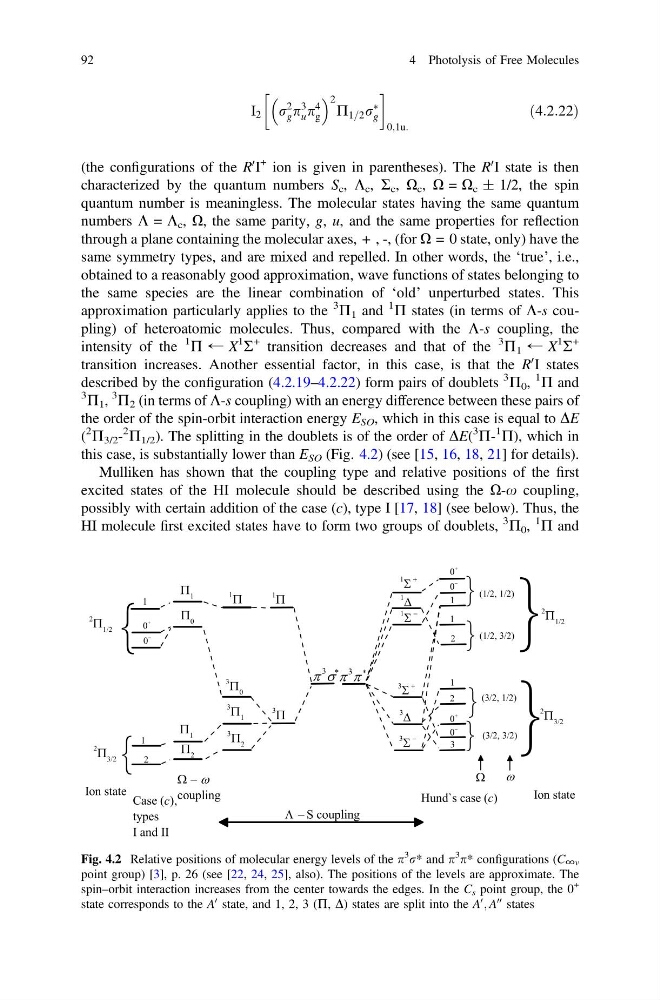
described by the configuration (4.2.19–4.2.22) form pairs of doublets
3 P 0 ,
1 P and
3 P 1 ,
3 P 2 (in terms of K-s coupling) with an energy difference between these pairs of
the order of the spin-orbit interaction energy E SO , which in this case is equal to DE
(
2 P 3/2 -
2 P 1/2 ). The splitting in the doublets is of the order of DE(
3 P1 P), which in
this case, is substantially lower than E SO (Fig. 4.2) (see [15, 16, 18, 21] for details).
Mulliken has shown that the coupling type and relative positions of the first
excited states of the HI molecule should be described using the X-x coupling,
possibly with certain addition of the case (c), type I [17, 18] (see below). Thus, the
HI molecule first excited states have to form two groups of doublets,
3 P 0 ,
1 P and
Fig. 4.2 Relative positions of molecular energy levels of the p
3
r* and p
3
p* configurations (C ∞v
point group) [3], p. 26 (see [22, 24, 25], also). The positions of the levels are approximate. The
spin–orbit interaction increases from the center towards the edges. In the C s point group, the 0
+
state corresponds to the A
0 state, and 1, 2, 3 (P, D) states are split into the A
0 ; A
00 states
92
4 Photolysis of Free Molecules
2
g p
3
u p
4
g
2
P 1=2 r
Ã
g
!
0;1u:
ð4:2:22Þ
(the configurations of the R
0 I
+ ion is given in parentheses). The R
0 I state is then
characterized by the quantum numbers S c , K c , R c , X c , X = X c ± 1/2, the spin
quantum number is meaningless. The molecular states having the same quantum
numbers K = K c , X, the same parity, g, u, and the same properties for reflection
through a plane containing the molecular axes, + , -, (for X = 0 state, only) have the
same symmetry types, and are mixed and repelled. In other words, the ‘true’, i.e.,
obtained to a reasonably good approximation, wave functions of states belonging to
the same species are the linear combination of ‘old’ unperturbed states. This
approximation particularly applies to the
3 P 1 and
1 P states (in terms of K-s coupling) of heteroatomic molecules. Thus, compared with the K-s coupling, the
intensity of the
1 P ← X
1 R
+ transition decreases and that of the
3 P 1 ← X
1 R
+
transition increases. Another essential factor, in this case, is that the R
0 I states
described by the configuration (4.2.19–4.2.22) form pairs of doublets
3 P 0 ,
1 P and
3 P 1 ,
3 P 2 (in terms of K-s coupling) with an energy difference between these pairs of
the order of the spin-orbit interaction energy E SO , which in this case is equal to DE
(
2 P 3/2 -
2 P 1/2 ). The splitting in the doublets is of the order of DE(
3 P1 P), which in
this case, is substantially lower than E SO (Fig. 4.2) (see [15, 16, 18, 21] for details).
Mulliken has shown that the coupling type and relative positions of the first
excited states of the HI molecule should be described using the X-x coupling,
possibly with certain addition of the case (c), type I [17, 18] (see below). Thus, the
HI molecule first excited states have to form two groups of doublets,
3 P 0 ,
1 P and
Fig. 4.2 Relative positions of molecular energy levels of the p
3
r* and p
3
p* configurations (C ∞v
point group) [3], p. 26 (see [22, 24, 25], also). The positions of the levels are approximate. The
spin–orbit interaction increases from the center towards the edges. In the C s point group, the 0
+
state corresponds to the A
0 state, and 1, 2, 3 (P, D) states are split into the A
0 ; A
00 states
92
4 Photolysis of Free Molecules