

(b) Two-Dimensional (Square) Lattice
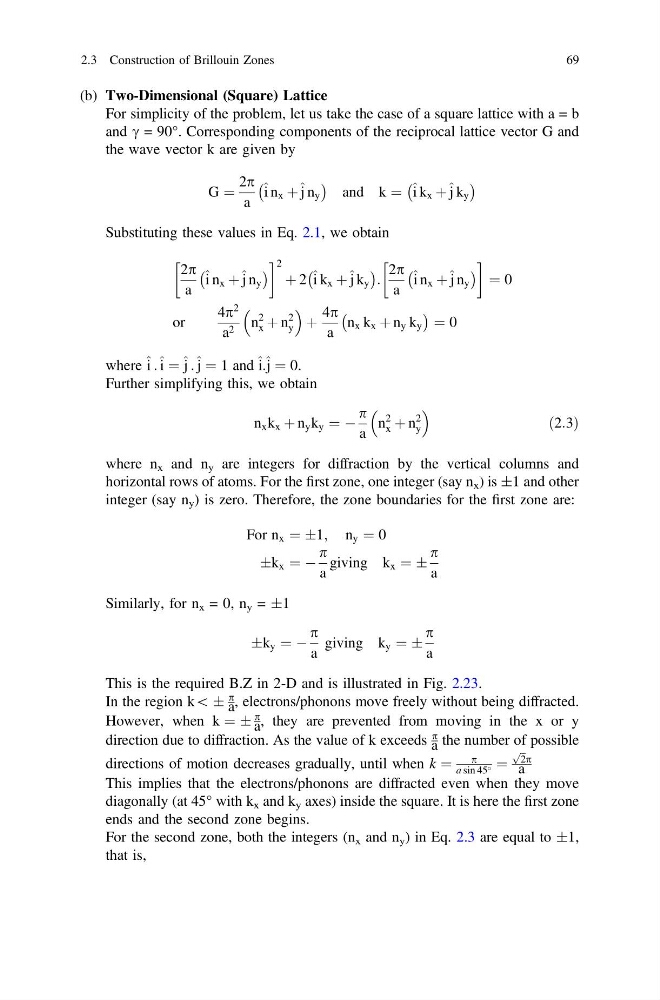
For simplicity of the problem, let us take the case of a square lattice with a = b
and c = 90°. Corresponding components of the reciprocal lattice vector G and
the wave vector k are given by
G ¼
2p
a
^ i n x þ ^ j n y
À
Á
and k ¼ ^ i k x þ ^ j k y
À
Á
Substituting these values in Eq. 2.1, we obtain
2p
a
^ i n x þ ^ j n y
À
Á
! 2
þ 2 ^ i k x þ ^ j k y
À
Á :
2p
a
^ i n x þ ^ j n y
À
Á
!
¼ 0
or
4p
2
a 2 n
2
x þ n
2
y
þ
4p
a
n x k x þ n y k y
À
Á ¼ 0
where ^ i : ^ i ¼ ^ j : ^ j ¼ 1 and ^ i: ^ j ¼ 0.
Further simplifying this, we obtain
n x k x þ n y k y ¼ À
p
a
n
2
x þ n
2
y
ð2:3Þ
where n x and n y are integers for diffraction by the vertical columns and
horizontal rows of atoms. For the first zone, one integer (say n x ) is ±1 and other
integer (say n y ) is zero. Therefore, the zone boundaries for the first zone are:
For n x ¼ Æ1; n y ¼ 0
Æk x ¼ À
p
a
giving k x ¼ Æ
p
a
Similarly, for n x = 0, n y = ±1
Æk y ¼ À
p
a
giving k y ¼ Æ
p
a
This is the required B.Z in 2-D and is illustrated in Fig. 2.23.
In the region k\ Æ
p
a , electrons/phonons move freely without being diffracted.
However, when k ¼ Æ
p
a , they are prevented from moving in the x or y
direction due to diffraction. As the value of k exceeds
p
a the number of possible
directions of motion decreases gradually, until when k ¼
p
a sin 45 ¼
ffiffi
2
p p
a
This implies that the electrons/phonons are diffracted even when they move
diagonally (at 45° with k x and k y axes) inside the square. It is here the first zone
ends and the second zone begins.
For the second zone, both the integers (n x and n y ) in Eq. 2.3 are equal to ±1,
that is,
2.3 Construction of Brillouin Zones
69
For simplicity of the problem, let us take the case of a square lattice with a = b
and c = 90°. Corresponding components of the reciprocal lattice vector G and
the wave vector k are given by
G ¼
2p
a
^ i n x þ ^ j n y
À
Á
and k ¼ ^ i k x þ ^ j k y
À
Á
Substituting these values in Eq. 2.1, we obtain
2p
a
^ i n x þ ^ j n y
À
Á
! 2
þ 2 ^ i k x þ ^ j k y
À
Á :
2p
a
^ i n x þ ^ j n y
À
Á
!
¼ 0
or
4p
2
a 2 n
2
x þ n
2
y
þ
4p
a
n x k x þ n y k y
À
Á ¼ 0
where ^ i : ^ i ¼ ^ j : ^ j ¼ 1 and ^ i: ^ j ¼ 0.
Further simplifying this, we obtain
n x k x þ n y k y ¼ À
p
a
n
2
x þ n
2
y
ð2:3Þ
where n x and n y are integers for diffraction by the vertical columns and
horizontal rows of atoms. For the first zone, one integer (say n x ) is ±1 and other
integer (say n y ) is zero. Therefore, the zone boundaries for the first zone are:
For n x ¼ Æ1; n y ¼ 0
Æk x ¼ À
p
a
giving k x ¼ Æ
p
a
Similarly, for n x = 0, n y = ±1
Æk y ¼ À
p
a
giving k y ¼ Æ
p
a
This is the required B.Z in 2-D and is illustrated in Fig. 2.23.
In the region k\ Æ
p
a , electrons/phonons move freely without being diffracted.
However, when k ¼ Æ
p
a , they are prevented from moving in the x or y
direction due to diffraction. As the value of k exceeds
p
a the number of possible
directions of motion decreases gradually, until when k ¼
p
a sin 45 ¼
ffiffi
2
p p
a
This implies that the electrons/phonons are diffracted even when they move
diagonally (at 45° with k x and k y axes) inside the square. It is here the first zone
ends and the second zone begins.
For the second zone, both the integers (n x and n y ) in Eq. 2.3 are equal to ±1,
that is,
2.3 Construction of Brillouin Zones
69